![]() |
| Jellycat's red plush horse with a golden mane |
![]() |
| Snoopy celebrating the new year |
![]() |
| Elmo with his Korean and Chinese friends |
![]() |
| Jellycat's red plush horse with a golden mane |
![]() |
| Snoopy celebrating the new year |
![]() |
| Elmo with his Korean and Chinese friends |
![]() |
| Painter Xu Beihong's depiction of lively horses |
Happy New Year of the Horse!
新年快乐!恭喜发财!龙马精神!
This year's mascot has been a big hit -- the plush horse with the upside down smile that was a manufacturing mistake in a factory in eastern China.
For many young people, the unhappy horse reflects how they truly feel about how life is for them these days.
![]() |
| Your choice of a happy or sad plush horse |
"This little horse looks so sad and pitiful, just like the way I feel at work," said a netizen called Tuan Tuan Mami.
"With this crying toy in the Year of the Horse, I hope to leave all my grievances at work behind and keep only happiness."
Another person who bought the sad plush horse said it was more relatable than their smiling counterparts.
"Imperfect is the true reflection of ordinary people. Our flaws are what make life truly vibrant," they wrote online.
Demand for the "cry-cry horse" was so high that the factory had to quickly add 10 more production lines.
The company even reportedly applied for an appearance patent for the sad-faced horse, and expanded its merchandise to include items like keychains and travel neck pillows.
So for those celebrating the Lunar New Year and trying to keep it together for the next few days while visiting relatives, the sad horse knows exactly what you're going through.
加油!
![]() |
| Vancouver Chinatown parades always include Chinese dancing |
Just in time for Chinese New Year is a new documentary called Spring After Spring, about three sisters who continue their mother's legacy of preserving and promoting Chinese dancing in Vancouver.
Directed by Jon Chiang, the film pays tribute to Maria Mimi Ho, who founded the Strathcona Chinese Dance Company, and helped start the Lunar New Year Chinatown Parade, where her students dressed up in colourful costumes and danced along the route.
![]() |
| Lisa, Val and Anabel talk about their mother |
Their mother died in 2010 and left a big hole -- would the three sisters try to continue doing the Lunar New Year Chinatown parade? How would they do it? Would it be good enough in their mother's eyes?
There is a lot of archive footage of their mother, so energetic and happy as she performed -- she was a school teacher, but her hobby was dancing despite having no formal training. She studied books and later videos to learn new steps.
![]() |
| Ho was a force in Vancouver's Chinatown |
While it's clear the trio love their mother, and Anabel says it is only now, some 15 years later, that she feels comfortable speaking about her, they also remember how she was a tough Asian tiger mom, how whatever they did was never good enough.
A lot of Asian kids can relate to that kind of scolding.
That's what director Chiang hopes will spark conversation about difficult topics from viewing Spring After Spring.
"I know that from my own experiences in my family, there isn't a lot of conversation around the topic [of grief]," says Chiang.
![]() |
| The three sisters are professional dancers |
He discovered the story of Ho from his friend who is Anabel's husband, and filmed it with a lot of care and thoughtfulness, giving everyone an opportunity to talk. However, their widower father doesn't say anything, and the film focuses on the three sisters.
Nevertheless, it was great for Chiang to encourage them to dance one of their favourite ones their mother got them to perform as a group. It shows the sisters united, passionate and happy dancing and enjoying each other's company.
Spring After Spring
Directed by Jon Chiang
78 minutes
| Looking for an activity to horse around? Lego does |
Now that 2026 has started, we're already looking towards Chinese New Year which starts February 17!
It will be the Year of the Horse, specifically the fire horse, which promises to bring speed, passion and opportunity.
This afternoon at Costco we spied the latest Lego set promoting the four-legged animal. Called "Galloping Horses Canvas" (C$140), the set features four equines kicking up dust as they run, and in the background is an ink painting.
It features four horses too in a Chinese painting that is kind of reminiscent of the artist Xu Beihong, who painted horses so well. The ones here, not so much.
Nevertheless, what is cool about the set is that the four horses actually move when you move the crank at the back.
The set also comes with two figurines, one wearing a horse head, the other a girl, and they are by a table with an ink brush and a scroll with a horse drawn on it and the Chinese character for the animal.
The Galloping Horses Canvas is one of three New Year-related sets; there's also one called Fortune Firecracker, and another called Fortune Master with the likeness of Choi Sun, the God of Wealth.
That said, this Lego reviewer gave a pretty honest review about the three sets. Might want to watch before you buy...
![]() |
| Cheung examines how people of colour are portrayed in media |
I just finished reading a thought-provoking book, especially for journalists and media outlets. Called Under The White Gaze, it's written by former Tyee reporter Christopher Cheung, who previously worked at Metro and the Vancouver Courier.
He grew up in a multicultural neighbourhood, went to school with classmates with different backgrounds, and then wondered why people who were not white were not covered in mainstream media in Vancouver.
As a journalist Cheung tried to rectify the situation, only to encounter many issues. When he tried to specifically do stories about Chinese people, they would downplay their achievements and not think they should be covered in the media, or found mainstream media would only cover different cultures through their holidays, such as Chinese New Year, Nowruz, Diwali, and so on.
It reminds me of the years when I worked at CBC Radio and I was tasked with producing the programming for the Chinese New Year show. There were expectations of what my managers wanted, and what the Chinese community was hoping would be covered in the show. And how do you make it sound fresh the following year, when the same topics are covered, like the symbolism of the food eaten, the tradition of wearing red and the meaning behind "Gung Hei Fat Choy!"
In Under The White Gaze, Cheung explains that even though he as a person of colour may report on a topic through a cultural lens, ultimately it's white editors who decide how people of ethnic backgrounds are portrayed in the media, which can verge on being racist. Hence the white gaze...
Cheung uses a lot of examples in the media, from the CBC, to Maclean's, to the Toronto Star, the Globe and Mail, and community papers to illustrate his points. Why are ethnic restaurants usually described as "hole-in-the wall", or "hidden gem", or when interviewing someone for whom English is not their first language, why is their broken English literally written out?
In one early chapter he talks about "darlings" and "deviants". Darlings are model minorities, immigrants who come to Canada and work extremely hard to succeed. The polar opposite are deviants, people of colour who give their community a bad name, such as those arrested for trafficking drugs, or convicted for murder.
Another situation is when words in a culture are equated to an English or western word. My father likes to describe jellyfish as "rubber bands", or baked char siu buns as "Chinese hamburgers". Other examples are banh mi is called described as a "Vietnamese sandwich", but then they are sometimes called banh mi sandwiches which is redundant, or dim sum being equated to Chinese tapas, which it definitely is not!
The book makes the reader think about stories they have read on people of colour and how they were portrayed; it also forces journalists to think carefully about how they should cover cultural topics in the future.
In Hong Kong, non-Chinese communities, particularly Indians, Pakistanis, Filipinos and Indonesians should be covered more in the media, and with more sensitivity. For the most part, it's as if they don't exist, unless an employer severely mistreats their domestic helper and is dragged to court. There are many successful professional Filipinos in the city, while many Indian families have long roots in Hong Kong.
Under The White Gaze leaves a lot for the reader to consider, and in particular journalists who want to do a better job of covering their communities, which are becoming even more multicultural. In general we need more understanding of others, giving people the opportunity to speak in their own words with context, and report on them in a sensitive way. That will help all of us understand and appreciate each other even more.
| A trio of lions performed this evening for a fundraising dinner |
| Turns out the pink lion had two girl performers |
![]() |
| Chestnut (top) and purple yam mochis |
![]() |
| Mango and durian (with gold stripe) |
| Two kirins blessing a store in Chinatown |
It's the 11th day of the Lunar New Year and in Chinatown a small group of young people got together to do some kirin dancing.
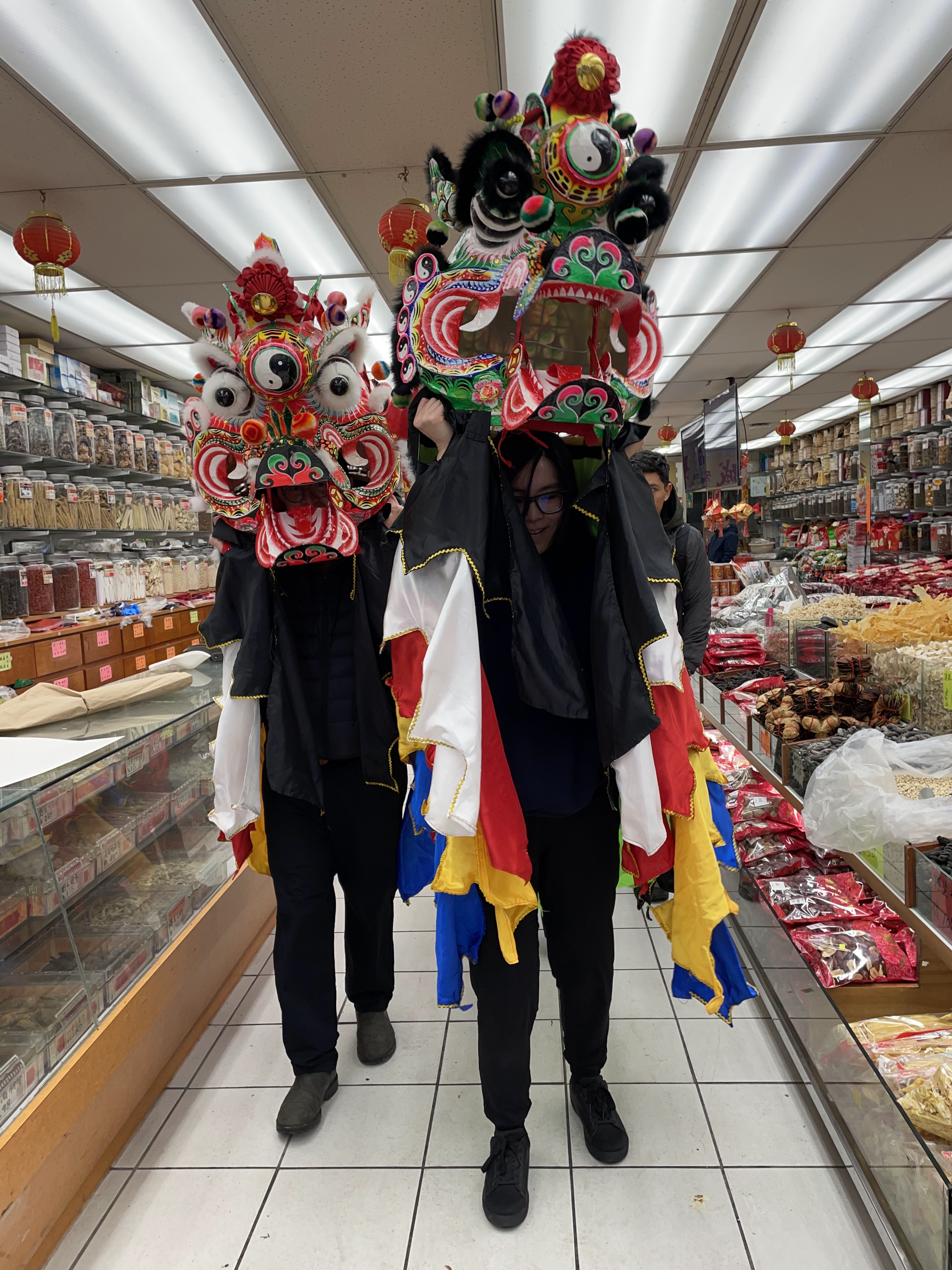
Last week it was the traditional Chinatown parade with lots of lions with their big fuzzy faces, batting eyelids and big mouths, but today it was the kirin's turn, a smaller spirit animal with intense eyes that stared ahead and a horn on top of its head along with the yin and yang on its forehead.
| The store owner poses with the Kirin Rising group |
They did a practice run at some stalls at Chinatown Plaza before heading out to some businesses in Chinatown. On the street the colourful kirins, one with a red head and the other green garnered a lot of attention.
Some passersby remarked they had never seen a kirin before and took pictures of videos. Others were so thrilled to see the pair that they even gave them lai see.
For the performers themselves they put in a lot of energy moving the heads this way and that, jumping around and bowing three times to each business; despite it being hard work they were energised by the attention and their smiling faces revealed how much fun they were having.
![]() |
| "Painting" a butterfly with sugar |
Today is the fourth day of the Lunar New Year and some retailers are taking advantage of the Chinese festival to cater to their customers.
One is Canadian luxury retailer Holt Renfrew and has had a series of special events happening in the store downtown.
Days before the new year there was a Lego building exercise where a Lego certified master builder made a snake which is shown in the store, and a calligrapher to write fai chun, or new year couplets.
| A completed bird on a stick |
Using a ladle with a round cup, the artisan deftly made the insect or bird and then placed a skewer on it as a holder. While it was drying, he made the next one, and as that was drying, he would use a metal slider to carefully remove it from the marble tabletop.
He drew a crowd, pleasing Chinese visitors, while non-Chinese were intrigued and lined up to get one.
Sweet, soft power in action.
![]() |
| Lion's head meatballs for Chinese New Year! |
Happy Chinese New Year!
It's officially the Year of the Snake.
Last night we had a family dinner for New Year Eve and heard it was quite the ordeal to even secure all the ingredients for our dishes!
At T&T Supermarket in Chinatown, there was a long queue to buy a live fish -- an essential food to eat to ensure a good start and finish to the new year. Anyone who wanted fish, but did not want to wait could go into the line for fish that was previously frozen or already killed and on ice.
![]() |
| We also had a whole fish and roast meats |
I made a contribution to the dinner with Shanghainese lion head meatballs (shizi tou), my second time making it. I basically used the recipe from America's Test Kitchen, and it's kind of funny seeing non-Chinese people research this dish and come up with a pretty much fool-proof way of making it.
The ingredients are: ground pork, soy sauce, Shaoxing wine, salt, sugar, chopped scallions, white pepper (black pepper will do), grated ginger, baking soda, water, and a beaten egg.
This time I added finely chopped water chestnuts to give the meatballs a slightly crunchy texture.
To make the meatballs soft in texture, put the mixture in a standup mixer with the paddle attachment and have it mix for a few minutes until you notice the meat is thoroughly mixed.
Next wet your hands before making the meatballs, about as big as the palm of your hand. They won't be perfect round balls, but it doesn't matter.
Then heat up a large pot with four cups of chicken stock, and when it boils, carefully add in the meatballs one by one. When it boils again, adjust the heat to low and let it simmer for about an hour.
In the meantime wash and chop up a whole napa cabbage into quarters and then chop the cabbage into two-inch pieces. After about an hour, scoop up the meatballs onto a plate and then place the cabbage into the pot and then place the meatballs on top of the cabbage and let it all cook down in another half hour.
It's basically done by then, or if there is a lot of liquid, add mung bean vermicelli or rice vermicelli to soak up the sauce.
This dish is a great one-pot meal and even the kids like to eat it!
![]() |
| It's a tough sell to get customers to buy flowers for CNY |
![]() |
| There are 395 stalls at Victoria Park this year |
| Ip was co-founder of non-profit Success |
A Chinese-Canadian who dedicated most of her life to public service, and was a co-founder of Success, a non-profit organisation which helped new immigrants, has passed away. Maggie Ip was in her early 80s.
She came to Canada in the 1960s from Shanghai and got her Masters in Education at the University of Ottawa, and later was a secondary school teacher.
Ip also served on Vancouver city council from 1993-1996, but before then she helped set up Success 51 years ago. Originally it focused on helping new immigrants from Hong Kong and China, but now serves people from around the world and has become one of the largest settlement service organisations in Canada.
In the beginning, many immigrants were "lost" and relied on friends for help to survive in Canada.
"Then we realised that they have so much potential... to help to build this country," Ip said last year on the 50th anniversary of Success.
"We would really like to make sure that they are adapted, they are adjusted and they will become contributory members of society. So this is how we started Success. That's why the Chinese call it 'immigrant mutual help'."
Ryan Drew, who works as the director of integrated services for newcomers at Success, says Ip leaves behind a rich legacy.
"Over those 50 years, she's been in a variety of different roles and capacities," she says. "And, you know, even right up to the present day, she was like attending volunteer recognition events.
"I think we've already seen her legacy in action. We are as an agency now... we've gone from this small group of volunteers, you know, sort of making things happen, in anyway they can, to being a large agency with over an C$85 million budget."
Ip leaves behind her husband Kelly and two adult children.
I happened to see her in February at a Chinese New Year event and she was in good spirits. Will miss her cheerful smile.
![]() |
| Many companies held their CNY banquets here |
![]() |
| The mid-sized concert venue will be sorely missed |
![]() |
| The dragon-in-waiting at Floata Seafood Restaurant |
| The lion made its way around the room |
![]() |
| Our lo hei topped with truffle sauce |
![]() |
| A healthier carb dish using red and wild rice |
![]() |
| Lau holding fortune No. 15, a neutral one for the sixth year |
![]() |
| Lau drew the stick at Che Kung Temple |
![]() |
| Happy New Year of the Dragon! |
| Two acrobats posed on spinning hoops |
| Freshly shucked and briny oysters |
![]() |
| There will be 16 of these neon signs installed |
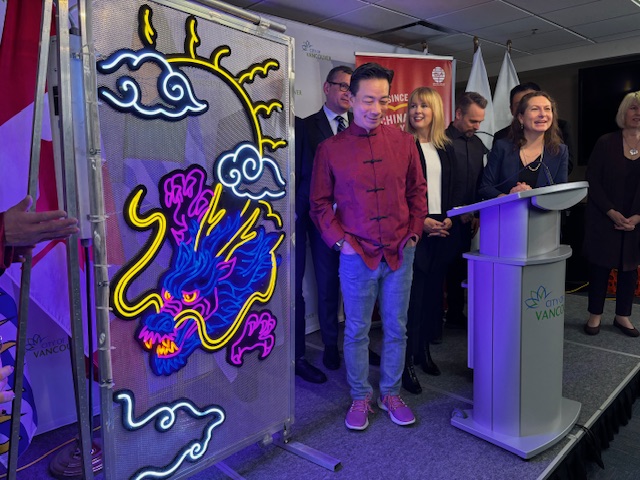
Vancouver's Chinatown looks brighter in the run-up to the Lunar New Year on February 10. Mayor Ken Sim unveiled a neon sign featuring a dragon that are being installed on the street lamp posts on East Pender Street between Main and Carrall streets.
In total there will be 16 of these neon signs just in time for the Year of the Dragon.
![]() |
| Mayor Sim unveiled the design for CNY |
"Chinatown used to be famous for its neon signs and its unique designs. And it really is an homage to the past. Even though it took all that time to get here, it's appropriate that it comes out at the start of the new Year of the Dragon," said Jordan Eng, president of the Vancouver Chinatown BIA.
He hopes the signs will stay up for at least six months, and possibly remain a permanent fixture.
"It'd be nice to have something on a more permanent basis, just because of the amount of time it takes to produce and go through the process to get it certified, and all the engineering effort that goes into it to get it to where we finally installed it," Eng said.
The Lunar New Year will be celebrated in Chinatown on Sunday, February 11 with a multicultural parade through the area. Places like the Dr. Sun Yat-sen Classical Chinese Garden and the Chinese Canadian Museum will have various workshops and demonstrations, from lion dances and calligraphy lessons, wood block prints and street food.
![]() |
| East Pender Street with neon dragon signs |
| Happy New Year! Now dig in again and again and again... |
Matsura (right) with a local in Okanogan County Frank (Sakae) Matsura, was the son of a Samurai in Hirado, Japan, but by the time he was gro...