Showing posts with label Xiaohongshu. Show all posts

Sunday, January 4, 2026

A Natural Form of Resilience


Chinese tourists in Kennedy Town last year

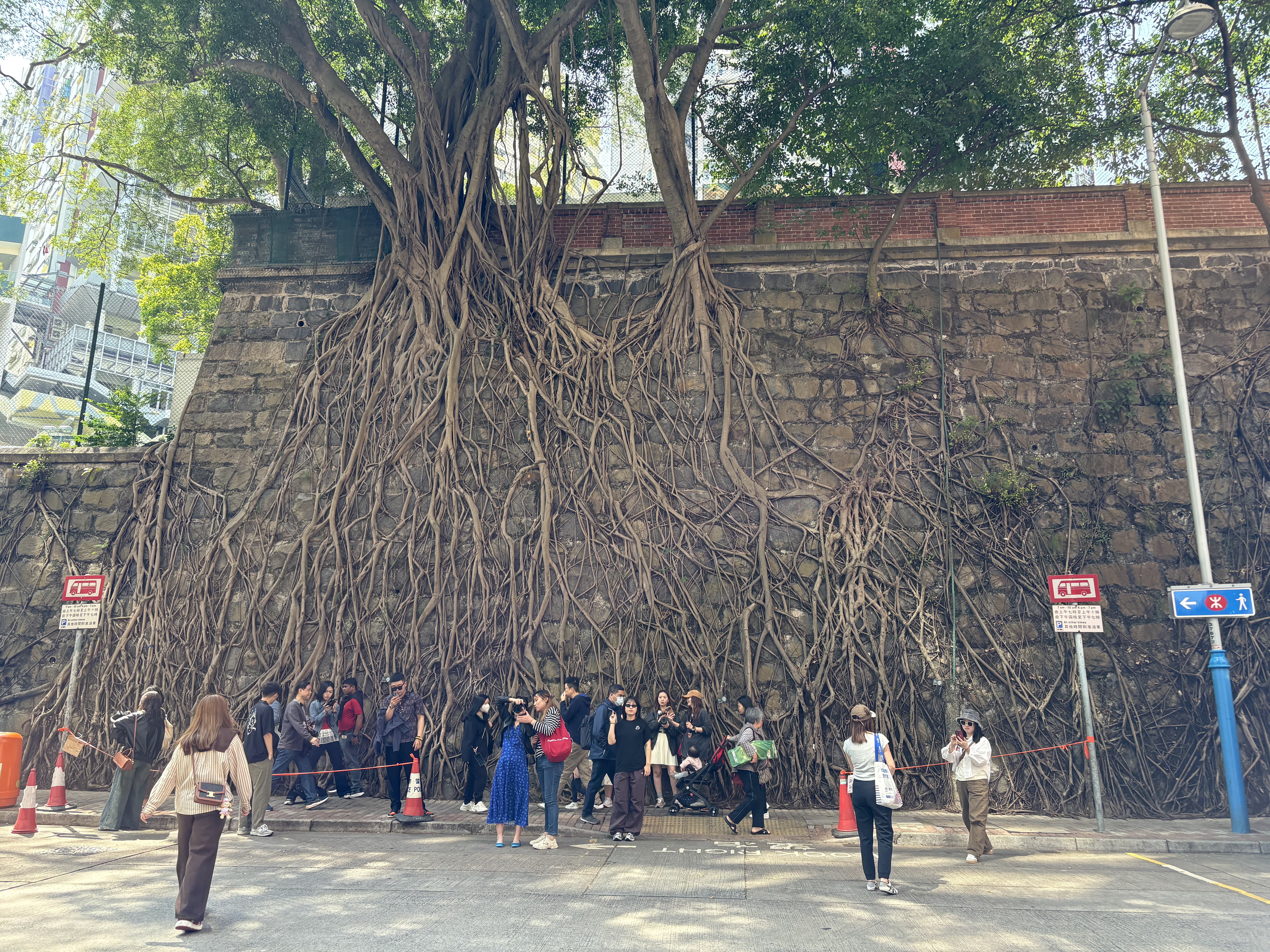
On Xiaohongshu, Chinese tourists flock to Kennedy Town, specifically Forbes Street to take pictures of and with the banyan trees that seem to effortlessly cling onto the wall. This phenomenon is unique to Hong Kong.

Some people call them masonry wall trees because stone walls were built between the 19th century and World War II as retaining walls using stone.

Banyan trees in Kowloon Park
As these walls were being constructed, some banyan tree seeds may have blown into the crevices of the stone walls or dropped by birds and managed to sprout and grow, with their roots on the outside of the wall. It's quite amazing these trees have managed to flourish despite such an unnatural environment to establish themselves in.

There are many trees in Kennedy Town, Mid-Levels and Wan Chai.

On this trip I saw some of these banyan trees in Kowloon Park, adjacent to the aviary pond.

Banyan trees are considered to have good feng shui, symbolising longevity and perseverance. It is not a tree that is cut down for its wood because its wood is full of knots, and it is hard to set on fire so it can't be used as firewood.

These trees are beautiful signs of resilience in nature!

Thursday, May 8, 2025

Poor Travel is the Hottest Trend Now


Young mainland tourists sleeping in McDonald's for the night


While Hong Kong saw 22 percent surge in mainland visitors from the year before, about 1.1 million tourists during the week-long May Day holiday, a lot of them were not staying in hotels.

They weren't even sleeping in beds.

Mostly students and young people stayed overnight in 24-hour McDonald's outlets in Hong Kong.

"Poor travel" is the new trend
Just like some homeless people who opt to find shelter in the fast-food restaurant, these tourists put their suitcases between their knees and put their heads down on the greasy tables to rest -- for several hours.

It's called "poor travel", and Hongkongers were not impressed.

The pictures of mainlanders occupying tables in McDonald's to sleep at went viral and the matter was brought up with Chief Executive John Lee Ka-chiu.

"Hong Kong has to be a city that welcomes tourists, and tourists include all kinds of tourists," he replied. 

"There will be high-end travellers, and there will also be non-high-end travellers, but we must look at tourism as a whole, so that every tourist will find their experience in Hong Kong is an enjoyable one, is a welcome one."

However, back in December 2023, Lee pledged the government's priority would be to attract more overnight visitors and boost their spending, and focus on high quality visitor experiences.

While Hong Kong did indeed attract a lot of visitors, they definitely did not spend much, and instead found as many free attractions and cheap food as they could by consulting Xiaohongshu.

It's another sign of China's economy slowing down considerably, and the instability is making people conserve their money, or they just don't have the cash to splurge.

Which made one Hongkonger comment online: "If you can't afford it, don't travel."


Monday, April 21, 2025

Hong Kong Still Trying to Attract Big Names


Coldplay's four concerts in Hong Kong generated HK$1.2B

When Coldplay came to Hong Kong to perform for four nights, the band's stay apparently helped generate an estimated HK$1.2 billion, from hotels to food, shopping and entertainment. 

However, when it comes to big names in classical music, many performers are eschewing Hong Kong and choosing Macau and other Chinese cities instead.

Bocelli performed in Macau late last month
Late last month Italian blind tenor Andrea Bocelli performed at Galaxy Macau, with 40 percent of the audience from Hong Kong. 

For example, superstar pianist Lang Lang and tenor Placido Domingo gave shows at Galaxy Macau in January and last October respectively, while Zubin Mehta conducted the West-Eastern Divan Orchestra at the Shenzhen Concert Hall and Guangzhou's Xinghai Concert Hall in March.

Some speculate it's because Hong Kong's auditoriums are aging, while places outside have newer facilities with better acoustics.

Most international stars are booked at least two years ahead, while in mainland China, venues can only be reserved six months to a year in advance. There is also the issue of visas -- when a performer goes to China, they can't pop out to Hong Kong for a performance and come back into the mainland again unless they get multiple-entry visas.

Lang Lang was also in Macau in January
There is also the problem that Hong Kong may not be a big enough market for performers.

"Hong Kong simply hasn't got a big enough potential market that measures up to mainland cities. If you are an international group that wants to build a following across China, being in Hong Kong doesn't get you onto Xiaohongshu or WeChat," says Kuh Fei, a Hong Kong critic and organiser of performing arts events.

So... who is the next big musical act coming to Hong Kong?

Singapore secured Lady Gaga for May, shutting out Hong Kong...

Monday, March 24, 2025

Hong Kong's Challenging Times


Hong Kong is facing challenging times these days

Last year when I visited Hong Kong, it was eerily quiet as a lot of people had left the city for Easter break. 

This time around it looked busier, but looking at the shopping malls it is sad to see how empty they are, as the shops are empty. Not a single customer inside. The shop staff are looking at their phones or looking very bored. This is the state of retail these days.

Times Square mall was quiet just after 6pm
Case in point: this afternoon I wandered around Harbour City in Tsim Sha Tsui, steps away from the Star Ferry. It used to be the place mainlanders shopped in, with queues in front of Louis Vuitton, Gucci and Dior. While there were people wandering around window shopping, hardly anyone was buying anything, even mainland visitors.

No locals are buying because they are worried about their financial situation. A few days ago a friend told me that his manager and mid-level managers were let go -- immediately. His immediately boss had no idea she would be sacked and after seeing the human resources manager, went to her desk to pack up her stuff and left.

Another who had an inkling of what was going to happen, said farewell to colleagues, took their purse with them and they didn't see them again. People at work purposely keep only a few items in the office just in case they will be axed.

Meanwhile those left behind must pick up the pieces and take on even more work, for the same amount of pay, or a pay cut even, as times are tough. 

Sunset light reflects on ICC building
The media industry is rapidly unravelling thanks to artificial intelligence. The Hong Kong Standard sacked all of their sub editors, people who check stories for grammar and make sure it is factually correct. They have all been replaced by AI. Currently AI can rewrite stories, but not necessarily with the information intact and must be looked over to ensure the facts are still there...

Editors are even using AI to rewrite stories for them -- the job they are supposed to be doing! Do they want to be out of a job themselves? It's so bizarre and crazy that this is happening so fast. My friends joked they will have to turn to basket weaving to sustain themselves financially.

Meanwhile millennials are challenging to work with, unable to follow instructions or have the passion to work hard. Two friends told me they are literally babysitting the staff they work with, following up to make sure they finish their assignments, and they do so at odd hours -- like 3am or 5pm, or don't consider how their work will be perceived outside of the company. But they can't be fired otherwise my friends will have to do even more work.

It feels like schools are downsizing by the month, as teachers continue to quit and leave, and about the same proportion of students; this has resulted in lowering qualifications for teachers, in particular NET or native English teachers, while the same goes for the police, who have pretty much done away with stringent physical tests.

How can Hong Kong survive like this? It's hard to be optimistic for the city when you see the difficulties and no light at the end of the tunnel. 

But when looked at another way, a friend who moved with her two daughters from Beijing to Hong Kong a year ago, they love being here, despite the challenges of having to learn Cantonese and English. They enjoy eating different kinds of cuisines, like the fact there are hardly any queues for rides at Hong Kong Disneyland, and they are exposed to different kinds of opinions.

Nevertheless does the government have ideas on how to navigate the city through these challenging times? It's time to think outside the box to stimulate the economy and bring back visitors who splurge, not ones who follow advice on Xiaohongshu to spend the least amount of money...


Sunday, March 23, 2025

Long Walk Along the Harbourfront


Gorgeous day for a walk and admire the Hong Kong skyline

This morning my friend and I did the 11.5km walk from North Point to Kennedy Town in just over two hours. It was a great way to walk off an accumulation of calories and see the city the way I used to see it when I lived in Hong Kong.

It was already sunny and hot at just after 8.30am when we set off, and luckily we had slathered on sunscreen and wore a hat. We walked past North Point, seeing people make use of seating areas to eat a snack, look at their phones or read the newspaper, and Fortress Hill before going to Tin Hau and Causeway Bay, walking around the Police Officers' Club.

Construction for the route in Sai Ying Pun
In Wan Chai there was a running race going on -- the My Boy 3K Family Run, based off of a comic strip character. We saw many people dressed in blue T-shirts with medals around their necks and then the actual race route along the Wan Chai waterfront. 

When we got to the Hong Kong Convention and Exhibition Centre it was great to see the familiar sight of Victoria Harbour and both Hong Kong Island and Kowloon. I was not able to spot any cats by the rocks though. 

Meanwhile there is construction extending from the Grand Hyatt Hong Kong so that people can walk from the hotel across an overpass to reach the walking path which will be fantastic once it's done; guests won't be confused as to how to get there and be able to enjoy the skyline by the harbourfront.

Pretty soon we arrived in Central, and spotted a military ship docked; I was surprised there were no People's Liberation Army soldiers out in front of the gates guarding the ship...

Military ship docked in Central
At the Ferry Piers there were the usual crowds hanging around waiting for friends or family before boarding together to go to the outlying islands and it wasn't as packed as it used to be pre-pandemic.

Shun Tak in Sheung Wan was basically the same, though with more pollution from the Turbocat ferries. I don't miss the noise pollution and the gasoline smell.

Soon after we arrived in Sai Ying Pun, and at Dr Sun Yat-Sen Memorial Park there were people exercising, children playing, and walking like us. But after passing the sports centre the route was diverted with lots of construction along what used to be the boardwalk.

My friend noted that not much seemed to have been completed since the last time he walked by this area. Alas will have to see how it looks the next time.

Finally we reached Shek Tong Tsui where we saw the former Instagram Pier that has been blocked off for years from public access, and soon enough we arrived at Kennedy Town.

The coffee shop Arabica is still very popular with mainland tourists thanks to Xiaohongshu, and across the street, many were trying to get a shot of themselves with Victoria Harbour in the background. There were more people taking pictures with the line of Banyan trees on Forbes Street. It is quite the miracle how the seeds for these trees landed in between the rocks of the stone wall and managed to cling on and grow into trees. 

Banyan trees are a tourist attraction in K-Town
It was heartening to see most of the restaurants and shops are still around.

Friday, March 21, 2025

Bakehouse Bakes up Success Story

Chef Gregoire Michaud with Bakehouse's famous egg tarts

Bakehouse is an extremely popular bakery that sells loaves of sourdough bread, pastries, cookies, sandwiches and doughnuts. Its most famous product is the sourdough egg tart, similar to the pastel de nata with its caramelised egg custard.

It was started 2018 by Swiss Gregoire Michaud, who quit his job as executive pastry chef at the Four Seasons Hong Kong. He first set up a wholesale business in 2013 supplying bread to hotels and restaurants before opening the retail bakery Bakehouse.

There are queues daily at the various locations
For someone who covers the food business it's been fascinating to watch Bakehouse grow from its first shop in Wan Chai to now having seven locations around Hong Kong.

A few days ago I caught up with Michaud and he continues to have a very humble attitude towards building his business and brand, and knowing full well that consistency is key.

The last time I talked to him was during the Covid-19 pandemic and he was having a hard time despite long lines at Bakehouse; the wholesale side of his business had completely plunged because hotels and restaurants did not order any bread, as hardly any customers dined out.

While retail sales at Bakehouse were doing very well, it was just barely enough to get by those few years. After the pandemic was over and borders reopened, sales bounced back very quickly.

Michaud said that the second most popular location after Wan Chai is Tsim Sha Tsui, with mainland customers passing through the area via the high-speed rail and thanks to Xiaohongshu, these visitors will go to Bakehouse and pickup not one box of egg tarts (six per box), but eight -- yes eight boxes of egg tarts. 

The flaky egg tarts are made with sourdough
But then someone on Xiaohongshu posted that if they wanted to skip the lines in Tsim Sha Tsui they should go to the Causeway Bay location.

There are even people in Taiwan who fly to Hong Kong specifically to stand in line at Bakehouse to buy the egg tarts and then get back on the next flight to deliver them to people who have ordered them online.

Some local residents have given up lining up for the prized egg tarts, saying because Bakehouse is trying to keep up with demand, quality has dropped...

Last year it was reported Bakehouse sold a whopping 18,000 to 20,000 egg tarts per day. At HK$12.50 each, that's a cool HK$91.25 million annually.

Quite amazing considering Michaud and his team were experimenting with some leftover sourdough dough to make egg tarts.

And they really are delicious. 

Thursday, January 23, 2025

Being Mistaken as the Xiaohongshu CEO

Dani (left) and Jerry (right) saw their video go viral overnight


A "normal guy" in Vancouver was mistaken as the CEO of Xiaohongshu or RedNote after he posted a friendly video giving tips to "TikTok refugees" and new users on how to use the app.

Jerry L. explained Xiaohongshu is mostly used to recommend places to eat or to visit, as well as tips for shopping and makeup.

"The platform is mainly Chinese-speaking, but do feel free to speak English and post English content because I believe there are a lot more English speakers on this platform nowadays," he said in the one-minute video. "We need to build this community."

At the end of the video he said: "Let me know your thoughts. I speak both Chinese and English. Feel free to ask me any questions."

Overnight the video went viral, as influencers shared his video, and it was even featured on Fox News online. 

They had mistakenly thought Jerry was the CEO of RedNote when in fact it is Charlwin Mao, who started Xiaohongshu in 2013 with Miranda Qu.

Jerry felt compelled to set the record straight right away.

"Guys, I'm not the RedNote CEO, just to be clear," he said in a followup video. "I'm just another normal guy in Vancouver. But whatever I said in that original welcoming video stays true. I really hope that you guys can enjoy this platform."

In the past week RedNote gained some 3.4 million users, up from 300,000 the week prior, partly because of fears that the US government would force TikTok to shut down, which is has for the time being.

Meanwhile Jerry L is originally from Shanghai and moved to Canada 10 years ago, and settled in Vancouver two years ago. 

His girlfriend Dani H. said they were overwhelmed by the reaction but glad to bring people together.

"I'm just glad it brought a smile to people's faces," she said.

The pair have started a TikTok account with the handle @FakeCEORealGF where they plan to share videos of their experiences of being Chinese Canadian in Vancouver.

Friday, January 17, 2025

TikTok Influencers Migrate to Xiaohongshu

Xiaohongshu seeing a surge in "TikTok refugees"

TikTok influencers who use the video platform to make short videos in the hopes of going viral are terrified the US government will force the social media app to shut down due to fears that it gives the Chinese government access to users' data.

That's because these influencers make money from their videos, and for some, that's their full-time gig.

However as a result of the impending January 19 deadline, TikTokers or content creators on TikTok are calling themselves #tiktokrefugees and "fleeing" to... another Chinese platform called Xiaohongshu.

There are fears TikTok will shut down Jan 19
Little do these influencers know that Xiaohongshu -- originally translated as "Little Red Book" -- in a satirical nod to Chairman Mao Zedong's book of quotations, is a Chinese company promoted as "RedNote" or "Red" in North America these days.

Xiaohongshu is like Instagram, where users can post pictures and videos. Initially it was called "Hong Kong Shopping Guide" to give tips to Chinese visitors to the city of where to eat, stay, and take pictures. For example they would give detailed instructions on where to have their "Instagram-worthy" shot with say a cup of Arabica coffee along the waterfront in Kennedy Town.

It was great for the cafe having lots of customers, but terrible for traffic in the area, as people blocked roads to get the perfect shot.

Started by Miranda Qu and Charlwin Mao in 2013, Xiaohongshu caught the attention of several Chinese tech giants, like Alibaba and Tencent, and last July the app was worth a staggering US$17 billion. The users are predominantly women, and as a result many beauty and cosmetic brands advertise on the app. Xiaohongshu does not have an e-commerce aspect so users need to turn to Taobao or TMall to purchase things.

Chew is invited to the inauguration
But now with so many TikTok influencers, especially those from the US trying to set up accounts on Xiaohongshu, Chinese cyber regulators may not be so keen on the flood of people, particularly those not from or in China.

Already Chinese officials have told the company it "needs to ensure China-based users cannot see posts from US users", which signals the government may see the influx of Americans to RedNote as a political security threat.

What's interesting is that already there are unfiltered interactions between Chinese and US users, sharing homework questions for example, or asking what life is like in China and getting real depictions instead of rosy pictures from government sources.

So how will Xiaohongshu get around this? Create a special area only US users can access? That might be too hard to manage, and not really beneficial to US influencers who might be providing content to a limited audience.

Or this is all moot after Donald Trump gets into office on January 20. He has already shown support for TikTok, even inviting CEO Shou Zi Chew to the inauguration on Monday. Maybe those TikTok "refugees" won't have to flee the video platform after all...


Saturday, November 16, 2024

Aquarium's Shark is Robotic


Would you pay to see a robotic whale shark in an aquarium?

At Xiaomeisha Sea World in Shenzhen, Guangdong province, visitors pay 240 yuan (US$32) admission to see real marine life, but instead were treated to a robotic whale shark.

Some were in awe of the innovative way to present wildlife, while others felt deceived paying so much to get in and see a fake shark.

"I cannot believe the whale shark is fake. It's outrageous to charge over 200 yuan for a ticket," said one online commenter.

Two aquarium staff with the robotic shark
While another on Xiaohongshu, the online guidebook wrote: "It's a wonderful alternative to showcase large marine creatures without imprisoning them in a tank. Rather than obscuring the whale shark's true identity from visitors, the aquarium should embrace this opportunity to educate the public on the importance of animal protection."

Although the robotic whale shark costs millions of yuan to produce, it can cost over 100 million yuan (US$14 million) to care for a real one.

It's also worth noting sharks can live between 80 to 130 years in the wild, but only about five years in aquariums, according to Li Jianping, dean of the Academy of Future Ocean at the Ocean University of China.

The aquarium can ensure optimal water quality and temperature control, but there just isn't enough space for the sharks to roam.

Some visitors suggested perhaps the aquarium should inform people in advance that there is a robotic shark on display so that they can decide if they want to pay the admission or not...

Monday, September 23, 2024

Bakehouse Has a Recipe for Success

Michaud launched Bakehouse 6 years ago

One of the few eateries in Hong Kong that is going gangbusters is Bakehouse, started by Swiss pastry chef Gregoire Michaud.

There are usually lines outside the original Wan Chai location, where young people are keen to have brunch or a sandwich along with some pastries washed down with coffee. Otherwise there's also a line for takeout, like loaves of freshly-baked sourdough bread, danishes, jam-filled donuts and the signature sourdough egg custard tart.

One fun fact is that Bakehouse sells between 18,000 to 20,000 egg tarts per day, which adds up to a whopping HK$91.25 million in annual revenue from those flaky egg tarts alone.

Even during the Covid-19 pandemic Bakehouse was busy with a 20 percent increase in business, but the bakery lost 60 percent of its wholesale business supplying bread and pastries to restaurants and hotels. Michaud had a tough time motivating staff during this period, but he just knew he had to keep going.

These days Bakehouse is extremely busy thanks to being featured in Xiaohongshu, a Chinese social media platform that has touted its egg tarts. Chinese visitors can be seen posing outside the bakeries with the aforementioned egg tarts or the coveted Bakehouse blue paper bag.

Because of the flood of customers, Michaud has said recently Bakehouse will double the number of outlets by the end of 2025, as well as expanding its main kitchen in Chai Wan.

Not bad for the former executive pastry chef at the Four Seasons Hong Kong, who traded his starched white chef jacket for a blue apron and has been non-stop ever since he launched Bakehouse six years ago. He also won over locals with his decent Cantonese, making fun videos with Chinese media.

He is also looking to expand Bakehouse across the border into China in the next 18 months.

"We will start by operating with a local partner, but we will be fully involved because we do not want to lose our quality and our integrity," Michaud said. "It's Bakehouse, but we also represent Hong Kong as a brand."

It's amazing to watch Michaud succeed with his vision and endless creativity in the kitchen. He's willing to try new things and knows local tastes. 

But yes those egg tarts. In Hong Kong, you have to try them, along with a bowl of wonton noodles, congee, milk tea, pineapple bun, roast goose, dim sum...


Tuesday, April 23, 2024

Picture of the Day: Xiaohongshu Photo Shoots

Everyone taking pictures of the street sign in Kennedy Town

Walking around Hong Kong I saw a lot of young Chinese tourists, mostly women in their 20s, dressed up and carrying cameras or their phones mounted on selfie sticks, posing in front of specific streets and landmarks.

They were taking pictures where others on Xiaohongshu or "Little Red Book", a social media and e-commerce platform somewhat similar to Instagram, had posted. 

This was their idea of a Hong Kong holiday, or any trip for that matter -- posing in front of places like Bakehouse, a popular bakery with the coveted blue paper bag, or in front of Arabica coffee shop with the coffee cup that has a percentage sign at its Kennedy Town location.

There are other better places to take photos...
While some of these shops may have a bump in business thanks to these visitors snapping up coffees and pastries, I've heard some of these tourists find empty bags or drained coffee cups to use as props.

Can we say these places have been Xiaohongshu-ed?

Why replicate the same angle as everyone else? Or why not create your own memories of the place with other kinds of pictures?

But no, they seemed obsessed with recreating the same picture (different outfits), and patiently waited for others to finish shooting before they set up their own shot. 

Meanwhile they crowd the sidewalks making it hard for local residents trying to get from A to B.

How long will this trend last? Asking for a friend...

Monday, September 25, 2023

Word of the Day: Special Forces Travel

People like to buy a coffee and sit outside by the waterfront

The new buzzword among young Chinese mainlanders is 特种兵式旅游 or "special forces travel" -- visiting as many destinations as possible in a short period of time while spending the least amount of money.

They look to the app Xiaohongshu to help them plan their itinerary, and Hong Kong is one of their destinations.

Taking photos on the "special forces travel" list
Instead of lining up at luxury brand stores to buy the latest handbag or shoes, they are on a budget and visiting Hong Kong's various districts, though one in particular is really popular -- Kennedy Town, where I used to live.

They are descending on the waterfront, where a certain coffee shop known by its "%" sign -- Arabica -- is a super hot spot for "special forces travel".

The place was already very popular with locals who would come here on the weekends and pose with their lattes and iced coffees, and now it seems their mainland counterparts are doing the same, except in exponential numbers.

In Xiaohongshu, Kennedy Town is described as "the most romantic neighbourhood" in the city, perhaps with the waterfront scenery paired with eclectic stores and cafes, made popular by Arabica and Slowood, an eco-friendly shop that invites customers to buy food in bulk.

It's easy to get to too via tram, MTR and bus.

Slowood is an eco-friendly shop drawing visitors
Some believe young mainlanders traveling on budget is a sign that China's economic recovery hasn't come to fruition as hoped, and the property sector seems to be teetering to the brink with Evergrande Group and Country Garden having deep financial problems.

Other say post-pandemic they want to go out and experience life outside as much as possible to make up for lost time.

While it's good that money will be going to local businesses instead of multinational conglomerates, visitors should be careful while taking pictures at Kennedy Town's waterfront! There's a lot of traffic there that doesn't stop!


VIFF -- Review: Our Mr. Matsura

Matsura (right) with a local in Okanogan County Frank (Sakae) Matsura, was the son of a Samurai in Hirado, Japan, but by the time he was gro...