Showing posts with label animals. Show all posts

Tuesday, March 10, 2026

Review: Hoppers


The animation feature topped the box office opening weekend

There was a lot of buzz that the animation feature Hoppers beat out The Bride!, making it Pixar's biggest opening weekend in a decade. 

Hoppers was screening at our neighbourhood theatre so we took two kids, aged 7 and 8 to watch this film -- in 3D. 

The 3D enhances the animation, but it isn't totally used to its advantage.

Mabel is an environmental activist in her teens
Nevertheless, the storyline is creative. Japanese-American Mabel Tanaka grows up to be an environmental activist influenced by her grandmother and promises to protect the glade that they used to appreciate together in the city of Beaverton.

But then the mayor, Jerry Generazzo has plans to destroy the natural habitat for animals in order to build a freeway and Mabel is desperate to stop him.

She asks for help from her biology professor Dr Samantha Fairfax, but then Mabel discovers they have developed technology that helps them communicate with animals.

Mabel uses it to try to convince them -- in particular beavers, as they are "nature's engineers" -- to move back to the glade, along with everyone else, but it's not as easy as she thinks.

The premise of the film, that Mabel can communicate with the animals is fun, creative and she also learns "pond rules" and the hierarchy of the animal kingdom. 

Dr Fairfax (left) is Mabel's biology professor
Some of the humour, both physical and the dialogue is funny, but not particularly laugh-out-loud hilarious, but enough to keep the audience interested in seeing what happens next.

Actor John Hamm makes for a sneaky mayor, and Bobby Moynihan is a funny beaver monarch named King George. I was surprised to see Meryl Streep voiced the Insect Queen, a short, but amusing cameo.

Apparently the Pixar animators enlisted the help of ecohydrologist Emily Fairfax who studies beavers and how they change landscapes by altering the flow of streams and rivers.

Hoppers has a strong environmental message, how to strike a balance between conservation and development, and how most humans view their role in the world as being at the top of the food chain.

Ecohydrologist Emily Fairfax
Oh and yes the animals are cute too, thanks to director Daniel Chong's passion for the project. Originally he had pitched a feature on penguins, but it was nixed because it's been done before already!

But then he discovered that beavers are "nature's engineers" and thought that was really cool and took six years to develop Hoppers.

Don't watch too many of the trailers because some of the gags get old really fast. Just go watch it in the theatre!

Hoppers

Written and directed by Daniel Chong

105 minutes


Thursday, October 2, 2025

Remembering Jane Goodall


Goodall was fascinated with animals at a very young age

This morning we heard the sad news that primatologist and passionate advocate for animals Jane Goodall died in Los Angeles. She was 91 years old.

My memory of her dates back to 2007 when she visited Beijing as founder of the Roots and Shoots program, where Goodall inspired the next generation to care about the environment where they live through local conservation projects.

This was my blog post on November 18, 2007 when Goodall was 73 years old:

In her youth she dreamed of going to Africa
Dr Jane Goodall has arrived in Beijing for a week-long visit to China.

Known for her ground-breaking research on chimpanzees in Tanzania, Goodall now travels the world some 300 days a year, spreading the word about environmental and animal conservation.

And she specifically focuses her message on young people, which led to the establishment of Roots & Shoots, an education program in 1991. There are now more than 800 of them in 98 countries, with over 300 R&S in China.

Some of these groups, ranging from elementary, secondary and university students came from Shanghai, Dalian and Tianjin as well as Beijing to show Goodall their environmental projects.

They ranged from planting trees in Inner Mongolia, to conserving rain water, feeding bears in a zoo with a pinata filled with fruit, and making crafts out of aluminum cans.

The famous scientist was dressed warmly in a large red coat and her silvery hair tied back loosely in a clip. When she arrived at Beijing City International School Goodall received applause from the students and they practically mobbed her, trying to take pictures and getting her to autograph pieces of paper.

She handled the attention quite well, and visited each of the booths and praised the students for their work.

The event then moved to the theatre where she gave a speech encouraging the audience to continue their conservation efforts as they are the next generation.

She said they were like roots and shoots, like the name of her program, growing and taking root and then breaking through tough barriers to grow.

She studied chimpanzees for decades
Then she told a story about a chimpanzee who was taken from his mother when she was shot dead. He was nicknamed "Old Man" after enduring 15 years of tests scientists conducted on him.


He was left to retire in a zoo on an island with three other female chimpanzees. A zoo keeper called Mark was to look after them but was warned not to get too close because they didn't like humans.

So he fed them by throwing food at them. He later noticed they got excited and hugged each other when he rowed the boat towards them. So Mark gradually brought his boat closer and closer to them until he could hand a banana to the Old Man.

He then stepped onto the island and nothing happened to him. Later on, he and Old Man made physical contact, grooming each other.

Old Man even had a baby chimpanzee with one of the females.

One day Mark was on the island but he tripped and fell on his face near the baby. The mother was horrified and came to rescue it, but not before biting Mark on the neck, thinking he wanted to harm her child. The other females followed her lead, also biting him on the leg and arm.

When Old Man came, Mark thought the chimpanzee would surely kill him. Instead the animal pushed the three females away so that the zoo keeper could get off the island and row back to safety.

Goodall said that if a chimpanzee, after all the years he was treated badly by humans, could bridge the gap and look after a man, we humans who are even more intelligent, should do the same, if not better.

It was a message that resonated with the audience and hopefully that will spur them on to continue their green efforts.

Goodall taught us to care for our community
But the fight for funding, especially non-profit organizations in China is tough. Only foreign companies step up to the plate and make contributions as there's no such thing as tax breaks for charitable donations. Non-profits do get some donations in kind by local companies, but those are few and far between.

The Chinese government is looking at creating a charity law. But this needs to be established soon, otherwise the momentum for non-profits like Goodall's will quickly fade when in fact they're making a huge impression on young people who are eager to make a difference. 

Rereading her story about Old Man, I can already imagine her talking about it in her soft voice that left everyone rapt with attention. 

A few weeks ago she was interviewed on CBC Radio and the host asked her how to have hope in the world when there's so much destruction, war, climate change, and so on.

Goodall replied that one can start by caring about their own community, finding something they want to save or conserve, and looking for others to help out.

When she was young she intently observed what animals, and in her case, chimpanzees did, and from watching them, she gave the rest of us more insight into their lives.

What she was doing was in a way mindfulness, being in the present and focusing on what was happening around her.

I've read she was most comfortable being with animals -- and actually her favourite is not chimpanzees but dogs for their unconditional love.

We are so lucky to have had Goodall in our lives, to remind us to look after the animals and environment around us, and that every little bit of care for them helps not only them, but us do better. We all have the capacity to help, love, nurture and care.


Tuesday, March 4, 2025

Tremors this Morning and Post-Oscars Thoughts


A 4.1 magnitude quake shook just after 5am

For some reason I woke up at around 4.40am and could not get back to sleep. At 5.02am I heard a muffled deep thump and felt some shaking! Another earthquake that was measured at 4.1 on the Richter scale, 42km east of Sidney, BC.

Again I was annoyed to find there was no public alert about it, but that's because it was below magnitude 5.0. So I turned to social media posting about my experience and others replied they had felt it too. 

Needless to say I couldn't really get back to sleep after that!

Anora swept five awards last night
Last night I caught the last part of the Oscars to see Adrien Brody win Best Actor for The Brutalist, and watch Anora sweep for Best Director, Sean Baker, Mikey Madison for Best Actress, and Best Picture.

Anora is about an exotic dancer who marries the son of a Russian oligarch, and when his parents find out, they are outraged to say the least.

Baker's wife, Vancouverite Samantha Quan had a great quote of the evening: "We made this film with very little money but all of our hearts," she said. "To all of the dreamers and the young filmmakers out there: tell the stories you want to tell. Tell the stories that move you. I promise you, you will never regret it."

It seems like indie films got big recognition by the Academy this year, not just Anora, but also the Best Documentary Feature No Other Land, which barely had any distribution in the United States because it was about the Israeli-Palestinian conflict before October 7, and Best Animated Feature, Flow, made in Latvia.

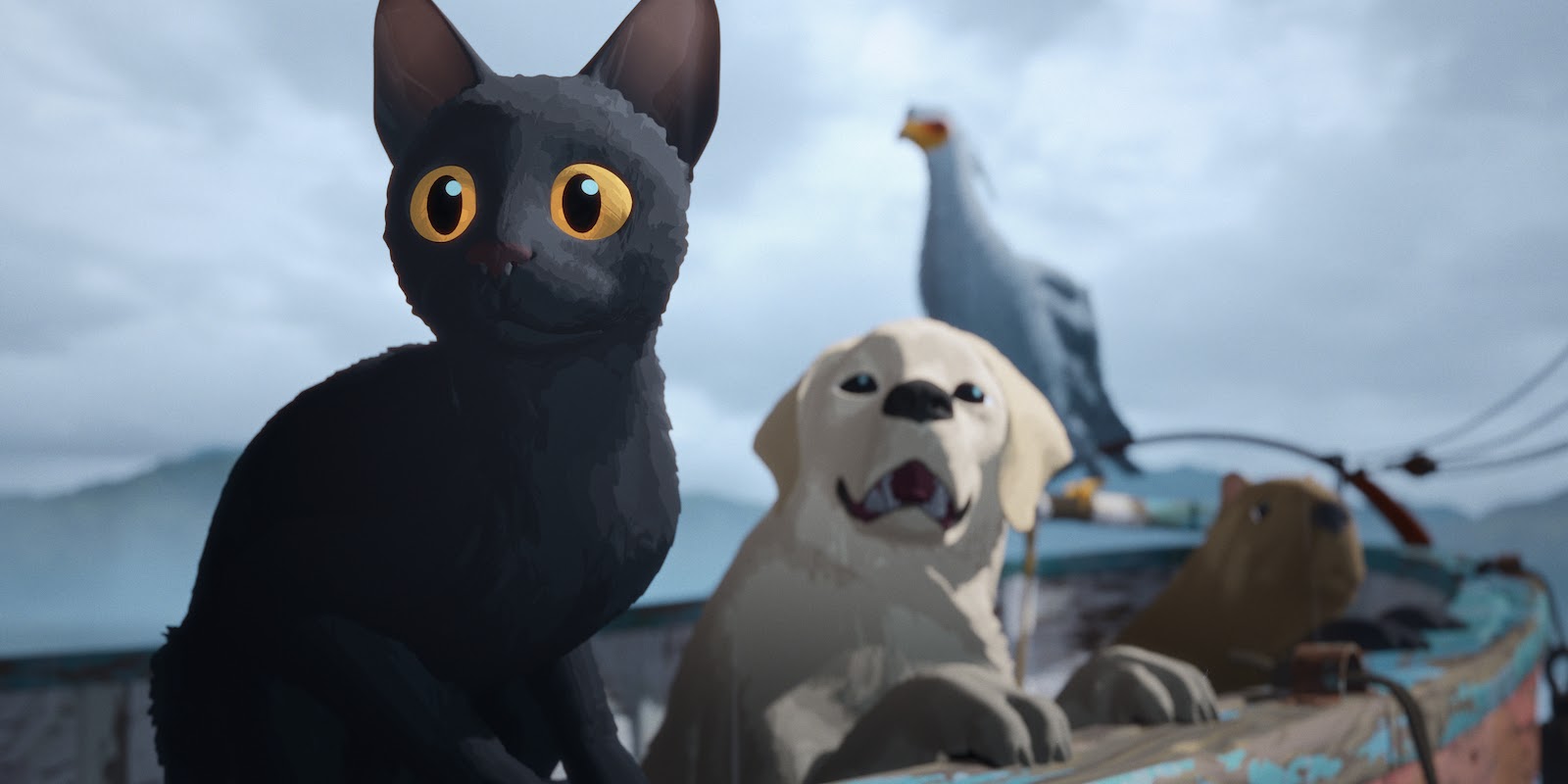
Flow features various animals on a boat
Flow was the only film I'd seen of all the Oscar contenders! But was very pleased to see this one win, beating out Disney's Inside Out 2 and The Wild Robot, Memoir of a Snail, and Wallace & Gromit: Vengeance Most Fowl.

The Latvian animation is universal -- there's no dialogue except for the animals making their meows, barks and chirps. The story, about a group of animals surviving a post-apocalyptic world on a boat is beautifully told with a lot of imagination with a touch of humour, making it fantastic viewing for all ages.

"We are all on the same boat and we must find ways to overcome our differences and work together," said Flow director Gints Zilbalodis.

Indeed. 


Sunday, December 29, 2024

Joe Average: No Average Artist


Average lived with HIV/Aids for 40 years

It is sad to find out that LGBTQ+ artist Joe Average died on Christmas Eve. He was 67 years old.

His art was whimsical and colourful
He was well known in the art community for his colourful, upbeat paintings and several murals of his could be found around Vancouver. They were mostly of faces of people, or flowers, or even animals and insects personified with big red lips.

But mostly Average was a symbol of surviving HIV/AIDS. He was HIV-positive at the age of 27, which motivated him to become an artist and advocate for HIV/AIDS awareness and LGBTQ+ rights.

"He had Aids for 40 years and he maintained his healthy attitude by being creative," said Michael Harding, a longtime friend. "Creativity is what kept him alive, and the love of the community."

This was evident in him donating artwork to many charitable causes.

Average's artwork made it onto a Canadian stamp, and on a loonie designed for the Royal Canadian Mint.

Average's work was featured on a stamp
In 2021 he was appointed to the Order of British Columbia, and last year the Order of Canada. 

Vancouver is so lucky to have such a talented and giving artist who did so much for the city and its residents through his art.

Sunday, October 6, 2024

VIFF Review: Flow


The wordless animated film features a black cat

What happens to the animals when a tsunami hits their environment? That's what the animated film Flow finds out in a co-production by Latvia, France and Belgium. There is no dialogue in the 84-minute film, though the animators take a bit of liberty with the animals' abilities.

Viewers first meet a cute black cat in what looks like a forested area, but after being chased by a pack of dogs, there is a herd of deer trying to outrun a massive flood of water that the cat gets caught up in.

The animals navigate flooded areas by boat
The feline encounters a boat and meets a capybara, a secretary bird, a lemur and a labrador, one of the dogs earlier. Together this rag-tag group, but in particular the cat realises through the challenges they encounter that they need each other to survive in a post-apocalyptic world.

The film is gorgeous -- some scenes look very real with the reflection of the water and the abandoned buildings, while the animals look slightly cartoonish, but that only makes them more endearing. There are several amusing points in the movie to lighten the mood and change the pace, but overall it moves along and isn't a drag.

It's interesting there are no humans in the movie, though there are many things they have left behind, like buildings and statues that have outlived them; the animals seems to adapt quite well to these places.

One of the animals the cat meets is a capybara
Hope to see Flow in wide release and curious to see how children in particular think of the film.

Directed by Gints Zilbalodis
84 minutes
2024

Saturday, December 3, 2022

Palm Springs: The Pulchritude of Prickly Plants


Beautiful yet dangerous cactus plants


One little gem of a place we visited in Palm Springs is for anyone interested in desert plants. The Moorten Botannical Garden has over 3,000 varieties, making it the world's largest cactarium, consisting mostly of cacti, but also succulents, and a few animals in between.

It was established in 1938 by Chester "Cactus Slim" Moorten and his wife Patricia. Moorten was an actor,  one of the original Keystone Cops and a stand-in for Howard Hughes. Moorten has a star on the walk of fame in Palm Springs.

Cactus buds may flower soon in the garden
In any event, according to the garden's website, he developed tuberculosis on a film set and recovered in Cottonwood Springs, near Joshua Tree. Moorten tried to make a living panning for gold and selling cacti and did a better job with the latter.

He moved to Palm Springs in 1938 and met his future wife Patricia who also had a green thumb, and they set up this garden at their home, which was called Cactus Castle.

Today their son Clark looks after the Moorten Botanical Garden and while it's quite small, it's still a nice little space packed with greenery -- of the prickly kind.

Admission is US$5 for adults and seniors, and you just wander around the garden admiring the numerous cacti species growing there. "Take your time like a turtle... and you will see more!" a small painted sign on a flat rock says. 

I had never before seen braided cholla 
There are so many different kinds of cacti, mostly know by the generic name of prickly pear cactus, but what's impressive is their size, having grown there for over eight decades! One interesting one for me was the braided cholla, and the catcus branches really look like they have been braided together.

Other kinds include barrel cactus, and opuntia or "snow white" cacti -- they have wisps of white hairs growing all over it so from a distance it looks fuzzy and cute!

The garden also has agave, bombax, and South African aloe plants, as well as a hutch with doves flying around in it, and a handful of tortoises, mostly sleeping.

On the website it claims the garden receives some 200 guests per day. Perhaps it's possible, as when we went there was a small, steady stream of people coming in, but the garden didn't feel packed at all.

Agave plants are also in the 84-year-old garden
The open-air gift shop not only sells small cactus plants, but also some ceramic tortoises with shells on their backs, and ants made of metal work.

1701 South Palm Canyon Drive
Palm Springs
(760) 327 6555


Wednesday, November 30, 2022

Palm Springs: A Visit to the Zoo

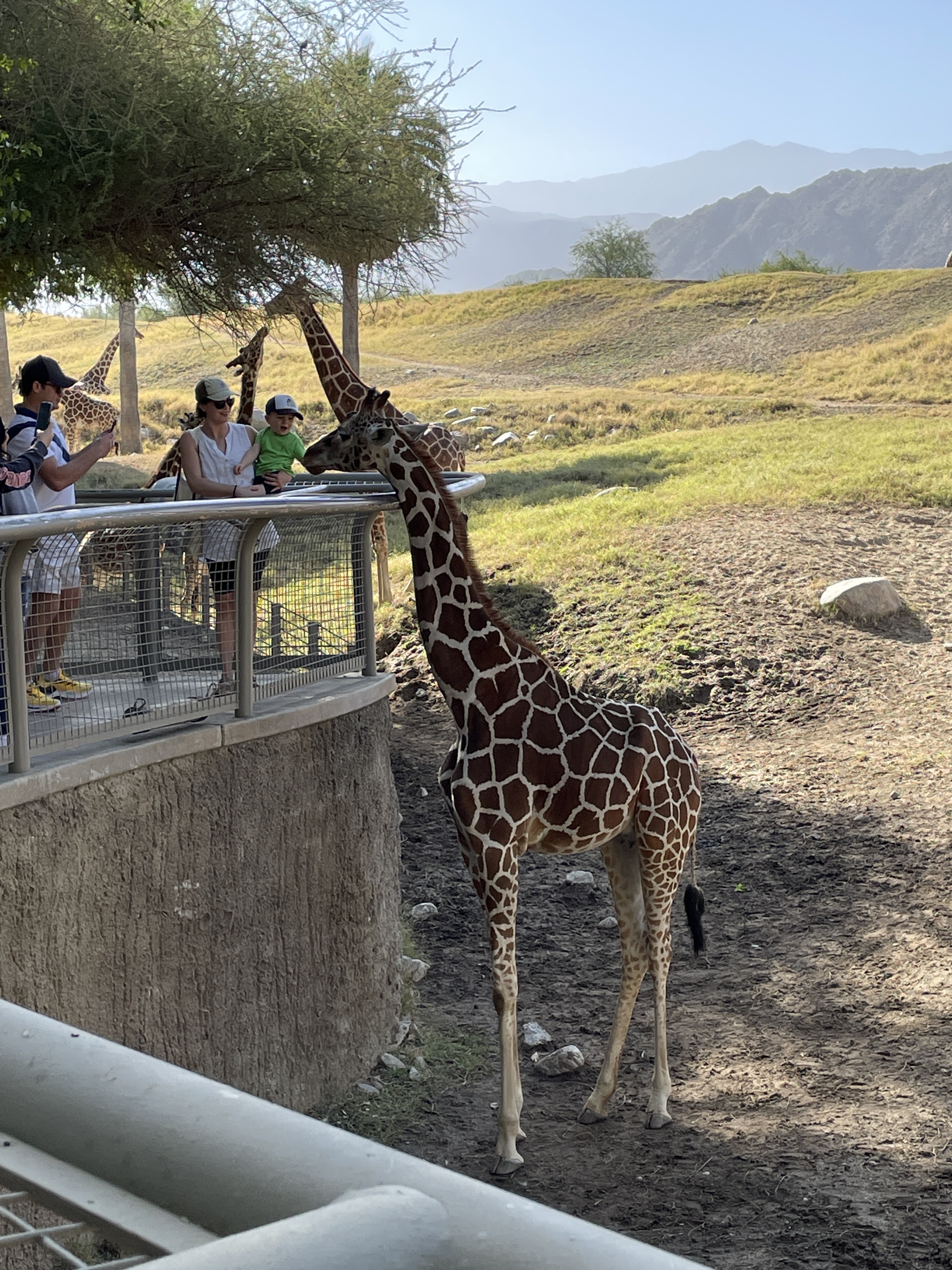
This giraffe gets free food from humans

Yesterday we visited The Living Desert Zoo and Gardens in Palm Springs and we enjoyed our time there, with few people around post-Thanksgiving and on a weekday.

It's quite a large zoo, with quite a lot to see and we didn't get to visit every section. However, the zoo is very thoughtful when it comes to seniors, with electric scooters (think a chair on wheels with a joystick) for rent at US$25, lots of washrooms available, benches and even colourful wooden rocking chairs!

Bending down for a drink of water
The staff are very friendly. If you look remotely puzzled they will try to anticipate what you need.

On the website it mentioned a 30-minute shuttle tour that shows the behind-the scenes of how the over 600 animals are looked after. When I inquired about this at the ticket counter, they said it was not available anymore... an annoying thing to hear when we have seniors who get tired easily and would have appreciated the ride...

As a result there was only so much we could cover on foot. We covered about half the park, the east side and perhaps the highlight was observing the giraffes at feeding time, which is from 8am to 3pm. Only those who have paid US$8 can go into a sectioned off area to get up close with the giraffes, who know humans are holding leaves for them to eat.

One younger giraffe came by and stuck out its tongue where people placed leaves on it and then it pulled them back into its mouth and munched on the leaves. Others, probably jaded or bored, grazed in the area or in the distance -- they weren't that keen to be near people.

There was also a pond where one giraffe took some sips of water. It had to spread its legs very wide before it could gingerly bend down and drink.

A dromedary camel walking into the enclosure
We saw ostriches, gazelles, sadly one shy rhino hiding behind a tree as he ate dry grass, and one zebra, but leopards were a no show. 

Just as I arrived, the zoo keeper had finished cleaning the area for the dromedary camels and she called to them to come out and feed. They only have one hump.

The mountain goats were fun, perched on a rocky hill. The zoo keepers had strategically placed dry grass up front so the goats stood there munching away for visitors to take pictures. 

In the Australia section, we walked into a space that had double doors -- the first set of doors had to close before the second set opened, because the wallabies were not caged and there was the possibility they could jump out.

But again they seemed leery of humans and we respected their space, staying on the cement path, while they huddled together, again eating. They were very much smaller than kangaroos, but still very cute. There was a kookaburra in a cage. When a man took out his camera, the bird seemed to puff up his chest and give his best pose, like a model.

Can you spot the mountain goats on the hill?
We were impressed by the model train exhibit -- several different tracks with trains running in different directions, complete with stores and homes. There were even billboards advertising for people to adopt a train, a clever fundraising drive. 

Many of the zoo enclosures were sponsored by donors with their names prominently displayed. Wonder if that means just the space, or paying for the upkeep of the animals too.

By this time we'd spent about two hours in the zoo. A nice leisurely walk around the zoo with some shaded areas; but almost every animal we saw was either eating or sleeping... makes you wonder how much longer zoos are relevant. 

However, The Living Desert focuses more on animals from Africa and Australia as the climates are somewhat similar, as well as those from North America.

Wallabies hanging out far away from humans
The Living Desert Zoo and Gardens
47900 Portola Avenue
Palm Desert
760 346 5694


VIFF -- Review: Our Mr. Matsura

Matsura (right) with a local in Okanogan County Frank (Sakae) Matsura, was the son of a Samurai in Hirado, Japan, but by the time he was gro...