Showing posts with label University of Hong Kong. Show all posts

Wednesday, October 30, 2024

Tang says Arrested Protesters Will be Charged... Eventually

Over 10,000 people were arrested in connection with protests


Hong Kong Secretary for Security Chris Tang Ping-keung says the authorities will continue to prosecute the 2019 protesters with no time limit, even "after 20 years". 

He said if a deadline was set it would go against the spirit of the rule of law and could risk "legalising illegal acts".

Some are calling for the authorities to wrap up cases five years after the 2019 protests, but Tang disagrees.

Tang says prosecutions will continue
"Unless there is a time limit for prosecution, we will lodge a case when we have sufficient evidence and upon agreement from the Department of Justice. This reflects the spirit of the rule of law," he said in an interview.

"I understand that some people have raised the idea that we should drop the cases based on a certain time frame, but this would in fact legalise illegal acts. I think this isn't in line with the spirit of the rule of law. Illegal things are simply illegal."

The police arrested 10,279 people aged 11 to 87 in connection with the 2019 protests, and of that total, 2,974 have either gone through or are undergoing judicial procedures as of September.

Of those, 2,403 have faced punishment after pleading guilty or were convicted. Therefore, there are more than 7,000 arrestees who have yet to be charged, five years later.

"If we had evidence and know who you are, but chose not to arrest you until when we wish to do so, then that's not right. But we need time to gather evidence -- this is reasonable," Tang said.

Tang says police are still investigating 5 years on
He explained the police were painstakingly going through video footage to identify each person and gather evidence in order to press charges, and a lot of people participated in the protests.

"This isn't a matter concerning how many years have been spent on this. For those who have offended the law and left Hong Kong, we will arrest them just the same if they come back after 20 years," Tang warned.

However, Professor Simon Young Ngai-man of the University of Hong Kong's law school said finality was a very important aspect of the city's legal system, which former chief justice Andrew Li Kwok-nang noted in a previous court case.

He acknowledged that while it was true there was no limitation period for indictable offences, it was also unlikely that the thousands of arrested-but-not-charged cases were still being actively investigated.

Young suggested the authorities should at least inform those whose cases were not under active investigation.

"I see no consistency with the rule of law to say to those persons that 'no active investigation is not being undertaken in relation to your case'. This would provide them with some degree of assurance that they can put the past behind them," he said. "For those whose cases are still active, nothing needs to be said to them."

But it seems the government is intent on keeping those arrested on edge, even if it takes 20 years or more to finally charge them...


Friday, October 18, 2024

Tackling HK's Problem of Subdivided Flats

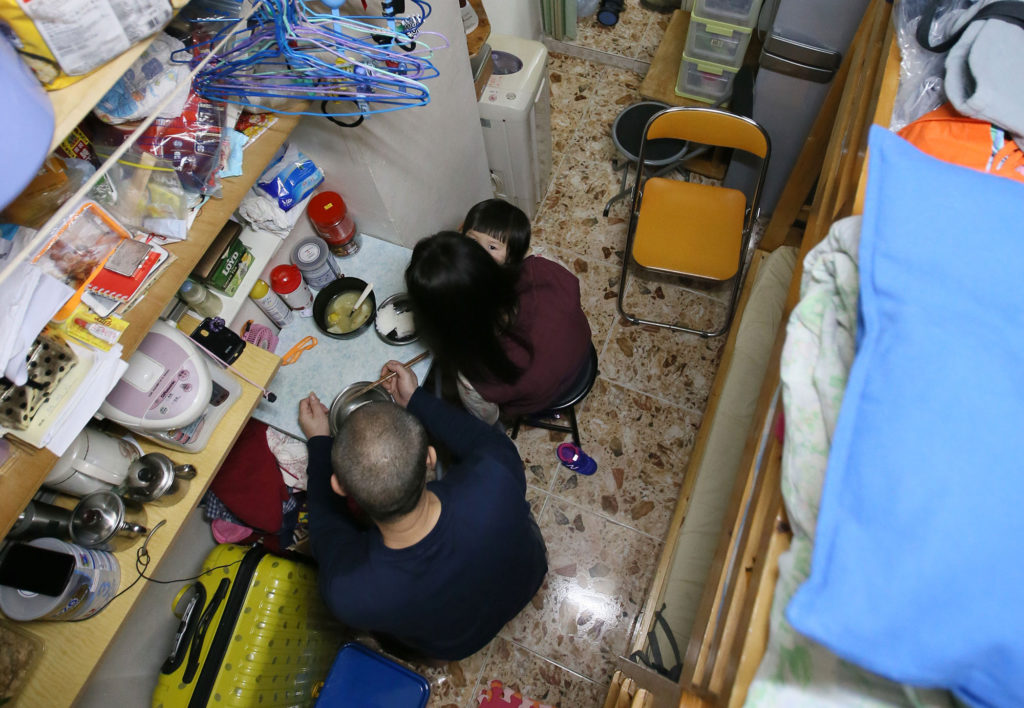
People with few resources end up in subdivided flats

In his policy address, Chief Executive John Lee Ka-chiu wanted to (finally) tackle the issue of subdivided flats -- where a space is subdivided to the point where tenants literally live in cupboard-like spaces, sharing bathrooms and kitchens, and there are hardly any windows for air circulation, let alone fresh air.

During his speech, Lee said about 30 percent of the 110,000 subdivided flats were "improper", and would be phased out with upcoming legislation, and that there would be time for landlords to upgrade these flats to meet the requirements of what the government believes is a decent living space.

How does Lee know it's about 30 percent? Deputy Financial Secretary Michael Wong Wai-lun said after it didn't necessarily mean the other 70 percent were in full compliance with the requirements.

Lee says 30 percent of subdivided flats "improper"
With the new legislation, subdivided flats that have been registered and meet the requirements will be designated as basic housing units and will be allowed to be leased.

That means the flat needs to be at least 86 sq ft, with a ceiling height of 2 metres, have a toilet and ventilation system, and meet fire and structural safety standards.

If landlords don't meet this new code, they could go to jail for at least two years.

It'll be interesting to see how this registration process works and what it will reveal in terms of the state of these subdivided flats. 

The big problem though, is that while it would be good for these living spaces to be upgraded, where will the current tenants live temporarily and also will their rents increase to pay for these renovations? Has the government thought of that?

That's Vera Yuen Wing-han's concern, an economics lecturer at the University of Hong Kong. She says the government phasing out the smallest subdivided flats could lead to higher rents for other subdivided homes as long as there was a demand.

Will tenants be forced to pay more for upgrades?
After all, people live in these poor-quality spaces because they can't afford to live anywhere else.

She also said landlords would have to pay for the renovations to meet the requirements and pass down these costs to tenants.

"If the government does not do anything, [tenants] will have to be squeezed into one unit with dividers," she said. "[This] kind of model happened in Hong Kong, like in the 1950s and 1960s when a lot of families were living in one unit, sharing the living room and the kitchen."

The government will launch the consultation process in December and start the legislative process next year, while the registration will begin in the fourth quarter of next year until the fourth quarter of 2026. Once legislation is passed, then the government will decide the time frame and targets for enforcement action against landlords. 

The Concerning Subdivided Units Alliance said the government's time frame for enforcement action against landlords was "too vague" and gave the latter too much flexibility. 

"It is unclear when the government will take the enforcement action," the alliance's Lai Kin-kwok said.

Lai also questioned the effectiveness of implementing the legislation without a clear enforcement plan, suggesting landlords could continue to rent out flats with poor living conditions.

Subdivided flats in Hong Kong are a difficult topic to deal with, as people are desperate for places to live in, and yet they are practically inhumane... 


Wednesday, August 28, 2024

Din Tai Fung Closes 14 Restaurants in China


The Taiwanese chain is closing 14 restaurants in China

When I was in Beijing, I was thrilled to see a Din Tai Fung open at a mall called Shin Kong Place, and ate there several times after work. 

So I was surprised to hear the Taiwanese restaurant chain known for its xiaolongbao is closing 14 stores in China, but perhaps it is indicative of the country's weak economy and how the Chinese are looking for cheaper places to eat.

The signature xiaolongbao at Din Tai Fung
On Monday the company's subsidiary, Beijing Hengtai Feng Catering Company announced it will close all of its 14 restaurants in northern China, including one in Xiamen. The brand's parent company in Taipei confirmed its 18 remaining restaurants across eastern China, run by a Shanghai-based partner, will continue operations.

"We deeply apologise for the inconvenience and disappointment this decision may cause our many loyal Din Tai Fung customers," the subsidiary said in a statement on WeChat. The move will affect some 800 employees.

When China finally lifted Covid-19 restrictions, Chinese residents headed out of the country on "revenge travel", and much like Hong Kong, local restaurants lost a lot of business. And now as the property market crisis trickles down, people are more cautious with spending, and that has adversely affected restaurants.

"The current situation in China is that while there is still traffic, the consumption power is weak, including in the restaurant service industry," said Darson Chiu, a Taiwan-based economist and director general of the Confederation of Asia-Pacific Chambers of Commerce and Industry.

At the entrance cooks make dumplings by hand
"A high-end brand like Din Tai Fung may not be able to meet the consumers' needs as they downgrade their consumption in China's current economic environment.

Indeed. Cheng Zhiwu, a professor of finance at the University of Hong Kong, found that some restaurants in Nanjing offered food for a table of 10 guests for 400 yuan (US$56), or 40 yuan per head, down from the previous price of 700 yuan.

Another factor in Din Tai Fung's closures may be because a lot of expats left China, and they made about 20 to 30 percent of the restaurant chain's business. 

It was just so interesting to see a Taiwanese brand become so successful in China despite all the political sabre rattling across the South China Sea. But alas, the slowing economy has forced Din Tai Fung to retreat...


Friday, October 13, 2023

More Babies Born in UK than HK

Fewer people having babies in Hong Kong these days

In another sign that Hongkongers are leaving the city in droves is the birth rate... which has increased in England and Wales. Almost 2,000 babies were born in these two places as opposed to the parents' hometown, due to migration using BNO pathways.

"When the young people left, they also took their fertility to other places," said Paul Yip Siu-fai, a population expert at the University of Hong Kong. "We are very likely to fall into a low-fertility trap and have little chance of escaping it."

The red line shows birth rate, black death rate
Britain's Office for National Statistics revealed the number of newborn babies with at least one parent from Hong Kong rose from 1,568 in 2019, to 1,602 in 2020, 1,665 in 2021 and 1,953 last year.

The figures were for England and Wales, while Scotland and Northern Ireland record their own statistics.

The BNO migration pathway came into effect after the national security law was implemented in 2020. Successful applicants and their dependants can live, work and study in the UK for up to five years, and then are eligible to apply for citizenship. 

Between January 2021 and June this year, 176,407 Hong Kong applications were approved, a 97 percent success rate.

Meanwhile in Hong Kong, the number of births plunged from 52,900 in 2019 to 43,000 in 2020, 37,000 in 2021, and only 32,500 last year, a decline of almost 40 percent over four years.

Yip urges govt to help families
In addition the total fertility rate, the number of children a woman is expected to have over her lifetime, also fell to 0.8, the lowest in the world. The rate should be 2.1 for a population to replace itself.

Yip says Hong Kong's falling birthrate is due to "a basket of reasons."

He urged the government to give baby bonuses and provide families with more childcare support, and emphasised the need to improve the education system.

This is not news... Yip has been sounding the alarm for years, while Chief Executive John Lee Ka-chiu says he is looking into it...


Friday, July 28, 2023

HK to Crackdown on "Soft Resistance"

Patriotism is a sign of agreement with Beijing

The Chinese Communist Party is determined to win at all costs.

After implementing the national security law in July 2020, Beijing thought it would defeat all dissent in Hong Kong following the 2019 protests.

However, people have found ways to continue their "soft resistance" in various ways, such as patronising the "yellow economic circle", refusing to sing the Chinese national anthem, not registering for organ donation because of its mainland links, and openly jeering at mainlanders in the city.

There is word Beijing is not pleased and wants to continue further repressing Hongkongers who refuse to bend in the CPC way.

Tang says soft resistance will be tackled
Secretary for Security Chris Tang Ping-keung said on July 25 that "soft resistance" must be tackled, and even hinted that some media, and people in arts and culture may be culprits of this soft resistance.

Earlier this month on July 3, Tang told Ta Kung Pao newspaper that Article 23 will include provisions to deal with "soft resistance", as he believed discussion about this would radicalise people... There are plans to pass Article 23 next year. 

Readers may remember the Hong Kong government under then chief executive Tung Chee-hwa tried to pass this legislation in 2003, but a mass street protest resulted in it being shelved -- until now.

There is the constant comparison that other countries like the United States and Canada have national security laws too, but these democratic countries do not weaponise it like Hong Kong and China.

So far 270 people have been arrested on national security charges in Hong Kong since mid 2020, around 70 have been tried in court, and all of them found guilty, says former lawmaker and journalist Emily Lau Wai-hing.

"This is a 100 percent conviction rate. I'm not casting aspersions on anybody," she said.

However, pro-Beijing senior counsel Ronny Tong Ka-wah claims the city continues to uphold free speech, saying: "Rest assured you can say anything you like in Hong Kong."

Lau says NSL has 100 percent conviction rate
Hard to believe Tong, previously a democrat who co-founded the Civic Party before doing a 180-degree turn towards Beijing.

In any event, there are concerns that the existence of "soft resistance" in Hong Kong gives Beijing a mandate for further repression in the city in a bid to extract complete submission.

"It's almost as if the government is saying the word 'patriot' is code for you agree with us. If you agree with us, then you can be in the district council, you can be in LegCo, you can be in the election committee and all these things. But if you don't agree with us, then you're resisting," says John Burns, an honorary professor of politics and public administration at the University of Hong Kong.

The people who are left in Hong Kong are seeing their space for resistance quickly diminishing... how much longer can they keep going? 


Sunday, May 14, 2023

Fact of the Day: Hong Kong's Lowest in the World


Hong Kong doesn't offer enough incentives to have children

Hong Kong has a new reputation of having the lowest birthrate in the world.

This ranking is according to a report by the United Nation Population Fund that was released on April 19.

The Hong Kong government previously said the population dropped as students went overseas to study.

Hong Kong's birthrate continues to plunge
But now it can't hide the fact that there are very few babies being born in the city. Many young women have migrated elsewhere in light of the national security law and there are others who prefer to remain childless.

According to the Census and Statistics Department, Hong Kong's fertility rate dropped from 1,080 in 2018 to 772 in 2021.

In the latest financial budget released in late February, Financial Secretary Paul Chan Mo-po proposed increasing the the child allowance by HK$10,000 (US$1,275) to HK$130,000.

However, lawmakers to residents complained the amount was too little to cover the costs of raising a child in Hong Kong. Experts suggest giving financial aid is the best option -- provided the amount was enough.

"There is international evidence suggesting that financial incentives including tax incentives have a positive impact on fertility, and at least, may encourage couples to give birth earlier," said assistant professor Tan Poh Lin, who studies Singapore's low birth rate at the Lee Kuan Yew School of Public Policy.

HK has a higher number of seniors than youth
However, Paul Yip Siu-fai, the chair professor in population health at the University of Hong Kong, said the government had yet to treat the low birth rate as "a matter of life and death" as the Singaporean government had.

"It will not work unless you invest a very large sum of money," he said.

Yip said the government should instead focus on improving people's quality of life to make them happier while improving work conditions for women.

Indeed. But will the government listen?

Saturday, May 6, 2023

Pillar of Shame Confiscated as Evidence

The Pillar of Shame when it stood in the HKU campus

The saga of the sculpture paying homage to the victims of the 1989 Tiananmen Square massacre continues with it being confiscated by the police yesterday, apparently related to a national security case.

The Pillar of Shame, which had been taken apart, wrapped up and hidden in the University of Hong Kong's Kadoorie Centre in Yuen Long, was taken by the police as evidence for a subversion case.

Since 1997, the eight-metre tall sculpture featuring people in an organic pyramid, was standing at the HKU campus until it was dismantled in the middle of the night by a crew in hard hats in December 2021.

It was removed late one night in December 2021
When Jens Galschiot, the artist who made the sculpture heard about the latest development from the media, he slammed the operation as "outrageous", as he said he was the owner of the artwork and no one had consulted him on the matter.

He wrote a message on his newsletter which read in full:

I just got the news from the media about the removing of the Pillar of Shame from Hong Kong University. This is outrageous. This is my sculpture and nobody has consulted or informed me about anything.
I have heard that the sculpture will be used as evidence under the national security law, but this makes no sense to me.
The pillar was placed in Hong Kong, before Hong Kong was handed over by the British. It is an art piece made and exhibited by a Danish artist (me) as his personal project. The initiative has been mine, nobody has incited me to put it there, and I personally paid all expenses for it. 
I cannot see how they can use the sculpture under the national security law. The Democratic Alliance and many Hongkongers have been assisting me putting the sculpture in Hong Kong, but so has shipping companies, crane firms and University of Hong Kong. Even Hong Kong authorities has given permission for me to put it up and move it around.
Though I am deeply touched that the Pillar is used this way in Hong Kong, the events confirm the that symbolic language of art cannot be crushed, and only gets stronger when attacked. The Pillar of Shame and talks about the June 4th massacre hasn’t been more present than now. Hong Kong (China!) took down the pillar but got a 1000 back. It appears as 3D prints all over the world, as AI and as banners.
 
Galschiot continues to demand sculpture back
Sincerely yours,
Jens Galschiot, May 5th, 2023
 
The security bureau released a statement replying to Galschiot in part: "Some organisations attempted to mislead the public in the name of artistic freedom and requested to return the evidence, smearing the police's legal action with insensible blame, undermining law and the rule of law."

Secretary for Security Chris Tang Ping-keung said the removal of the statue had nothing to do with the upcoming June 4 anniversary, and that the operation was done according to the ongoing investigation.

"The legal proceedings are still ongoing. I cannot reveal any details... We will continue to search for more evidence to support the prosecution work," he said.

The organiser of Hong Kong's annual Tiananmen Square candlelight vigil -- the Hong Kong Alliance in Support of Patriot Democratic Movements of China -- together with three of its leading members, Lee Cheuk-yan, Albert Ho Chun-yah, and Chow Hang-tung have been charged with inciting subversion under the national security law.

The chances of Galschiot retrieving his sculpture have dimmed significantly now that it has been confiscated as "evidence"...

Tuesday, April 4, 2023

Hong Kong's Declining Workforce, Student Populations

Hong Kong doesn't have enough workers across all fields

In yet another sign that Hong Kong's population is decreasing, last year the city lost over 94,000 employees, the biggest drop in the working population since records began almost 40 years ago.

The downward trend has been happening since the 2019 protests and in the last four years some 220,500 workers have left Hong Kong. The drop has been exacerbated by baby boomers retiring at 60 or 65, and experts say the combination of these factors will continue for the next year or two.

Many workers left Hong Kong or retired
"Many of the people who were born in the 1960s, when Hong Kong was experiencing the post-war baby boom, have reached retirement age. Meanwhile, the city is also seeing many emigrate to other regions and countries," said Professor Paul Yip Siu-fai, associate dean of the University of Hong Kong's faculty of social sciences.

As a result there are 73,150 job vacancies in the private sector, a jump of 20 percent from last year.

The education industry is in dire need of people with 7,750 positions that need to be filled, followed by transport and logistics at 7,390 jobs. Human health services is third at 6,510 vacancies.

Hong Kong's official population figures show the population has dropped for a third consecutive year to 7,333,200, a 1 percent drop from 2021.

Schools with few students may need to close
And because of the falling population, at least two primary schools may close because they don't have the minimum of 16 students to stay open.

Pupils and teachers have been leaving Hong Kong during the school year, and that coupled with the declining birth rate has led to fewer Primary One classes. The actual number of Primary One classes won't be known until the school year starts.

However, it is worth considering that with the government's push to develop the Northern Metropolis, the area near the border with the mainland, there could be an increase in students there. The plan is to turn this area into a residential and tech hub with some 900,000 flats and up to 650,000 jobs.

"If we axe schools now, when the population of the district goes up again in the future, there will not be enough schools," says Chu Wai-lam, vice-chairman of the New Territories School Heads Association.


Friday, January 27, 2023

Covid-19 Inquiry Welcome, but with Caveats

Many agree to an inquiry, but after the pandemic is over

After infectious diseases expert Yuen Kwok-yung pitched the idea of an independent inquiry into the Hong Kong government's handling of the Covid-19 pandemic, others are putting in their two bits as well.

Fellow experts David Hui Shu-cheong and Leung Chi-chiu agreed, but said the inquiry should start later.

Meanwhile professor Lau Yu-lung in the University of Hong Kong Paediatrics agrees in principle, and adds the inquiry should be headed by a judge and that it should start after the World Health Organisation declares the pandemic over.

Hui says inquiry should start later, not now
However, Executive Council convenor and chairperson of the New People's Party Regina Ip Lau Suk-yee threw in her opinion and as expected, she had many caveats. 

She did not like the idea of independent judges heading the inquiry because they are not policy experts, but isn't that the point?

Ip also said the inquiry should be held after the WHO declares the pandemic over, as there are still new variants. But as they are not as life-threatening as the original Covid-19, there is an argument to have it sooner rather than later.

Nevertheless, she did acknowledge there was a lack of support for infected patients at the peak of the crisis last year, saying the review should look into how to better mobilise social resources and how to maintain medical services when handling a large number of infected residents.

In addition Ip suggested looking into ways to make good use of technology and mobilise civil servants in handling major crises -- isn't that what they did in the latter half, when there was not enough manpower for essential services? 

Ip says officials should not be targeted
But perhaps most importantly, she stressed the inquiry should not target government officials who she says worked hard over the past three years.

"Everyone was handling it hand learning along the way, as well as optimising measures. We should not hold anyone accountable for everything, but should instead look for shortcomings and optimise procedures," she said.

While a blame game is not productive, an inquiry needs to uncover what happened and why, and how to make things better in the future.

But in some cases, there were things the health experts suggested and the government did not take the advice, or processes were completely mismanaged or incompetent. The design of the LeaveHomeSafe app comes to mind... 

Most would agree the community vaccination clinics were well organised, but did the government do enough to encourage people, particularly the elderly to get jabbed? Why did the authorities not clamp down on mis- and disinformation on vaccines and how many vials of vaccines were wasted? 

Taxpayers deserve to know what happened, and an inquiry -- if it ever happens -- is a good place to start. But caveats aren't very helpful when the government lacks integrity and transparency...

Sunday, December 18, 2022

Chinese Tourists Gamble and Get Vaccinated in Macau

Since last month Macau began vaccinating Chinese visitors

Chinese travellers to Macau are not just going to the gambling tables at the casinos, but also heading to a designated immunisation clinic to get mRNA vaccines in their arms.

As the Covid-19 restrictions are being lifted in China, the number of infections are exploding and some people are trying to do whatever they can to protect themselves.

While the Pfizer BioNTech vaccine is used in Macau and Hong Kong, it is not approved for use in China.

Macau University of Science and Technology
But last month Macau's Covid-19 Infection Response Coordination Centre announced it was lifting restrictions on vaccinations for short-stay visitors.

Since then, the Macau University of Science and Technology Hospital -- the only vaccination site offering mRNA vaccines for tourists -- is now the place mainland visitors go to these days.

However, they are getting the mRNA vaccine that fights against the original Covid-19 strain and not the newest bivalent one that targets both Covid-19 and omicron.

In addition, the shots aren't free -- mainland tourists must shell out between HK$1,360 to HK$1,650 (US$175-US$212) per shot.

Mainland tourists cannot go to Hong Kong yet as the border still remains closed, but some Chinese visitors in Macau who got inoculated hope to get another dose in Hong Kong.

How fascinating that Macau has become a vaccination destination, and Hong Kong may soon become one too. That said the Hong Kong government had thrown out the idea of becoming a place for medical tourism... this might be the chance...

Beijing funeral homes inundated with bodies
Meanwhile on the mainland there are no accurate numbers of cases of Covid-19 infections, but what is for sure is the number of bodies arriving at morgues and funeral homes.

In Beijing, there are two designated funeral homes that are allowed to cremate those who have passed from Covid-19 and an Associated Press reporter saw about a dozen bodies delivered to one funeral home within one hour.

The Wall Street Journal is reporting about 200 bodies arriving daily, and quoting one crematoria worker as saying, "It's 24 hours a day. We can't keep up."

Usually a few dozen bodies are cremated daily. 

The government has not reported any new deaths from Covid-19 since it relaxed its pandemic restrictions on December 7. The official death count is 5,235.

However, a University of Hong Kong study predicts nearly 1 million people could die from Covid-19 without a massive fourth dose vaccination campaign, a supply of antiviral drugs and social-distancing measures.

The funeral homes and crematoriums will be literally burning the midnight oil for the next few months... the number of lives lost is a painful cost for insisting on the zero-Covid path for the longest time...


Wednesday, November 23, 2022

Pillar of Shame Still not Resolved, Almost a Year Later

The Pillar of Shame had stood in HKU campus since 1998

Hard to believe but it's been almost a year since the Pillar of Shame sculpture was unceremoniously taken down from the University of Hong Kong campus and packaged up, and stored in an undisclosed location.
Since then Danish artist Jens Galschiot has been trying to locate it to bring back to Europe.

But he's only heard radio silence.

"Now, I cannot even get information about where my sculpture is," the artist said in a statement, adding the work appeared to be damaged when it was taken down on December 22, 2021 in the middle of the night. "It's quite frustrating," he said.

Jens Galschiot is calling for the statue's return
Instead of moping about it, Galschiot has escalated his campaign by teaming up with Hong Kong-based NGOdei to do an augmented reality campaign, calling for the return fo the artwork.

Participants can download the AR (augmented reality) app and digitally place the sculpture in any location in the world, take a picture and then upload it onto social media with the hashtag #returnthepillar.

In addition people can use the 3D files of the sculpture and print a 3D model of the work, which remembers the tragedy of the June 4 massacre in Tiananmen Square in 1989.

Galschiot is hoping greater awareness of the sculpture will in turn lead to the return of the work to him.

Previously he had offered to go to Hong Kong personally to pick up the sculpture, and his lawyers have reached out to the university's lawyers to come to some kind of agreement, but the HKU lawyers say they have not received any instructions from the university on what to do with the Pillar of Shame.

The 23-foot tall sculpture was first erected in Hong Kong on the eight anniversary of the crackdown. 

The statue was dismantled late at night
The removal of the sculpture came a year and a half after the national security law was implemented, and the university was criticised for the way it handled the whole matter, from its reasons for taking it down to how they made sure it was dismantled at night, and eventually other tertiary institutions scrubbed their campuses clear of any reference to June 4.

One would think HKU would want to end this incident quietly and quickly by returning it -- but the longer it digs in its heels and refuses to resolve things, the worse the university's name will be in terms of reputation outside of Hong Kong.

Why not do the end honourable thing and give it back? Burying it forever will not end the matter...

Thursday, November 3, 2022

Paul Chan Claims No Special Treatment

Look who's back... and ignoring all protocols for returnees

One country, two systems continues robustly in Hong Kong when it comes to its treatment of Financial Secretary Paul Chan Mo-po.

He contracted Covid-19 while in Saudi Arabia, but somehow tested negative on Monday and returned to Hong Kong on Tuesday -- and the Centre for Health Protection did not declare his PCR test on arrival was negative. 

Instead the CHP claimed he was a "recovered case" and waived from doing any quarantine. 

Ho slammed the government for zero consistency
Where did he go? Straight to the Global Financial Leaders' Investment Summit where he addressed the crowd without a mask.

The media was on Chan's case, but claimed he was not handled differently from others at the airport:

"The treatment I have been given was the same as anyone. There's no particular privilege at all," he said, adding he went through Hong Kong's usual pre- and post-flight checks.

Such a high profile case that the CHP didn't seem to scrutinise close enough...

He was in a room full of people and even though he didn't eat with them, he spoke to them maskless!

Ho Pak-leung, the city's leading microbiologist from the University of Hong Kong, slammed the government regarding Chan's case as "failing to comply with a unified standard."

Is Chan's vaccine pass amber? It should be...
"Besides, some unnecessary screening measures towards new arrivals will hinder the process for society to return," he added.

Ho said it was inevitable for the city to soon scrap all entry curbs and go to "0+0", and that the amber health code on the Vaccine pass should be scrapped as well.

This hypocrisy will continue post national security law, where elites can do as they please, while the plebeians are severely punished for any minor infraction.

If there is a wave of Covid-19 cases from bankers in the next few days, we know where it came from...


Friday, August 12, 2022

Hong Kong's Population Continues to Drop


Hongkongers will continue to leave in the next 2-3 years


Hong Kong's population continues to drop, as more than 113,000 people left the city in the past 12 months, a record 1.6 percent decrease in the population. It is the second straight annual decline in numbers.

The figure is from the Census and Statistics Department released on Thursday. Hong Kong's population fell to 7,291,600 from 7,413,100 from mid-2021. There were also 61,600 deaths and 35,100 births between mid-2021 and mid-2022, a decrease of 26,500 people.

The graph clearly illustrates the population plunge
Some of those deaths can be attributed to Covid-19 when a spate of elderly people passed away after contracting the virus in seniors' homes.

The decline to 7.29 million people was sharper than last year's 1.2 percent decrease.

Of course the Hong Kong government is trying to explain away the numbers, saying the drop in the population is due to people moving away for school and work, while strict quarantine measures have made it hard for people to come back or move there, and the birth rate has fallen further because of the Covid-19 pandemic.

The authorities don't want to own up to the reality of why people are leaving, as someone on Twitter put it succinctly: "If 'one country, two systems' in Hong Kong is such a success, there wouldn't be hoards of middle class in their 30s and 40s giving up what ought to be the start of the most economically lucrative stage of their lives to move to another place to start again or even semi-retire."

People in 30s and 40s leave HK to start over again
Professor Paul Yip Siu-fai, a population health expert at the University of Hong Kong, predicts the emigration wave will continue for at least the next two to three years, as many residents are looking for ways to leave.

"The pull and push factors are in one direction, which go against Hong Kong," he said.

He called on the government to address the housing shortage as well as concerns about the city's overall development.

"Some people do not understand the national security law, they are really worried. So the government should explain the law clearly to allay their concerns. This is very important," he said.

Alas will the government heed Yip's advice, when the NSL is deliberately vague to scare people?


Tuesday, July 26, 2022

NSL Indoctrination Begins


University students must now pass a class on NSL to graduate

The Hong Kong Education Bureau is making sure students are learning about the national security law with university students having to take a non-credit course on the subject in order to graduate.

In an email sent to all University of Hong Kong students on Monday, students must enrol in a course titled "Introduction to the Constitution, the Basic Law and the National Security Law" from the 2022-23 academic year.

HKU will offer the course in September
The HKU course will be taught online with a "self-directed learning approach" -- whatever that means.

"Students will have the flexibility to take this course in any semester throughout their period of study and there is NO NEED TO ENROL in this course during the upcoming course selection and/or add/drop period," the notice says, adding students just need to pass the course without further details.

It's not just this university but also the other seven that will launch or have already started offering national security courses.

Ming Pao reported that the Chinese University of Hong Kong, Hong Kong University of Science and Technology, and the Hong Kong Polytechnic University will begin offering the NSL course the upcoming school year.

Baptist U has incorporated NSL in seminars
Meanwhile, Hong Kong Baptist University, the Education University of Hong Kong, Lingnan University and City University of Hong Kong have already incorporated national security content into their curriculum in the format of seminars and workshops, according to Ming Pao.

But don't think that young children have escaped the opportunity to learn about NSL -- the Education Bureau has collaborated with the Security Bureau to create picture books for pupils in kindergarten, primary and secondary schools "to raise the sense of national security," said Secretary for Education Christine Choi Yuk-lin.

"... [the Education Bureau], together with the Security Bureau will gift all secondary and primary schools, and kindergartens, a picture book titled 'Our Country, Our Safety', and introduce a sense of national security and raise students' awareness and sense of responsibility of maintaining national security through various themes and real-life examples."

Wonder what examples Choi has in mind...

Kindergarten pupils to get NSL picture books
She added the EDB will also provide subsidies of around HK$50 million for secondary and primary schools, and HK$10 million for kindergartens to promote reading. 

Ostensibly reading NSL-and patriotic education-related materials...


Sunday, June 5, 2022

33 Years Later Remembering June 4


The Goddess of Democracy at UBC

On the 33rd anniversary of the Tiananmen Square massacre, Hong Kong police were out in force around Victoria Park in Causeway Bay, making sure nobody was doing anything to commemorate June 4th.

Meanwhile the pitches were empty, even though there were claims someone had booked them. 

Police officers in Causeway Bay near Victoria Park
For many, the thought of possibly being arrested near Victoria Park was not worth it, or would rather mark the sad anniversary at home with candles. The ability to congregate as a group in the tens of thousands and focus on the victims was something people did for 30 years in Hong Kong, but no more.

An activist, Lau Shan-ching, was arrested for wearing a mask and T-shirt that said: "Commemorate June 4th Victoria Park 2022" for allegedly uttering inciting words and participating in unauthorised assembly. Others weren't even allowed to leave flowers at the park. 

One woman was detained briefly for wearing a T-shirt that had these words written on the back: "You cannot fight against the future." She was warned the message may constitute illegal assembly. 

Right...

US consulate had candles on the windowsills
University campuses in Hong Kong have also taken down any kind of memorials to the event, from the Pillar of Shame at the University of Hong Kong, the Goddess of Democracy at Chinese University, slogans written on walls and sidewalks have all been painted over.

This is the way Beijing wants it to be -- whitewashed from history and forgotten while fewer people come out publicly to mark the anniversary.

Beijing even asked consulates not to commemorate the event, but many defied the request and lit candles that were placed on window sills for people to see. It was a peaceful yet firm act of resistance.

This afternoon I went to the University of British Columbia to see the Goddess of Democracy statue which is near Brock Hall. I was heartened to see some flowers already placed there, and some white candles had already burned out, but another one was lit.

Activist Lau Shan-ching was arrested by police
There were also some umbrellas placed there in reference to the 2019 protests.

One on side of the base of the statue was a plaque with the headline, "The Empty Chair". It read:

"Liu Xiaobo was awarded the 2010 Nobel Peace Prize for "his long and non-violent struggle for fundamental human rights in China." As he was imprisoned in China at the time, his award was presented to an empty chair at the ceremony in Oslo.

"In 2017, LIU became the second Nobel Peace Prize laureate to die in government custody."

A man in black wearing a yellow mask handed me a piece of paper with lyrics to songs that would have been sung at the candlelight vigil at Victoria Park.

I explained I had just recently moved back. "I did too, I moved here a year ago," he said.

Flowers and umbrellas by statue
He was by himself and seemed happy to sing songs, including Glory to Hong Kong in English.

Most people walked by him, a few people stopped to take pictures.

Just over a year ago the June 4 Museum in Hong Kong was abruptly shut down. It was not unexpected but it was still shocking to see happen. I had just visited the day before because it was the next logical place to commemorate the incident after Victoria Park was shut down.

But now the place to visit is the Hong Kong News-Expo near PMQ above Sheung Wan, where there are copies of newspaper front pages of June 4.

It's ironic considering it's a government building and funded with taxpayer money...

Monday, May 30, 2022

June 4 Erased from Hong Kong


The candlelight vigils in Victoria Park in HK are no more

The 33rd anniversary of the Tiananmen Square crackdown is this Saturday. Earlier this year the Pillar of Shame, a statue dedicated to the victims of the June 4 massacre in Beijing was quietly taken down in the middle of the night in the University of Hong Kong, and last December, the Goddess of Democracy removed from Chinese University of Hong Kong. 

Days before the anniversary last year, the June 4th Museum in Mong Kok was forcibly shut down, its display items removed by the police, and the mass gathering in Victoria Park where participants shouted slogans, sang songs and lit white candles is no more.

This statue has been carted off into storage
The Hong Kong Alliance, organisers of the previously annual event were arrested and charged with being "foreign agents" over incitement to subversion.

Now because of fears of violating the national security law, churches in Hong Kong did not hold mass to commemorate the June 4 anniversary, ending the 33-year tradition.

"We find it very difficult under the current social atmosphere," said Reverend Martin Ip, chaplain of the Hong Kong Federation of Catholic Students, one of the organisers.

"Our bottom line is that we don't want to breach any law in Hong Kong," he said.

But luckily in Vancouver this past weekend, commemorations already began. 

At the University of British Columbia there is a Goddess of Democracy statue between the main study hall and the bus loop.

Materials from the June 4 Museum confiscated
"It's been happening in China for 33 years -- no one can say something about June 4," says Mabel Tung, of the Vancouver Society in Support of Democratic Movement. 

"Right now, they say May 35 as representing June 4. Because they try to erase June 4. Young people in China, they don't know what happened June 4 because their parents didn't want them to know. They would be in trouble if they talk about that in Mainland China," she said.

The group will also hold a march and vigil in front of the Chinese consulate on June 4.

Tung says Beijing is afraid of June 4.

"They try to erase history," she said. "So they try to erase any image related to June 4 because Hong Kong is the one city in the world that still remembered June 4 every year with a candlelight vigil. Almost 200,000 people in the park... and now it's gone. So we have to keep the spirit here."

The Goddess of Democracy at UBC campus
Tung never thought the vigil would be banned in 2022 because Hong Kong was supposed to have 50 years of no change until 2047. 

But here we are. Reminders from statues to slogans painted on sidewalks and walls have pretty much been physically scrubbed away from the city, but the victims will forever be remembered in people's hearts and minds.

VIFF -- Review: Our Mr. Matsura

Matsura (right) with a local in Okanogan County Frank (Sakae) Matsura, was the son of a Samurai in Hirado, Japan, but by the time he was gro...