| The start of the Grouse Grind |
| Lots of heavy breathing from everyone hiking |
| Beautiful views along the way |
| Last stretch is a scramble up rocks |
| Gondolas taking passengers down the mountain |
| The start of the Grouse Grind |
| Lots of heavy breathing from everyone hiking |
| Beautiful views along the way |
| Last stretch is a scramble up rocks |
| Gondolas taking passengers down the mountain |
![]() |
| Large pieces of braised fish maw surrounded by goose webs |
![]() |
| Visitors can wear shoe covers on the glass walkway |
During the Covid-19 pandemic, after dinner during the week I walked along the Hong Kong waterfront from Kennedy Town to the Hong Kong Convention and Exhibition Centre and back, a good 10K.
I enjoyed being among people, in the fresh air and getting exercise.
![]() |
| The last 1.1K section was unveiled to the public |
But yesterday the last section, about 1.1K long was finally completed, from the North Point Promenade to Hoi Yu Street in Quarry Bay. Now people can literally go from Kennedy Town to Shau Kei Wan in 13K.
Part of the North Point section features a glass walkway, where visitors need to wear shoe covers... seems a bit over the top for a path that's mainly for looking at the scenery above than below the water.
Nevertheless this project of designing and constructing a 13k promenade is 16 years in the making and it's great to see it's finally finished.
![]() |
| The path is a great way to see the city |
When I recently visited Hong Kong I was staying in North Point and walked along the waterfront towards Causeway Bay a few times.
Can't wait to go back and walk the whole 13K!
![]() |
| This book has clear, incremental ways to change your habits |
If you've got some goals and wondering how to achieve them, James Clear has the answer for you -- Atomic Habits, incremental changes to your daily habits that must might help you succeed.
Clear grabs your attention right away by describing a horrific freak accident in high school that almost left him for dead. He had had dreams of becoming a baseball player, but this accident was a massive setback not only physically but academically too.
However, with good habits, from cleaning his room everyday to studying not only got him back on track to be named a top athlete in college, but also win academic honours too.
![]() |
| Clear gives examples of changing his life |
Clear tells another great story about the British cycling team and how they were not very good. But a new coach tried to make incremental improvements of 1 percent here and there, from the bikes to the uniforms to how they were training and strategy that led to British cyclists winning the Tour de France.
Basically Clear explains we have good habits and bad habits, so try to change your bad habits into good ones.
That means trying to make good habits easier to do, and bad ones harder. He gives the example of watching television. If you want to watch less, you can only turn it on if you can name the show you want to watch. Or unplug it so you have to plug it in. Or lock it in a cabinet, or place out of sight so you have to move it to be able to watch it.
Another interesting point he makes is we make goals such as wanting to lose weight. How do you do that? Clear says we should try to be the person we want to be. If we want to lose weight we should start to think about how a healthy person thinks. Does a healthy person eat chocolate? Maybe you should put in extra steps instead, or eat an apple.
To build more good habits, stack them with ones you already have. For example, once you wake up in the morning, make your bed and then take a shower. Other possible good habits to add on are, if you see a set of stairs, climb them instead of taking the elevator, or if you want to buy something over $100, wait 24 hours before buying it.
In order to increase the chances of changing or improving your habits is to change your environment so that you will have a higher chance of doing them. He says if you want to draw more, put pencils, pens and paper on your desk, or to exercise more, have your workout clothes set out to change into, and to eat healthier, chop up vegetables and fruits and put them in containers so you won't turn to junk food.
Starting something may seem daunting to people, and Clear suggests the two-minute rule or at least opening a book and reading a page or working out for five minutes; in this way you have shown up which is a big part of starting good habits.
He also writes about a young man who became very successful in sales very quickly. How did he do that? He had two jars on his desk, one filled with 120 paper clips. Each time he finished a sales call, he would put one paper clip in the empty jar and so on until all 120 paper clips were in the second jar. It was a physical reminder of how much he had accomplished in one day. That's why things like journals can help people keep track of what they have eaten or done.
Atomic Habits is very easy to read with clear relatable examples that make you think there are some small ways you can improve yourself in all aspects of your life.
I borrowed the book from the library, but had to wait a while as there were over 90 people ahead of me wanting to read Atomic Habits too!
| Under the highway overpass is a place for people to exercise |
In the last few years I lived in Hong Kong, particularly during the Covid-19 pandemic, my friend and I did a lot of walking along the harbour. It was a way of decompressing and also feeling like we accomplished something, counting the number of kilometres with some sweat. I also wore down a few pairs of runners.
Towards the end we could walk from Kennedy Town to Sai Wan Ho on a path hugging the shoreline, though there were some sections where we had no choice but to walk inland before the path continued again along the harbour front.
| A colourful path directing cyclists and pedestrians |
There are two paths that periodically converge or separate; one of which juts out periodically so people can take pictures of the harbour or stand or walk and enjoy the view.
This morning I checked out the path and saw a number of seniors taking advantage of the path, some young professionals using the route to walk to work in the car-free zone, some squeezing in a run before work, or walking their dogs.
I walked to Fortress Hill, the next district west of North Point and did a loop around the giant vent shaft which is part of the Central-Wan Chai Bypass, before turning back.
In the end I walked about 4km and broke in a bit of a sweat even though it was a chilly 15 degrees.
| A mini hill to climb on the left for kids |
| The walking path inside the forest is slippery! |
Vancouver has been very chilly, with sub-zero temperatures overnight and into the early morning. Since the heavy snow over a week ago, side roads are still covered in packed snow and ice, and only today has the white stuff finally partially melted on street in front of our house to reveal patches of asphalt.
While most of the sidewalks are cleared, it's walking in Pacific Spirit Park that's become treacherous. After it had snowed, the paths were fine to walk on with some grip on your boot soles, but after the snow melting and then freezing several days in a row, the routes are very slippery -- and that's when it's flat.
That was my experience yesterday when I attempted to walk into the park and made a quick exit to get back onto stable cement.
The other day a neighbour near the entrance of the park saw an ambulance and fire truck parked there. The paramedics and firemen had come to extricate a young woman who had fallen less than 1km into the park on a slope. It is unclear if she was trying to go up the hill or down.
Nevertheless, these rescuers had to make sure they themselves didn't fall, get the woman onto the stretcher and then carry her back (without slipping) to the ambulance.
Today the yellow metal bar at the entrance of the park is open, but today it was closed, though that didn't stop others from entering at their own risk.
Rain is expected on Saturday and temperatures finally rising above 2 degrees to 5 degrees! Maybe it will finally wash away all the snow and ice for good. It was nice when it first came down, but we're all over it already!
![]() |
| Pure Fitness is behind on rent in the location I worked out at |
When I lived in Hong Kong I used to be a member of a gym at the ICBC Building in Central. It was not the most convenient location, but I was motivated to go because it was the only gym in the city that had a pool. It was a small, 20m pool, but better than public ones that were extremely crowded with people having varying swimming abilities.
At least here the water was pretty clean, and fewer people in general. I also met some nice people there.
![]() |
| The small but nice pool in Central |
But the start of the Covid-19 pandemic led to numerous infections in the gym because not enough precautions were taken and eventually gyms were closed for months on end. In that period I began walking along the harbourfront about 10K every night and even further on the weekends, though I did miss swimming a lot.
When the gym finally reopened, I only went to swim a few more times because I was leaving Hong Kong.
A friend told me today that Pure Fitness was slapped with a lawsuit from the landlord of the ICBC building location for allegedly not paying the full rent amount for a few months, about HK$13.6 million.
It also doesn't help that lots of foreign companies have left Hong Kong, along with them their employees, many of who were expats who joined Pure Fitness. The pandemic also resulted in people finding alternative ways to get fit without having to pay expensive membership fees...
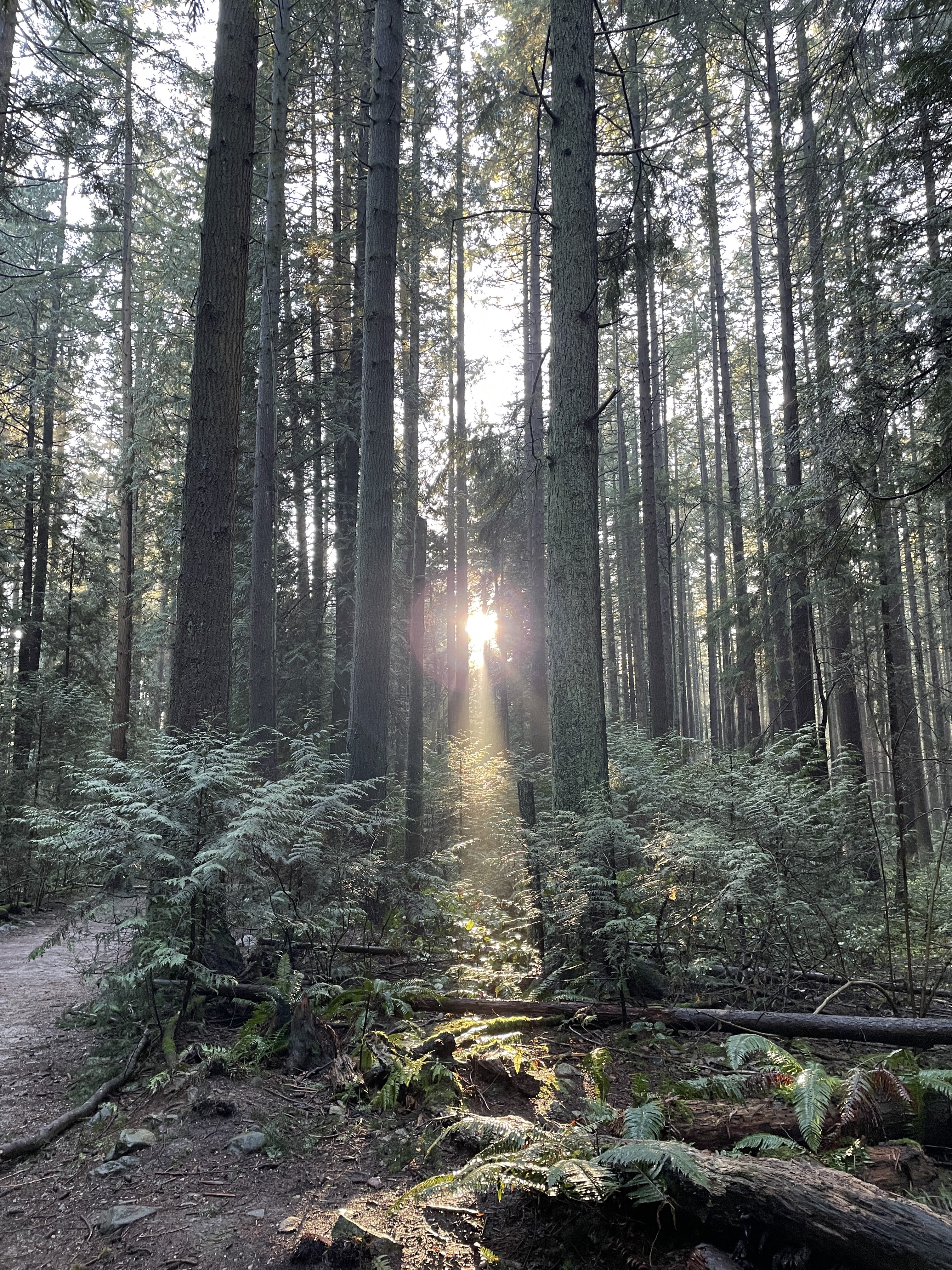
| The sun's rays were playful among the trees |
Yesterday I woke up to pouring rain and thought that pretty much dashed the hope of being able to walk outside. The weather report claimed the rain would taper off by early afternoon but it didn't look like it.
However, by 1pm the rain cleared and the sun even made an appearance.
After lunch, I walked towards Pacific Spirit Park and soon saw there was a light fog in the area, casting fantastic rays in the forest.
I couldn't help but take numerous pictures along the way, observing the sun's rays among the trees.
It was a pleasant walk save for the muddy paths in certain points. A fellow walker remarked how nice an afternoon it was but forgot to wear his rubber boots.
Yup, me too...
| Dramatic windy scenes along the west side of the Seawall |
Today was a long day that started with breakfast with an ex-colleague who is in Vancouver for Christmas. We loaded up on brunch at White Spot and then headed downtown to walk around the Seawall at Stanley Park.
Construction of the Seawall began back in 1917, overseen by master stone mason James Cunningham. But it wasn't until 1980 when the entire loop of the Seawall was declared completed.
| Lions Gate Bridge with busy traffic |
By the time we reached underneath Lions Gate Bridge, the temperature became chilly, and powered on to keep warm. Towards the mouth of Burrard Inlet, the wind picked up and I was bent forward as the wind blasted us head on. Even the water crashed onto the walkway, spewing onto the asphalt. We thought we had avoided it and then splash! We were sprayed with seawater. Luckily it wasn't a lot, but it was such a surprise!
From walking around the Seawall we didn't see too much of the trees taken down. About 25 percent of 160,000 of the trees need to be chopped down because they were infested by the hemlock looper moths, a native species. The problem was further exacerbated by drought this summer. Removing the dead and dying trees will cost taxpayers C$4.4 million, but it needs to be done, and other, more resistant trees need to be planted.
| Looking out to the Pacific Ocean and the sun |
Needless to say we were exhausted by the time we got back and I promptly closed my eyes for a light nap on a chair! We had walked 16km in total, over 22,000 steps and 1,000 calories spent.
![]() |
| Pilates reformer machines help isolate muscles to work on |
Matsura (right) with a local in Okanogan County Frank (Sakae) Matsura, was the son of a Samurai in Hirado, Japan, but by the time he was gro...