Showing posts with label democracy. Show all posts

Saturday, October 17, 2026

Paris - Revolution Fomented in the French Capital


Our tour ended at The Pantheon, where martyrs are buried


We did a walking tour of Paris' Latin Quarter, which is located on the Left Bank, near Sorbonne, the university area. The tour focused on the French Revolution which lasted 10 years, 1789 to 1799. 

For most of us who studied the French Revolution in high school, we only know about July 14, 1789 with the storming of the Bastille and the execution of Marie Antoinette, but those events were only small parts of the revolution.

A quiet neighbourhood where activists met
It turns out most of the discussion around creating democracy and liberty, the rights of man, were mostly held in the Latin Quarter where activists met.

Our guide explained that the aristocracy and the clergy were basically the ruling elite, while everyone else, including professionals and intellectuals as well as the peasants did not own land and so they didn't have much political power.

At the same time King Louis XVI spent a lot of money fighting in the Anglo-French War (1778-1783), creating a lot of debt and forcing fiscal reforms which included the abolition of feudalism, separation of the church and state, and the Declaration of the Rights of Man and the Citizen.

Danton was known for his rousing speeches
The educated class who were not part of the ruling elite discussed the above issues in secret societies, and our guide took us to these specific areas, from a quiet neighbourhood that now houses a flower shop and Manuel Canovas, a French fabric brand, and a small alleyway where the likes of French activist turned statesman Maximilian Robespierre and Benjamin Franklin (US ambassador to France) hung out.

Another activist was Georges Danton, a French lawyer and politician who was one of the leaders of the French Revolution for overthrowing the monarchy. However, he was later arrested by paranoid revolutionary activists and was tried on charges of conspiracy and venality. He was then executed by guillotine in 1794. We saw his statue on the street, looking as if he was giving one of his many rousing speeches.

Le Refectoire des Cordeliers
We also visited an area where the Faculty of Health at the University of Paris is located, where there was a church-like building where revolutionaries like Danton, Jean-Paul Marat, and Camille Desmoulins met up called Le Refectoire des Cordeliers.

Our final stop was the Pantheon, a building that pays tribute to Greek architecture and later became a mausoleum for martyrs, and well known personalities. People like Victor Hugo, Voltaire, Marat, Jean-Jacques Rousseau (a philosopher whose work influenced the French Revolution), and Emile Zola.

The two-hour tour revealed how little we knew about the French Revolution, that it actually lasted a decade, and there was so much discussion about how they wanted the French republic to function, in that everyone had rights to life and liberty, and freedom of the press and speech.

Franklin and Robespierre met here
The French seem to hold these values very closely even today, which shows their understanding of where they have come from, and how critical it is to fight for democracy, that it is not to be taken for granted.


Saturday, April 4, 2026

Maria Ressa Warns Democracy is Fragile

Ressa (left) shared the stage with CBC anchor Arsenault


Last night I had to opportunity to listen to journalist and Nobel Laureate Maria Ressa speak at the University of British Columbia in Vancouver.

Held at the Chan Centre for Performing Arts, the almost sold-out audience gave her a standing ovation as she walked on stage, and she was so excited by the warm reception.

It's not easy to have Ressa come half way around the world, when she still has charges in court to fight; Ressa explained to CBC host Adrienne Arsenault that every time she wants to travel, she has to ask the courts for permission.

The talk was held at UBC in Vancouver
She didn't explain whether all her travel requests are granted or not, but we were thrilled to have the democracy activist and tech geek on stage.

The first time I heard Ressa speak was in 2018 at the SOPA or The Society of Publishers in Asia, where I received an Honourable Mention for my story. As the keynote speaker, she talked about her media company Rappler and how they use Facebook to disseminate their stories.

However, they found there were opposition voices on the social media site, proxies that would spread disinformation about their stories on Facebook, and those posts got more attention, thanks to algorithms. This created distrust in Rappler, and media in general. It was frightening to hear.

While Ressa and her Rappler team have been able to systematically analyse how this all happened, things have gotten substantially worse in the virtual world, as she outlined in last night's lecture.

Through her powerpoint presentation, Ressa showed how the opposition created horrible memes of her -- putting her face on top of a scrotum -- and showed us the image -- though she joked that her skin wasn't that dry.

The intensity of the personal attacks have gotten worse, and her team has found that it is particularly bad for female journalists, and even worse for female journalists of colour.

Ressa's 2022 book
She also talked about how seeds of disinformation are planted years in advance in social media, and then constantly repeated; once a real event happens, those bogus seeds quickly sprout and spread online like wildfire and it's near impossible to rectify the situation.

Why is this all important? Ressa believes facts, truth and justice are crucial in a democracy. When you have the facts you have the truth, and when you have the truth, you can pursue justice.

However, why is it that over 70 percent of countries today have authoritarian governments? And just south of us, Ressa noted that Donald Trump has turned the United States into a dictatorship within his first 100 days in office. She said former Philippine President Rodrigo Duterte did it in six months.

Sounds chillingly familiar to Hong Kong after the national security law was enacted in 2020.

In the case of Trump, he has managed to sideline the media, senate and judiciary, and use social media to promote his policies without any checks and balances. He signed 142 executive orders in 100 days; in his first term he signed 220 EOs.

Already in the first term Trump discredited the media, saying they were fake news. Now he just disseminates his thoughts on his own social media platform, Truth Social.

Ressa asks why Canada has not built its own social media platform! Why rely on tech bros like Mark Zuckerberg and Elon Musk to spread journalistic stories online? They had prime time seats during the inauguration! 

Zuckerberg removed fact checkers from Facebook too, and refuses to allow people to post legitimate media stories online. What we are left with are opinions of people that are without integrity.

More people joining No Kings protests
But there is some optimism. Ressa says the No Kings protests are getting bigger each time. she cited Harvard political scientist Erica Chenoweth's research that it takes around 3.5 percent of the population actively participating in protests to ensure serious political change.

Last week some 8 million Americans took part in the latest No Kings protests in all 50 states; perhaps the next one will galvanise 12 million people, or 3.5 percent of the US population...

Ressa says we are lucky in Canada to still have democracy... do we? She warns us to be vigilant and to stand up to things we believe are wrong, otherwise it will be normalised.

Many in the audience bought a copy of her 2022 book, How to Stand Up to a Dictator, and they quickly lined up after the talk, waiting for her to sign their copies.


Thursday, July 17, 2025

Poilievre Frustrated by Long Ballot in By-Election


Poilievre is running in a by-election next month to win a seat


Conservative leader Pierre Poilievre is gearing up for the upcoming by-election in Battle River-Crowfoot Alberta on August 18, hoping to win the seat to get back into the House of Commons after losing his seat in Carleton, Ontario in the April federal election.

Even though the riding is expected to be a solidly Conservative one, Poilievre may not have it so easy.

An electoral reform advocacy group called the Longest Ballot Committee, has plans to run a whopping 200 candidates in Battle River-Crowfoot -- more than double the 91 who ran in Carleton. It's known as a long ballot protest that causes delays in voting and confounds voters.

There might be some 200 names on the ballot
Poilievre doesn't want these long ballots in the upcoming by-election.

"We have to take action because this is a scam. It is unfair, it is unjust and it must stop," he said recently at a town hall in the riding where he is running.

He suggested that nominees require 1,000 signatures to run to prevent such protests. 

"That would make it impossible for 200 people to go out and have their names piled onto the [candidate] list," Poilievre told the town hall.

"There are a number of other things that you could do that would make it so that only real candidates who are truly running to put their name forward in our democracy that are on that list."

Currently candidates only need 100 signatures to secure a nomination and electors are not prevented from signing multiple forms.

Race for Battle River-Crowfoot got interesting!
The Longest Ballot Committee rejected Poilievre's suggestions, saying needing such a large number of signatures would have a "negative impact on Canadian democracy."

"This ill-conceived and self-serving electoral reform proposal by [Poilievre] is downright dangerous, and reinforces our conviction that politicians are not well-suited to decide the rules of their own elections," the group said in a statement.

It added it would continue to use the long ballot as a form of protest as "long as we are legally permitted to do so."

So the by-election on August 18 has become much more interesting! We can't wait to see the names of the candidates on the ballot!

Thursday, November 21, 2024

Polarising Opinions on the 45 Verdicts


These pro-democracy activists are either jailed or in exile


After the verdicts for the 45 pro-democracy activists, politicians and academics were read out, many human rights organisations and western governments spoke out about the judgments.

US Department of State spokesperson Matthew Miller said in a statement on Tuesday that the 45 defendants had been "aggressively prosecuted." They now face "life-altering imprisonment" for their peaceful participation in political activities which are protected under the Basic Law of Hong Kong, he said.

Tai was sentenced to 10 years in prison
Maya Wang, associate China director at Human Rights Watch said in a statement: "Running in an election and trying to win it is now a crime that can lead to a decade in prison in Hong Kong. Today's harsh sentences against dozens of prominent democracy activists reflect just how fast Hong Kong's civil liberties and judicial independence have nosedived in the past four years since the Chinese government imposed the draconian National Security Law on the city.

"But while the Chinese and Hong Kong governments have now significantly raised the costs for promoting democracy in Hong Kong, they will not be able to extinguish Hong Kong people's decades-long struggle for freedoms."

However, the Hong Kong government said the verdicts and prison terms imposed by the High Court were supported by "irrefutable evidence", and that foreign governments including the United States, the European Union, Australia and Canada, "anti-China organisations", and foreign media had "turned a blind eye to the facts"and made "exaggerated remarks" about the trial that lasted 118 days.

"Any reasonable and fair person, upon reviewing the court's judgment, would be convinced of the severity of the crime and the guilt of the convicted individuals, supported by irrefutable evidence. Despite these ironclad facts, Western countries, anti-China organisations and politicians, and foreign media continue to distort the truth and maliciously attack," the government's statement read.

Two vastly different opinions about the verdicts and that polarisation will continue...

Monday, October 28, 2024

The Need for Conversation in the Age of Rage

Off (centre) and Williams discussed their books on Friday


On Friday I went to a stimulating discussion at Granville Island as part of the Vancouver Writers Fest about the political and social divide, how disinformation is driving us as a society apart and how we can try to bridge the gap again. The answer? By talking to each other again.

Entitled "Listening in the age of rage", two authors, Carol Off and Ian Williams tackle this very timely topic in their books, At a Loss for Words: Conversation in an age of rage, and What I Mean to Say respectively. 

Off analyses six words
Off was the host of the CBC Radio current affairs show As It Happens and in her over 25,000 interviews, she began noticing, towards the end of her time there, that the people she interviewed, used words as weapons, something that wasn't so prevalent before. So she began examining six words: democracy, freedom, truth, woke, choice and taxes.

She gives the example of freedom and it was during the freedom convoy protests in January 2022 that the protesters kept using the word "freedom". Off says the protesters wanted freedom from society, freedom to do whatever they wanted, the freedom not to care for anyone else.

Meanwhile Williams is a Giller Prize-winning author and professor who has observed how there are two polar opposites, but most of us in the middle are too timid to speak for fear of being cancelled, but he says we need to listen to others and also stand our ground otherwise the middle will be lost and it will be even harder to find any kind of commonality.

He also talked about as a professor, he is expected to "care" more for his students than before. However, he is constrained by university protocols that he should care, but not get too involved, but at least show some empathy.

Off jumped in and said she guest lectured some students about her book and was annoyed that the students believe everyone is entitled to their own opinion and that these opinions are all valued. She said she lost it, and ranted then did that mean that Vladimir Putin's opinion that Ukraine should be annexed should be valued and talked about other dictators. She had a point. It was going too far.

Williams encourages active listening
In addition, she said these dictators do not appeal to rationality, but emotion. When all rationality is gone, all people have left is emotion, and used Donald Trump's silly statement that in Springfield, Ohio, the Haitian immigrants are eating cats and dogs. The media went there to check, and no, they were not eating people's pets, but it was Trump appealing to people's base emotions of feeling these immigrants were taking away jobs and invading the country.

This analysis helped the audience have a better understanding of how and why people think this way, but perhaps still not quite comprehend how people can even have this kind of bizarre thinking, but this is how dictators can control people, by appealing to their emotions not their rationality.

In the end Off and Williams encourage people to try to stop this by actively listening to the other side to try to understand where they come from and to question them about where they got their information from, to see how credible it is, or to show rationally that their argument has no basis.

An audience member asked about being part of the left, but there are disagreements within the left that he was not doing enough and pouring guilt on him. Williams suggested that he stop thinking this way, that he had done what he could do, or that he has other ways of promoting his point of view otherwise it gets too exhausting to defend yourself when you should be banding together to fight against the right.

The discussion was a lot to take in but it made people in the room realise we are all in this together and we each need to do our part to bridge the gap. So start listening and analysing what words really mean these days!

Friday, December 29, 2023

HK Activist Now in the UK Seeking Asylum

Chung wrote on social media that he is now in the UK

Another pro-democracy activist is seeking asylum in the UK, after managing to leave Hong Kong via Japan.

Tony Chung Hon-lam, the founder of the now defunct Studentlocalism revealed his situation in two Instagram posts. Chung, who had advocated independence, was one of the first to be convicted under the national security law for secession and money laundering, and was sentenced to 43 months in prison. He was the youngest person sentenced under the national security law.

One may remember he was arrested outside the US Consulate in Hong Kong in October 2020, allegedly seeking asylum along with two other Studentlocalism members.

He had founded Studentlocalism for independence
After Chung was released he had to regularly check-in with national security authorities about where he had been, who he had met and the nature of the conversations he had. Chung said the authorities even offered to pay him for information on others to prove that he had reformed himself.

The authorities also asked him to go to the mainland, like Agnes Chow Ting, but Chung refused; the authorities asked if it was because he was still involved in activities violating national security.

Chung also had to sign a document that barred him from disclosing his conversations with the authorities so he could not seek help from lawyers or tell anyone about his situation.

"Under enormous stress and fear, I can only endure silently," he said.

As a result, this pressure put a lot of strain on Chung's mental health. Since October he was not feeling well, and both western and Chinese doctors said it was due to his immunity weakened by the mental toll on his body.

Chung managed to persuade correctional services authorities to allow him to travel to Okinawa, Japan for a holiday to take care of himself. When he arrived in Japan, he began contacting overseas organisations to help him. From there he traveled to the UK.

"This also means I can no longer return to my home, Hong Kong, in foreseeable future," he said. "Although I had anticipated the arrival of this day in the past, I had a heavy heart when I made up my mind."

He said in the future he would devote himself for his city as a "Hongkonger in exile."

"I believe only when Hong Kong people don't give up, the seeds of freedom and democracy will sprout again one day," he said.


Sunday, August 6, 2023

Graffiti with Chinese Characteristics


The "art" before it was covered in graffiti in an angry response

Brick Lane in East London is known for graffiti on the walls, adding an artistic touch to the neighbourhood.

However, some Chinese art students whitewashed a long wall with white paint and then spray painted in red 24 Chinese characters that would easily have been spotted in their homeland: "Prosperity, democracy, civility, harmony, freedom, equality, justice, rule of law, patriotism, dedication, integrity, and friendship".

The words are meant to represent the core values of socialism.

The 24 characters sparked fierce criticism
However reaction was swift.

On top of the whitewashed wall was instant feedback on the "art".

There were strong words, like "F*** Communism", "Remember June 4th", "No Freedom in China", "But some are more equal than others", while in between the characters for "patriotism" there's a sticker of the face of Chinese leader Xi Jinping with the words, "No Xi Dictatorship".

These are only a few of the examples.

The "art" or "art stunt" also raised questions as to whether the students should have even painted Chinese slogans in the UK, or did they do this as an act of satire?

Regardless it riled up a lot of people, including many Chinese living there who do not want to return to China and graffitied the graffiti.

Someone took the time to type up a description of the "art work" as one would find in a gallery or museum to give it context.

Sticker reads "No Xi Dictatorship"
It reads in part:

"The twelve Core Socialist Values are a set of official interpretations of Chinese Socialism promoted in China since 2012. Written in 24 Chinese characters, they represent the values of

"prosperity, democracy, civility, harmony, freedom, equality, justice, rule of law, patriotism, dedication, integrity and friendship

"The sight of this slogan is ubiquitous in public spaces around China, frequently appearing as giant posters and as stand-alone installations. Chinese President Xi Jinping aims to promote these values in a campaign to the extent that public support for Chinese-style Socialism will be "as ubiquitous as the air".

"In August 2023, a group of free-spirited Chinese artists from London painted these values on a graffiti wall in Brick Lane, East London, deliberately emulating the style that these would have been found in a Chinese setting. In an adamant display of freedom of expression, the characters stand as a silent reminder of the oppression of thought, press freedom and to free speech that is still rampant in China in 2023."

It ends with "#agendasetting".


Friday, July 28, 2023

HK to Crackdown on "Soft Resistance"

Patriotism is a sign of agreement with Beijing

The Chinese Communist Party is determined to win at all costs.

After implementing the national security law in July 2020, Beijing thought it would defeat all dissent in Hong Kong following the 2019 protests.

However, people have found ways to continue their "soft resistance" in various ways, such as patronising the "yellow economic circle", refusing to sing the Chinese national anthem, not registering for organ donation because of its mainland links, and openly jeering at mainlanders in the city.

There is word Beijing is not pleased and wants to continue further repressing Hongkongers who refuse to bend in the CPC way.

Tang says soft resistance will be tackled
Secretary for Security Chris Tang Ping-keung said on July 25 that "soft resistance" must be tackled, and even hinted that some media, and people in arts and culture may be culprits of this soft resistance.

Earlier this month on July 3, Tang told Ta Kung Pao newspaper that Article 23 will include provisions to deal with "soft resistance", as he believed discussion about this would radicalise people... There are plans to pass Article 23 next year. 

Readers may remember the Hong Kong government under then chief executive Tung Chee-hwa tried to pass this legislation in 2003, but a mass street protest resulted in it being shelved -- until now.

There is the constant comparison that other countries like the United States and Canada have national security laws too, but these democratic countries do not weaponise it like Hong Kong and China.

So far 270 people have been arrested on national security charges in Hong Kong since mid 2020, around 70 have been tried in court, and all of them found guilty, says former lawmaker and journalist Emily Lau Wai-hing.

"This is a 100 percent conviction rate. I'm not casting aspersions on anybody," she said.

However, pro-Beijing senior counsel Ronny Tong Ka-wah claims the city continues to uphold free speech, saying: "Rest assured you can say anything you like in Hong Kong."

Lau says NSL has 100 percent conviction rate
Hard to believe Tong, previously a democrat who co-founded the Civic Party before doing a 180-degree turn towards Beijing.

In any event, there are concerns that the existence of "soft resistance" in Hong Kong gives Beijing a mandate for further repression in the city in a bid to extract complete submission.

"It's almost as if the government is saying the word 'patriot' is code for you agree with us. If you agree with us, then you can be in the district council, you can be in LegCo, you can be in the election committee and all these things. But if you don't agree with us, then you're resisting," says John Burns, an honorary professor of politics and public administration at the University of Hong Kong.

The people who are left in Hong Kong are seeing their space for resistance quickly diminishing... how much longer can they keep going? 


Thursday, July 13, 2023

Yuen Promotes Virtual HK Parliament in Vancouver

Yuen showing his Hong Kong passport in this handout photo

Despite having a HK$1 million bounty on his head, Elmer Yuen (Yuan Gong-yi) is unfazed and traveling to Vancouver proposing a virtual Hong Kong parliament with representatives in the diaspora.

"I don't feel threatened," the venture capitalist said in an interview with a Canadian news outlet. "[Chinese President Xi Jinping] is more scared than I am."

He has even distributed photographs of himself holding his Hong Kong passport, though Yuen probably holds another passport.

Ho (left) and Yuen promoting HK Parliament
Yuen was spurred by the arrest warrants for him and seven others, to fly to Vancouver from the United States to promote his virtual Hong Kong parliament to Hongkongers here and try to get the federal government to endorse it.

"My whole idea of this traveling is to get everyone to vote in order to run for the members of parliament. So that's what I'm doing. I'm not scared," he said.

"Because of this warrant for my arrest is everywhere, at least 1 million people got news of what's happening about the Hong Kong parliament."

This is not a new idea -- he proposed it last July together with Vancouver journalist Victor Ho Leung-mau, who was accused by the Hong Kong government of subverting the national security law.

They are hoping to jump-start the election later this year or next year, with the aim of having the parliament reflect the democratic power of Hongkongers that had been promised to them before 1997.

"I want the Canadian government to recognise the Hong Kong parliament. That's the most important (thing). I am no a mission and my mission is to fight the Communist party and you cannot fight as an individual," said Yuen.

Yuen's son Derek is married to Eunice Yung
"You must have the organisation and the organisation is [the] Hong Kong parliament."

Yuen also plans to travel to Taiwan, Australia and the UK to promote this parliament-in-exile plan.

"If they want to fight for the freedom of Hong Kong, the best thing is to vote. You don't have a gun, you don't have anything. So, your weapon for democracy and freedom is your vote," he said.

However, Hong Kong police have accused Yuen of colluding with foreign forces to endanger national security.

His daughter-in-law, New People's Party lawmaker Eunice Yung Hoi-yan is urging Yuen to surrender himself, even though she claims to have cut ties with him last August.

In the meantime will Yuen be able to realise his plan for a parliament-in-exile? 

Some may just be too busy keeping their head above water to contemplate this plan... 

Friday, June 2, 2023

Chinese Police Stations Shut Down in Canada

One of the alleged police stations in Markham, Ontario

Canadians can breathe a sigh of relief now that the RCMP has shut down the Chinese police stations that were in British Colombia, Quebec and Ontario -- but did not make any arrests.

This latest news follows the expulsion of Chinese diplomat Zhao Wei for allegedly targeting at least two federal politicians for intimidation because of their pro-democracy stance on China.

Mendicino said the RCMP shut down the stations
In April, Public Safety Minister Marco Mendicino told a parliamentary committee the federal police force had taken decisive action to close down the alleged stations.

According to Spain-based human rights watchdog group Safeguard Defenders, these police stations monitor Chinese nationals and persuade those who have been suspected of committing crimes to return to China to face charges.

However, the Chinese embassy denies this claim, saying the stations provide Chinese nationals with assistance to things like renewing driver's licenses. 

Last fall the RCMP began probing the alleged police stations in the Greater Toronto Area, and then by mid-March it announced it was also looking into reports of stations in Vancouver and Montreal.

The RCMP later told a Canadian news outlet that some of the activity it's investigating "is occurring at locations where other legitimate services to the Chinese Canadian Community are being offered."

An alleged station in Montreal, no arrests made
In other words, the stations were irrelevant.

The RCMP says it continues to investigate "transnational repression activity, and those responsible for transnational repression, to ensure Chinese and other Canadians are safe from foreign influence."

Now if only the Canadian government finally get its act together and hold some kind of inquiry into foreign interference to really clear the air...


Saturday, April 8, 2023

Vancouver Papers Converts Newsrooms for Lease


Vancouver Sun and The Province are published by Postmedia

Postmedia Network is a conglomerate that owns a lot of community papers across the country as well as the National Post and Financial Post. However Postmedia is not completely Canadian -- 66 percent of it is owned by American media conglomerate Chatham Asset Management.

In Vancouver it owns the Vancouver Sun and The Province, the former a broadsheet, the latter a tabloid. Media is a tough business to be in, and sounds like it's even tougher when the owner is a company that while specialises in media, does not have the passion for it.

So I don't know if readers were shocked or not surprised to find out today that Postmedia has shut down its offices and asked its staff to work from home permanently in a bid to further cut costs.

The office building is located by Canada Place
The office space they previously occupied downtown near Canada Place will be subleased, according to Harold Munro, editor-in-chief of both the Vancouver Sun and The Province.

"It's been three years since we vacated the newsrooms to work primarily from home. Initial concerns about the sudden shift quickly gave way to a pleasant realisation that all of you have the tolls and talent to thrive away from the office," his memo read.

"This is to inform you that Postmedia plans to sublease the newsroom and office space."

He said in the memo that this permanent move would not come as a surprise, as the staff had been out of the office for so long.

"You have all found new ways to communicate creatively and effectively with a level of commitment and professionalism that produces the highest quality journalism in the province."

The memo also said staff were asked to come into the office before April 21 to retrieve their personal belongings.

Last October The Vancouver Sun stopped publishing a print edition on Mondays and actively pushing readers to go online for news content. It's hard to understand as the paper, while thin, is still choc full of ads, many of them full page or even front-page wrappers that cover the front page of the paper. The newspaper also generates advertorial content for money.

The Sun doesn't have a print edition on Mondays
This latest announcement has to be demoralising for staff, and are now stuck absorbing what should be office costs at home. Some may not even have a dedicated space to do their work.

In the meantime good luck with trying to sublease the space when the Vancouver office vacancy rate has increased to about 10 percent. 

Perhaps for those who have been in Vancouver all this time the local media has been dying a slow death, but for people like me it's a shock to see it disintegrate so quickly.

So much for trying to fight disinformation and misinformation, and standing up for democracy. Pretty soon both these local papers are going the way of the Dodo bird...

Wednesday, March 29, 2023

Review: Navalny

Opening scene of Navalny, following the politician's career

On Monday I went to watch the matinee screening of Navalny, which recently won Best Documentary in the Academy Awards. Most of the audience were seniors and at one point I thought I was the youngest in the room, and then some people in their 20s walked in.

Alexi Navalny is? was? the official opposition to Russian President Vladimir Putin. He is a charismatic lawyer and politician, tall, handsome, has a wry sense of humour and loves his wife Yulia, as well as their two children.

The film starts with director Daniel Roher asking, so if you die, what message would you like to leave for the people? Navalny says we're not going to make a movie about my death. It's going to be a thriller.

Roher felt a duty to film as much as possible
Roher says in interviews the film was set up to be a thriller from the get-go -- he wanted to do it when he followed the news of Navalny's poisoning in Siberia and was recovering in Germany.

That's where the Canadian director started filming Navalny, tracing his career as a politician, offering a viable alternative to Putin and inspiring millions of Russians to stand up to the authoritarian regime.

Roher has said he was very aware of filming a politician who knows how to use social media and make videos, which is why Navalny the documentary is a well rounded portrait of the man, showing a wide range of emotions and situations from him convulsing on a plane to joking with his daughter.

As a result Roher asks provoking questions, particularly about Navalny associating with far right groups with Nazi leanings. Navalny answers them in a way that makes viewers squeamish about him standing together with these people, but at the same time understanding his need to reach out to all stakeholders regardless of their political views.

Viewers get to know Navalny's team who do investigative stories on Putin, and meet an outsider, Christo Grozev, chief investigator for Bellingcat, an online investigative journalism group.

The moment Navalny gets shocking intelligence
Grozev is Bulgarian but has worked in the media in Russia, speaks Russian and admits he is a computer nerd. He investigates Navalny's poisoning and through analysing phone logs and flight passenger lists, is able to name the people who tried to kill Navalny.

The most dramatic scene is a tense 15 minutes watching Navalny call up some of these people trying to get them to tell him why they did this to him and how. Two or three recognise his voice; Navalny changes tack and pretends to be the deputy of a commander and needs to know the details of the botched assassination attempt to write up for a report.

A man who is a specialist in making chemical weapons is sick at home with Covid-19 and not in the right frame of mind begins to tell Navalny how it all transpired...

There is also palpable tension watching Navalny when he takes a flight home to Moscow, journalists filming him through the whole flight. The constant barrage of cameras is vital to witness how he is whisked away at passport control. Did he know that would be the last time he would hug and kiss his wife? Did he think he would be let off easily? Or was he prepared for this all along?

Grozev is on Russia's most wanted list
Meanwhile protesters at the airport waiting for Navalny are roughed up and arrested by the police -- it is a terrifying reminder of how protesters were treated in Hong Kong in 2019, and how repressive these two regimes are. One Russian protester taken away demands to know what she has done wrong and none of the officers reply. Others have their arms twisted and broken as they are taken away.

Today Navalny is in solitary confinement in a gulag in Siberia, with hardly any contact with his family for months now. He is allowed two books to read and once a day can write with a pencil and paper for half an hour. There is no sign of when his sentence will end, nor if he can even have civilian doctors treat him for his back pains. He had flu symptoms before and has lost a lot of weight. 

His lawyer managed to tell him that he had won an Oscar.

American-educated daughter Daria has told CNN's Anderson Cooper that the government is slowly killing her father.

Meanwhile Putin has put Grozev on Russia's most wanted list, making it very stressful for him to travel and do his work, but he is undeterred in continuing to cover more injustices. 

Yulia gives a message to her husband at Oscars
At the Oscars, Yulia, who is considered the unofficial first lady of Russia, wore red -- her signature colour, meant to invoke Russia. 

"My husband is in prison just for defending democracy," she said before addressing her husband directly: "Alexi, I am dreaming of the day when you will be free and our country will be free. Stay strong, my love. Thank you."

Navalny
Directed by Daniel Roher
98 minutes


Friday, March 24, 2023

Hearing Chris Patten's Thoughts on HK


Patten (left) and Vines have a good chat over dim sum

Green Bean Media was started by former Hong Kong journalists who have migrated to the UK and want to keep reporting on news about their hometown.

They have followed people making the big move to the UK as well as developments in the 47 defendants charged in allegedly subverting the state for organising primaries, and Cantonese food.

Their latest video has garnered a lot of attention because it's an interview with Chris Patten, the last governor of Hong Kong. One might assume members of Green Bean Media were terrified of interviewing him themselves so they rounded up fellow exile journalist Steve Vines to do it.

The video is here: https://www.youtube.com/watch?v=MoA8iMymy8c&t=561s

And they aptly arranged to have the video interview in a cha chaan teng in London. The small cafe pulled out all the stops, giving "Fat Pang" the opportunity to eat some HK-style food, including his favourite egg tarts.

Patten's book on HK
Personally doing food interviews, it seems rude to eat while someone is asking me questions, but Patten seems very happy to dig into the dishes even as Vines is asking him something! 

The 29-minute video focuses on Patten's thoughts about Hong Kong in his book called The Hong Kong Diaries, from his personal diaries he kept when he was governor from 1992 to 1997.

In it he says foreign secretary and ambassador to Beijing Percy Cradock believed Patten should not have caused so much trouble trying to fight for democracy for Hong Kong, that he should have just done his five years as governor and then left quietly.

"He wrote the Chinese leaders may be thuggish dictators, but they're men of their word," recalls Patten. "We know that they were thuggish dictators, but one thing we know for certain is that they weren't men of their word."

Patten remembers speaking to British and Hong Kong businessmen who believed the average person was not interested in democracy, only in making money, and yet these elites had foreign passports tucked in their back pockets. 

"It was always interesting when I looked at some of my critics just to think through what they would do if things went wrong," he says.

Cradock believed Chinese would keep their word
He adds some of them have since passed, but did not reveal any of their names in the interview, which he should have done for the record.

Meanwhile Vines shares a conversation he had with a friend back in Hong Kong, as they previously believed through crises like SARS and the economic downturn that the city would bounce back, but this time they didn't have this optimism anymore.

"I think the reason why he and you are more pessimistic now is what the Chinese Communist Party wants is Hong Kong without Hongkongers," Patten says. "Maybe you have a city but you don't have a thriving city, you don't have a city with any heart."

He talks about how young people from Hong Kong come up to him and ask if they should go back and Patten says he has no answer. While he has seen from history authoritarian states have disappeared at the snap of fingers, he doesn't know when that will happen in China. 

Vines mentions the BNO scheme, that has allowed over 140,000 Hongkongers to migrate to the UK with the possibility of settling there permanently.

Patten believes it is successful because people understand the plight of Hongkongers, and that they will be a boon to the UK economy.

Patten in Hong Kong on June 30, 1997 
The former governor cites the example of meeting one man in his late 20s who had just qualified to become a doctor and was on his way to a job interview with the local health authority in Oxford. 

"People from Hong Kong will make this a more successful country," he says. "They will be strong members of civil society."

He adds sardonically that perhaps the UK should thank the Chinese for giving them all these Hongkongers.

Vines' plight is also worth highlighting. He was a well known correspondent in Hong Kong, was the founding editor of the Eastern Express newspaper and Spike magazine, a commentator and interviewer on RTHK and author.

But after the national security law was implemented in July 2020, Vines began feeling the pressure of watching what he was saying and doing, even though he had written a book about the 2019 protests.

While he says in the video he found it unhealthy to be constantly watching his back, Vines did receive calls hinting it would be best if he left Hong Kong.

Within months he sold his food business and his flat in Sai Kung, packed up 34 years' worth of possessions and moved back to the UK in July 2021. 

Vines was well known commentator on RTHK
He is active in the Hong Kong community in the UK and says there isn't a day where he isn't talking to someone from the city or writing about it.

What comes through most in the interview is Patten's genuine love of Hong Kong and its people, and how he has carried the burden of wondering if he had done enough for them since 1997.

Which is why he is constantly advocating and doing whatever he can from his privileged perch, from writing to the Prime Minister about Jimmy Lai, to greeting migrants settling in their new home.

But once the interview is over, that good food can't go to waste, and Patten reaches over to pick up a slice of pork belly with his fingers.


Thursday, September 29, 2022

Ronson Chan Flies to Oxford, Hui Sentenced in Absentia


Chan is chairman of the largest journalist association in HK

It is a relief to know that Hong Kong Journalists Association chairman Ronson Chan is flying out tonight to the UK to attend a six-month fellowship at the Reuters Institute for the Study of Journalism at Oxford University.

Chan paid a fine related to a traffic charge
Thursday morning Hong Kong time he had to go to court (again) to face a charge of running a red light last year. He was fined HK$2,000.

Outside the court he told reporters he was looking forward to the six-month program as a temporary break from his 18-year career as a journalist in Hong Kong. 

Meanwhile former lawmaker Ted Hui Chi-fung was sentenced in absentia to 3.5 years in jail for jumping bail in cases stemming from his alleged disruptive behaviour in the Legislative Council and for participating in the 2019 protests.

It is the first time a fugitive was sanctioned in absentia for offences allegedly committed in Hong Kong related to the protests.

Hui and his family have settled in Adelaide
The court found Hui guilty of contempt in June for breaching bail conditions. He had given up his passport but then managed to persuade two judges to give him permission to travel on the pretext of attending climate change meetings in Denmark in November 2020.

It was later revealed that Hui enlisted the help of Danish parliamentarians to draft a fake itinerary and invitation to enable him to leave Hong Kong on what was thought to be official business.

Hui's parents, wife and children left the city soon after he did, and they are now settled in Adelaide, Australia.

The judge ruled in June that Hui had consciously abandoned his right to defend himself, pointing to his Facebook posts where he "continued to display his displeasure or dissatisfaction towards the legal system in Hong Kong" and "proclaimed publicly his disdain for the integrity of this court".

Hui was in Denmark in November 2020
Before the ruling today Hui wrote on his Facebook that he would continue to lobby for Hong Kong at an international level no matter what the sentence was.

"The only objective effect of a severe sentence on me is to exacerbate the deterioration of Hong Kong's rule of law, giving the entire world a glimpse on how the Hong Kong court is content with persecuting residents fighting for freedom and democracy in cahoots with tyranny," he said.


Tuesday, September 13, 2022

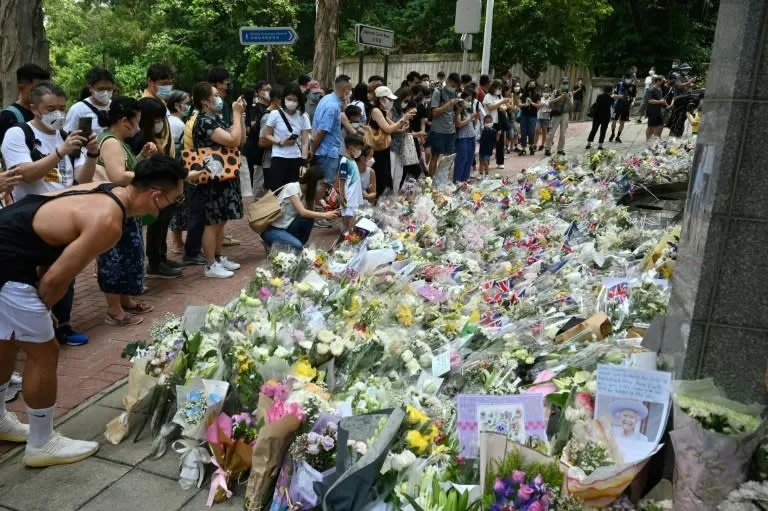
Overwhelming Turnout to Mourn Queen


Davidson's picture of the sea of flowers

In the days following the Queen's death last Thursday, people in Hong Kong have been flocking to the British Consulate in Admiralty to lay flowers. The last few days have had extremely long lines that stretch through nearby Hong Kong Park to Cotton Tree Drive with people wanting to sign the condolence book.

Despite the hot weather advisory, they have been waiting in line for about three hours each day, as the condolence book is available from 10am to 4pm until this Friday.

The British Consul-General Brian Davidson tweeted that over 2,500 condolence books have been filled and he posted pictures of thousands of bouquets placed on the ground by the consulate.

Pictures and notes were also placed at consulate
It's also interesting to note that convenor of the Executive Council Regina Ip Lau Suk-yee came to the consulate earlier today with two bodyguards(!) presumably to sign the book of condolence. Interesting considering she is a staunch pro-Beijing politician. 

Did she not get the memo that Beijing stated Hong Kong was never a British colony?

A few days earlier she posted this tweet:

"Queen Elizabeth II visited Hong Kong two times during her reign. She impressed me as a dutiful and caring monarch, who had weathered many storms but never shunned her responsibilities. She is a symbol of resilience and loyalty to her people and country, May her soul rest in peace."

In any event, local media are suggesting the long lines of people at the British consulate is an unofficial referendum of how people feel about what is happening to Hong Kong, that the onslaught of changes is too much to bear, and they are nostalgic about the past, pre-1997.

People lined up for hours in hot sun to pay respects
The Queen's death has given some Hongkongers the opportunity to openly show their appreciation to the British, though critics say the country didn't do enough to give local people full democracy. Others think then British prime minister Margaret Thatcher gave up Hong Kong too easily and shouldn't have handed it back at all.

Hongkongers have until September 19 to openly mourn the Queen and all things British; once it's over, the authorities will surely be back to punishing those publicly unfurling British flags or seen pining for the UK...


VIFF -- Review: Our Mr. Matsura

Matsura (right) with a local in Okanogan County Frank (Sakae) Matsura, was the son of a Samurai in Hirado, Japan, but by the time he was gro...