| The ground floor of Mercado do Bolhao in Porto |
![]() |
| The "lobster tail" before we tried it |
| Lots of colourful fruits for sale |
| The ground floor of Mercado do Bolhao in Porto |
![]() |
| The "lobster tail" before we tried it |
| Lots of colourful fruits for sale |
![]() |
| Carney explains why Canada walked away from the trade deal |
![]() |
| Winter melon soup with seafood on top |
![]() |
| A basic winter melon soup with mushrooms |
![]() |
| A carefully carved winter lemon |
| Plump and juicy spot prawns are here for a limited time |
Spot prawn season has begun in Vancouver and prices are wildly all over the place.
These prawns have white dots on their tails, while their carapace (the prawn head exoskeleton) have red and white stripes.
Every year around 2,450 metric tonnes of spot prawns are harvested, and about 65 percent are caught between Vancouver Island and the mainland.
Over 90 percent of the catch are exported to Asia, and we get the rest locally, for about a six-week period.Last week spot prawns were around $50 a pound at T&T Supermarket, which was quite the sticker shock, and it made us wonder how much restaurants would be charging.
So we were quite relieved to see the price cut almost in half when we went to T&T yesterday, at just under $26/lb. And many other people were buying spot prawns too.
We bought one and a half pounds of the prawns that were wrapped in butcher paper and then placed in a plastic bag. On the way home I could periodically hear their tails batting at the paper.
At home we placed them in a colander with a plate on top and put them in the refrigerator for a couple of hours.
The best way to retain their natural flavour is by poaching the prawns in boiling water seasoned with ginger and scallions to temper the fishy smell.
To prepare the spot prawns, using scissors we clipped off the long antennae, its legs and the bottom edge of the tails before cooking them in the boiling water.
After about a minute or so the prawns are cooked, their bodies curled up.
We also make a dipping sauce with soy sauce, a bit of sweetness (maple syrup or honey), oil and chopped scallions.
Remove the head and the rest of the shell, dip the prawn meat into the sauce and eat! The meat is firm and sweet!
![]() |
| The Mister Softee ice cream truck's jingle drew in customers |
![]() |
| Does this describe a Hongkonger in Vancouver? |
![]() |
| Seafood congee was delicious |
![]() |
| Tote bags with nostalgic designs |
![]() |
| Precisely presented scallop crudo with black apple and celery |
The other day we were invited to dinner at The Botanist, described as a modern Canadian restaurant located in the Fairmont Pacific Rim in downtown Vancouver.
I have eaten here a handful of times for lunch and really enjoy the atmosphere, as it's not stuffy, but not casual either, the food is always memorable, and service is friendly.
![]() |
| Earthy snails and mushrooms under the basil pasta |
Dan Oostenbrink and his wife own the farm and their sons help out on this family-run operation. They bought it in 2013, assuming they would need to use pesticides and fertilizers and for the first year they did that. But the following year they brought in a different consultant who advised they use less of their land in the beginning and grow organic produce.
At first Oostenbrink was skeptical, but recalls when his son harvested a perfectly round cauliflower with no imperfections, he was heartened and encouraged that it was possible. Since then they have expanded to use the 37 acres and use regenerative farming like composting and increased biodiversity to keep the soil fertile.
![]() |
| Steamed sablefish with squash compote |
So we were excited to try chef Hector's menu that featured lots of Local Harvest's produce.
A trio of amuse bouche began the meal: an oyster tartare of compressed vegetable roots and citrus topped with some caviar served in an edible oyster shell; chicken wingettes with mojo de ajo and smoked salmon roe; and side striped sope, or thick corn tortilla with vegan XO sauce, shellfish emulsion and salicornia, or sea asparagus.
These amuse bouche were beautifully presented and tasted delicious, but they were messy to pick up, and my fingers were coated in too much sauce.
![]() |
| Very tender wagyu with an onion tart |
The next dish moved from the water to the ground with the earthy tasting grilled Burgundy snails cooked together with foraged mushrooms, and pickled garlic scapes hidden under a sheet of basil-flavoured fresh pasta with madeira jus.
We went back into the water again with steamed sablefish provided by EatFish.ca. the fillet was finished with a red kuri and carnival squash compote, with epazote, a leafy herb, and salsa macha to give it a subtle spicy kick. This dish was artfully presented with an intricate leafy design made of squash.
![]() |
| Creative pear and squash verrine |
For dessert, an intriguing finish using kabocha squash to make a light cremeux, which is between a cream and a custard that was accompanied with Anjou pear compote, and intriguingly, candy cap mushroom ice cream!
The Botanist
1038 Canada Place
Vancouver, BC
V6C 0B9
+1 604 695 5300
| The mall at Gilmore Place is taking shape |
| Pan-fried scallop-flavoured chips, anyone? |
This afternoon we had to pick up some groceries at T&T Supermarket, so my relative wandered the snack aisles while I went to stock up on some food we ran out of.
She came back with this bag of Lay's potato chips -- in scallop flavour.
Actually it's pan-fried scallop flavour. So precise.
We came home and she promptly opened the bag for us to try.
Sniffing the contents inside was a sweet seafood kind of aroma.
The thin chip also had a seafood taste, a hint of shrimp crackers, not specifically scallops.
Would we specifically buy this one? No, but it was fun to try!
| Eating lots of seafood at Andy's Shin Hinomoto in Tokyo |
We ate pretty well in Tokyo, but probably not as good as most Japanphiles who specifically head to the Land of the Rising Sun for the marvellous food at cut-rate prices.
Last Thursday we arrived in the evening and by the time we checked into the hotel, it was almost 8pm. Before I went on my trip, my Japanese hairdresser suggested that I try the food at McDonald's because the items would be different than in Vancouver.
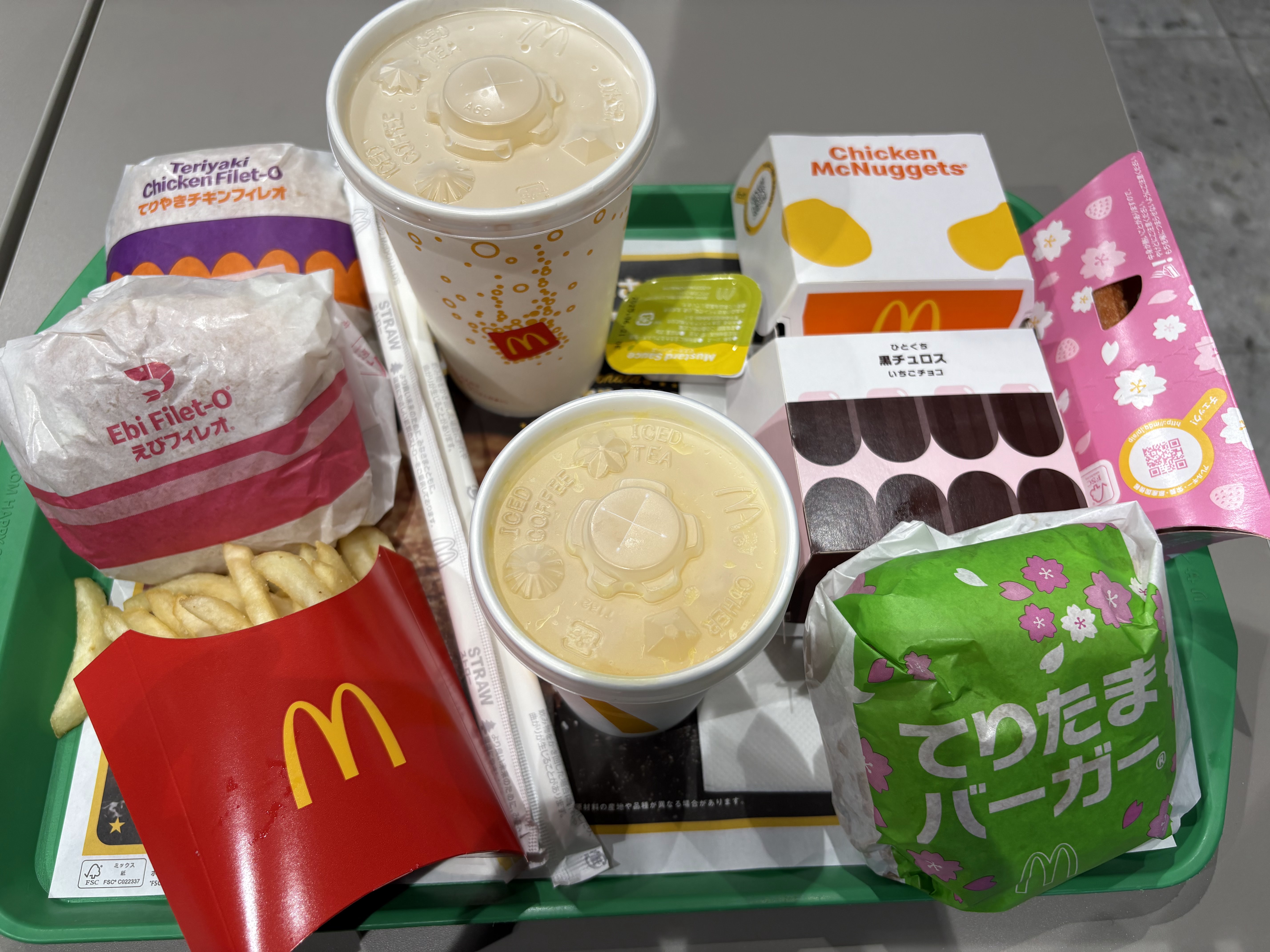
| McDonald's food in Japan is... different |
We tried an ebi filet-o or Filet-O-Shrimp, chicken teriyaki Filet-O, a grape soda, medium fries and two desserts, one that looked like mini churros with a strawberry filling, and strawberry daifuku pie in sakura pink packaging.
The Filet-O-Ebi substituted fish for shrimp with lettuce and mustard and it was not bad, tasting slightly sweet, while the chicken teriyaki burger was smothered in the dark sweet sauce to make the chicken patty palatable.
Meanwhile the Qoo white grape soda was far from natural juice, but still refreshing, though the fries seemed undercooked, but we ate them anyway.
Like other McDonald's meals, you wolf down the food, but then don't feel full. For dessert, the chocolate churros, called hitokuchi kuro churros were baked rather than deep-fried, and the strawberry filling was not jam, but artificially flavoured pink. The pie, available for a limited time, had a filling that was part mochi, part strawberry jam which was strange. Nevertheless it was the latter that made the pie taste extremely sweet. I finished off the fries to balance out the saccharine taste.
| Meaty king crab served cold |
The next evening we went to an izakaya called Andy's Shin Hinomoto in Yurakucho. It is located under a train overpass, so you can periodically hear trains going by. There are several eateries in each of these moon-shaped deep alcoves that are quite cozy.
Andy is Andy Lunt, an Englishman from Leicester, who in 1978 married the izakaya's owner's daughter and in 1986 came to Tokyo to help out with the business, and then taking over in 2010.
People can put their bags and umbrellas in little nooks or up above in fishing nets suspended from the ceiling. What a great idea to save space!
Our host had already ordered the king crab and it was boiled, but served cold, and the parts chopped up, but not cracked liked they would be in Chinese restaurants. Instead they were cut open with incisions here and there to help make it easier to extract the sweet meat aided by a skinny long metal tool.
| Large plump clams cooked in sake |
With beers, highballs and a plum drink, the total came to 26,000 yen for three. Again we walked off the meal by walking to the Imperial Palace, which had strategically placed strong headlights to prevent people from coming too close.
We walked to a place near the subway station that sells taiyaki, a fish-shaped pastry that has different fillings. We had the custard and red bean one. They were very hot out of the waffle iron, and a good way to keep warm as the temperatures began to drop.
| Tender cuts of beef for yakiniku |
We started off with thin slices of beef tongue that were delicious and then moved onto other cuts of beef that I was unfamiliar with, but everything was tender, despite not being marbled. Some cooked meats we wrapped in lettuce or shiso leaves, and grilled the odd slices of peppers.
Service was great, as after each round the staff came by to replace the metal wire rack over the charcoal. For dessert I had two scoops of soybean ice cream with a caramel sauce drizzled on top. This meal cost 2,000 yen less than the izakaya!
Our final dinner was at Savoy after our visit to Tokyo Skytree. The pizza place opens at 5.30pm and we didn't know we could make reservations so when we arrived there was luckily a short lineup ahead of us. The first group ahead of us was eight people including four young children; the parents couldn't decide if they wanted to order take away or eat in... Luckily we didn't wait too long, perhaps half an hour or so and we were the next batch of people to go in.
The best seats in the house were near the entrance where the pizza oven was located, with a roaring fire, but we were led to the back kitchen where salads were prepared and dishes were washed. It was kind of strange to have a open view of the back of house, but perhaps they felt they could take advantage of hungry diners eager for any kind of view.
| A watery Margherita pizza at Savoy |
We also had some meatballs covered in tomato sauce and some sprinkled melted parmesan cheese that were very tender and total comfort food.
Not long after we finished the meatballs the Margherita pizza arrived. It looked great, with the slightly burnt crust. But when I pulled a slice away to eat, I could see the tomato sauce was quite watery, which dulled the taste of the pizza. I still liked the crust which was airy and held up to the watery filling.
| Excellent blue fin tuna pizza |
Finally (and giving us a bit of time to digest), the Blue fin tuna pizza came with a side of wasabi and we were not disappointed! This was definitely a memorable pie. Since there's only a few slices of tuna, they were all bunched up in the middle and seared from being in the pizza oven; some bits were still a bit raw.
The combination of the slight sashimi taste of the tuna combined with cheese was so smooth and sweet, and the roughly chopped spring onions added a bit of crunchy texture. We did not need the wasabi to liven things up. It was already so good.
For dessert we didn't only have one but two tiramisus, very light, almost fluffy light and a hint of the espresso-soaked ladyfingers underneath. We walked out feeling sated and happy to make it to this place. Our total eating time: 45 minutes.
![]() |
| When will Hong Kong finally lift Japanese seafood bans? |
Since August 2023, Hong Kong and China have imposed restrictions on Japanese seafood after Tokyo decided to start releasing 1.34 million tonnes of treated waste water that was used to cool down the Fukushima nuclear power plant that was damaged in a 2011 earthquake and subsequent tsunami.
While China has a blanket ban, Hong Kong does not allow seafood from Tokyo, and the prefectures of Fukushima, Chiba, Tochigi, Ibaraki, Gunma, Miyagi, Niigata, Nagano and Saitama.
![]() |
| Daily testing has not found any abnormalities |
But despite testing seafood daily, the Hong Kong authorities have not found any abnormalities in the concentration of hazardous elements, such as tritium, caesium-137 and strontium-90.
The seafood bans and the weak yen prompted lots of sushi fans to fly from Hong Kong to Japan to eat their favourite fish -- even in the above mentioned places that were banned.
It also caused several Japanese restaurants in Hong Kong to shut down, unable to import authentic ingredients vital to their business.
Simon Wong Ka-wo, president of the Hong Kong Federation of Restaurants and Related Trades, said a review of the ban was long overdue.
"People travel to Japan to eat seafood there. That makes a mockery of the import ban," he said.
![]() |
| Hongkongers have gone to Japan to eat seafood |
But government food safety adviser Dr Vicki Fong Lai-ying remained cautious.
"It is fine to keep strict monitoring of safety for better protection of public health," she said.
"There is a high risk that the contaminated and polluted water could be passed to the ocean, which may in turn affect the food chain."
Lawmaker Steven Ho Chun-yin, who is deputy chairman of the Legislative Council's food safety and environmental hygiene panel, agreed, saying the government should not relax the ban until "there is reasonably sufficient reliable information made available that the seafood there is safe to consume".
How much more data is needed? Surely by now -- 14 years later -- there would be evidence of radiation affecting seafood by now. And besides, Japan's own Food Safety Commission has even more stringent radiation standards than Hong Kong.
What gives?
![]() |
| Chinese consumers can start eating Japanese seafood soon |
![]() |
| China banned all Japanese seafood in Aug 2023 |
![]() |
| Hong Kong banned some seafood |
![]() |
| Seafood paella was the highlight of the dinner at La Marcha |
| Cauliflower (left) and mushroom croquettes |
| White bean stew, pork belly, chorizo, creme fraiche |
![]() |
| Chocolate cake, blackberry sorbet |
![]() |
| ICAC has charged five food inspectors for theft of food samples |
| Showing off some cool knife skills |
We ate all our meals on the Ruby Princess this past week and I can attest as a cruiser that the novelty fades quickly; the breakfast buffet looks pretty much the same everyday, and in the fine dining restaurant, ingredients are used in different ways. It's best to eat something fresh on the menu -- and asking your waiter for tips on what's good that day.
Nevertheless we have to say running the food outlets on a cruise ship is no easy task. Executive chef Russell Clarke explained that half the staff are related to food and beverage, either cooks or waiters from some 50 different countries.
| Pastry chefs busy making cakes for the day |
On stage, Clarke quickly made three dishes for the audience of passengers: shrimp cocktail with mango salsa, lamb chops, and pavlova with berries and coulis.
However, we weren't invited to try the dishes -- the pavlova looked rock hard and dense -- but to go to the galley kitchens to take a look. Apparently this is a popular tour and some people raced to the kitchens! In the end there wasn't much to see, except lots of empty work spaces, stainless steel everywhere and only a handful of chefs working at 11am.
Perhaps the cooks were shy, or Clarke wanted the area cleared out, we could only look at a distance though some areas were decorated with creative carvings of vegetables and fruits. Some were constructed to look like mice and birds, but the flowers carved out of the side of a watermelon were most impressive.
![]() |
| A hearty slice of prime rib with potato, beans |
We were given a fact sheet on how much food is produced on the ship, and it involves ordering 110-115 tons of food delivered on a single cruise.
Three butchers clean and cut 1,700 fish into portions daily, while five butchers, three assistants and helpers prepare beef and poultry. On a cruise, 1,400lbs of poultry, 1,700lbs of beef, 1,400lbs of pork and pork products (like sausages); 300lbs of veal, and 200lbs of lamb are cooked daily.
While I had a large slice of prime rib that was pretty good on the last night, the lamb rack I had was overcooked. Interestingly the cream of whatever vegetable soup like cauliflower, or lentil, and the Alaska seafood soup were really good. These are made by 13 staff, preparing 550 gallons per day.
Some 1,600lbs of salad are served daily along with 400lbs of shrimp, 13 gallons of mayonnaise, and 1,500 sandwiches. The Caesar salad was consistently good and what I ate the most.
The bread served on board is made fresh daily by 10 bakers, including the bread rolls we ate everyday that had a light crunchy exterior and fluffy interior along with whipped butter. I did not try the pizza nor the croissants. The bakers use some 1,500lbs of flour daily! I saw some dough being proofed when we went through the kitchens.
| Breads are made daily on the ship |
Every morning I ate fruits -- honeydew, cantaloupe, watermelon and pineapple. Sometimes there was papaya. Towards the end of the trip there was more canned fruit like apricot, peach and pineapple. I ate those anyway, and once had canned figs. Around 6,000lbs of fresh fruit is served daily, while 400lbs of butter are used everyday!
For those who drink coffee, 470 gallons are consumed, 62 gallons of coffee cream, and 400lbs of sugar for the coffee.
After consuming all that food, someone has to clean the dishes. Fifty-seven people wash china, glasses, silver, and pots and pans. Everyday 70,000 dishes are washed, while 21,500 glasses are washed.
And that's just the passengers. There are also 1,1000 crew who need to eat too!
![]() |
| Roasted suckling pig was very tender with salad and fries |
![]() |
| Hearty octopus salad with onions and coriander |
![]() |
| Bacalhau had more potato than cod fish in them |
![]() |
| Long awaited grilled sardines arrived warm |
![]() |
| Serradura cream cake wasn't too sweet |
![]() |
| Many restaurants were quiet in Hong Kong this long weekend |
![]() |
| Cheap food in Shenzhen, though quality not high |
Matsura (right) with a local in Okanogan County Frank (Sakae) Matsura, was the son of a Samurai in Hirado, Japan, but by the time he was gro...