Showing posts with label book. Show all posts

Wednesday, October 21, 2026

Review: I Deliver Parcels in Beijing


Hu's first-person account as a courier

I lived in Beijing just before the appearance of smartphones, WeChat and T-Mall, which resulted in the explosion of Chinese people buying clothes and food online and having them delivered to their homes and offices.

Practically overnight people's lives changed -- there was no need to go to the store or restaurant in person, someone did this for you, saving lots of time and effort.

But for those people providing that service, the delivery workers, it was and still is hard work.

We never knew what that experience was like, until Hu Anyan, a budding writer, published his first-hand accounts during the Covid lockdowns.

He worked a string of several low-paying jobs
His descriptions of what it was like to work for delivery companies as well as a string of other lowly jobs were compiled into a book, called I Deliver Parcels in Beijing in 2023 which became a hit and sold 2 million copies, and then was translated into English by Jack Hargreaves.

Hu is not a particularly ambitious person, but likes to do his job well, whatever it may be. He writes mostly about what it's like to be a delivery driver on a trike, and earning less than 2 yuan per package is hard to fathom, considering he had to pick up the parcels from a central warehouse, go to the addresses, go up elevators or stairs to deliver the packages or contact the people to collect them.

That's a lot of work. 

And if the items in the package are damaged or spoiled, he has to compensate out of his own pocket. These drivers also have the stress of people complaining their packages haven't arrived, as well as worrying about getting into an accident on the road.

Readers can't help but sympathise for Hu, and then there is the additional issue of having to deal with his colleagues and managers, many of whom are not collegial or professional, which he recounts in various incidents.

We first meet Hu working in a logistics depot sorting items, re-packing them, and then putting address labels on them. He thinks he can earn more money by working the night shift, but it's physically demanding and also difficult for the body to adjust. 

Delivering parcels is a tedious task for low wages
He describes not only what it's like on the job, but also what he does after work. When he is off work in the early mornings, his mind is still buzzing from working that it takes a few hours to calm down and sleep; he resorts to wandering grocery stores to tired out his body, even though it's already exhausted.

Later in the book he describes working at a convenience store, a bicycle shop, magazine and comic book publishers, and even trying to start his own business selling knock-off trendy clothes and a snack shop.

Hu also works in different cities, from Beijing, Shanghai, and Guangzhou, to Foshan, Nanning, Dali, and Xiaguan, and even flies to Hanoi, Vietnam to see if he can be an entrepreneur there.

All these jobs with meagre salaries in different cities shows Hu's attempts to try to keep his living costs low, but then salaries are lower in the smaller municipalities; it's a no-win situation when working in a gig economy. 

He also bounces from job to job every six months or a year, probably because he realises he won't be making much more money, or feels he should be doing something else.

Interestingly he says his parents don't push him to work harder or get better jobs, and he does move back with them for a few years. The jobs have also taken a toll on Hu's mental health, making him lose interest in interacting with people, isolating himself. 

It seems that writing has helped him understand his experiences better and how they have shaped him as a person.

There are millions of people doing these jobs for very little pay in China. Is it any wonder they don't make enough money to buy an apartment, let alone save enough to have any safety net? It's a side of China that is rarely talked about, but exists, according to Hu.


Saturday, July 4, 2026

Bookseller Lam Wing-kee Dead at 70

Lam was the owner of Causeway Bay Books 

Lam Wing-kee, the Hong Kong bookseller who was in the news for being abducted and detained on the Chinese mainland in 2015, has died at the age of 70 following a years-long battle with cancer in Taipei.

Before then it was an open secret that books critical of Chinese leaders were sold in Hong Kong, and those curious to learn more would head to Causeway Bay Books, as these kinds of publications were banned on the mainland.

His press conference in 2016 attracted attention
However, on October 24, 2015, he and four others related to the bookstore had disappeared, and it wasn't until February 4, 2016 that the provincial authorities in Guangdong confirmed Lam was in their custody, along with two others.

Eight months after he was detained, Lam was allowed to return to Hong Kong to fetch more information on the customers of the bookstore, but instead of returning to the mainland as instructed by the authorities, he held an unprecedented press conference with legislator Albert Ho Chun-yan.

Lam claimed he was abducted by mainland officials at the Hong Kong-China border in Shenzhen in October 2015, and that he was blindfolded and handcuffed, and transported to Ningbo. He recounted being held in solitary confinement, interrogated and accused of illegally sending banned books to the mainland, that his confession on mainland TV was scripted, and the Hong Kong government didn't help him at all.

That press conference really made Hongkongers worried about their safety -- they were used to rule of law, knowing their rights, having access to a lawyer and an unbiased judge. But what happened to Lam could happen to anyone. And then what? What legal protections did they have if the Hong Kong government didn't assist them?

It seemed their greatest fears about China were actually happening.

Lam moved to Taiwan in 2019
In April 2019 Lam was in the news again for relocating to Taiwan, following the proposal of the extradition bill in Hong Kong. Opposition to that bill later morphed into the biggest protest marches for months in the city's history that were later quelled by the end of the year.

Lam started his life again in Taipei, crowdfunding to open his bookstore, Causeway Bay Books in 2020. When he opened it, Taiwan president Tsai Ing-wen sent flowers and a congratulatory note. She later came in person.

Two years later, Lam revealed he had stage one lung cancer, and was receiving chemotherapy treatment. But by last July, he told the media that his cancer had already progressed to stage four, with some cancer cells close to his heart.

He slowly wound up his business and it was suspended last month.

Many will remember his courageousness in revealing what happened to him as a warning to others.

In a BBC interview last year, Lam said: "Everyone has their own values. You can't go against your values, nor can you betray others.

"If you believe something is right, you should continue to stick to it. It's not like you're harming anyone. If everyone could do that, this would of course be a better place."


Monday, March 2, 2026

Review: Nomadland


McDormand stars as Fern, learning how to be a nomad

In 2017 journalist Jessica Bruder published Nomadland: Surviving America in the Twenty-First Century, a non-fiction book that followed retirees who lived in vans and traveled around the country to find work after the global financial crisis. 

Actor Frances McDormand read it, bought the rights to option the book for a movie, and persuaded Chloe Zhao to write and direct it. They took the book and included some of the actual nomads in there, such as Linda May and Bob Wells, who runs workshops on how to live independently in their vans.

Originally McDormand was thinking of teaching these nomads how to act, but instead she and fellow actor David Strathairn embedded themselves with them, which makes Nomadland a kind of docu-drama. And it won Best Picture, Best Director and Best Actress in the 93rd Academy Awards in 2021.

Many scenes show the vastness of the country
McDormand throws herself completely in the role of Fern (not based on someone in Bruder's book), a widow who used to live in Empire, Nevada, where she and her husband worked in a mining company. But it went bankrupt and Empire lost its postal code; people had to leave and go elsewhere.

She packs up some stuff and lives in her her van, and meets people like Linda who give her pointers how to be a nomad, with tips on on working at Amazon, how to manage an RV park, and later processing food or making fast food. It gives viewers an insight into what it's like to work in these low-paying jobs, some of them seasonal, and how tight money is.

The audience also gets tips on how to live in a van, including having a bucket to go to the bathroom...

When fellow transient people meet, they are all friendly and happy to share, there is hardly any competition; one gets the sense there is good energy there.

Fern drifts from job to job, and one wonders how this will end, but that's the point -- these people need to survive financially and these gigs are the only things they can get, and drive to the next one, wherever it may be.

The nomad community is kind and helpful
However, another interesting characteristic about Fern is that she is fiercely independent. She is given several opportunities to live in a house and have some security, even from her own sister, and a fellow transient guy who likes her, but Fern refuses; she would rather wander on her own and not feel obliged to others.

The cinematography of Nomadland shows the winding long roads, the vastness of the outdoor space, and how humans are so small in the country. 

Zhao is sympathetic to these nomads and it's fascinating seeing her tell their story by letting them be their authentic selves. After watching Nomadland, one wonders if they could live like these nomads, but perhaps it's not something you think about until circumstances forces you into that situation. 

It also reminds you to be kind to others, as they might literally be surviving day by day and just need a break. While it's the life they have chosen, they are just trying to live life on their own terms, which makes them happy.

Nomadland (2020)

Written and directed by Chloe Zhao

108 minutes


Saturday, January 31, 2026

Review: Grit by Angela Duckworth

Want some inspiration? Read for some grit tips

What makes someone succeed? University of Pennsylvania Psychology professor Angela Duckworth believes it's a combination of discipline, passion and grit.

In 2016 she wrote the book Grit: The Power of Passion and Perseverance with lots of interesting stories backed up with research, her own and many other psychologists past and present. You could say Duckworth is passionate about the subject and determined to know everything there is to know about grit.

Some of the stories on people like Jeff Bezos when he was a child, or Warren Buffet's tips on career goals, Seahawks coach Pete Carroll in 2013, and actor Will Smith insisting he will be No. 1, one way or another, who said this in 2003:

Duckworth has numerous examples of grit
"The only thing that I see that is distinctly different about me is: I'm not afraid to die on a treadmill. I will not be outworked, period. You might have more talent than me. You might be smarter than me, you might be sexier than me. You might be all of those things. You got it on me in nine categories. But if we get on the treadmill together, there's two simple things: You're getting off first, or I'm going to die. It's really that simple."

He said this long before he smacked Chris Rock on stage during the Academy Awards in 2022. This kind of dates Duckworth's book (and same with how Bezos has turned out), but their stories still show how they became successful.

In Grit, Duckworth says just because someone has talent or genius doesn't mean they have grit , compared to someone who is determined and practices relentlessly. When you have talent and add effort, you get skill. And with skill added with more effort leads to achievement.

But what about flow, the state in which athletes and artists do their sport or art effortlessly? A competitive figure skater described it like this:

"It was just one of those programs that clicked. I mean everything went right, everything felt good... it's just such a rush, like you could feel it could go on and on and on, like you don't want it to stop because it's going so well. It's almost as though you don't have to think, everything goes automatically without thinking..."

It is a state that does not have anything to do with improvement, Duckworth says. "In other words, deliberate practice is for preparation, and flow is for performance."

What is deliberate practice? She says it is a clearly defined stretch goal; full concentration and effort; immediate and informative feedback; and repetition with reflection and refinement.

In order to do that it doesn't necessarily mean endless hours of doing something over and over again, but intentional, deliberate practice with the goal of improving, which entails making it a habit, a ritual that is done daily.

With these kinds of ideas and research, readers wonder what they can do to get grit, and Duckworth addresses this in the last few chapters of the book, particularly how parents can instil grit in their children through discipline, but not the Asian Tiger Mom way, but teaching them to finish what they started and to do it well.

It also has to do with passion, because without it, why bother? Duckworth says if a child wants to quit a sport or a musical instrument or dance, they can't stop on a whim, or when they have a bad day; they should only do that when there is a natural end, like the season or school year is over. 

She also stresses that it's important to be a role model for your children, so they see that you struggle and that you are determined to finish a challenge like a marathon, or complete writing a book.

As writer Alex Martinez says: "To finish things, you have to put the work in. When I was younger, I'd meet many people who were writing stuff. They'd say to me, 'Oh yeah, I am a writer as well, but I've never finished anything.' Well, in that case, you are not a writer. You are just somebody who sits down and writes things on a bit of paper. If you've got something to say, go ahead and say it and finish it."

But one doesn't have to be a parent to try to instil grit in children -- they can be extended family, friends and teachers who encourage kids by giving them opportunities and knowing how to push them, by saying things like, "I'm giving you these comments because I have very high expectations and I know that you can reach them", instead of "I'm giving you these comments so that you'll have feedback on your paper."

The child or student realises that someone believes in them and wants to see them do well which can inspire them to do better next time. That's what Duckworth's research shows.

When it comes to work, company culture that promotes grit will also develop employees who want to work hard. Not the Chinese "996" way, where one works from 9am to 9pm, six days a week, but what Jamie Dimon, CEO of JP Morgan Chase says in the company manual, How We do Business: 

"Have a fierce resolve in everything you do." "Demonstrate determination, resiliency, and tenacity." "Do not let temporary setbacks become permanent excuses." and "Use mistakes and problems as opportunities to get better -- not reasons to quit."

And finally, don't just finish something, but finish strong, putting in as much effort as you did in the beginning and at the end. 

Duckworth says one can grow their grit and the time to start is now.


Tuesday, October 28, 2025

Review: Never by Rick Astley


His book is conversational, easy to read

Eighties pop songs are back on the airwaves thanks to young people who are discovering them for the first time. For me they bring back memories of my senior high school years. Classmates were totally into Michael Jackson, Duran Duran, A-ha, Depeche Mode, and Rick Astley.

He was a clean-cut guy who gave off the boy-next-door vibes, wearing a suit and singing Never Gonna Give You Up, and Together Forever, songs that had catchy, optimistic tunes that were sweet and endearing. 

The British singer became so big so fast, but also disappeared just as quickly.

Never Gonna Give You Up was a huge hit in 1987
What happened to him?

Turns out at the age of 27 he quit the music business and lived quietly with his wife and daughter.

But then in around 2006 Rickrolling became a thing -- people would prank others by sending a link on email that when they clicked on it was to Astley's music video for Never Gonna Give You Up, giving him a second lease on his music career.

He writes about all this and more in his conversationally-written autobiography Never that was published last year. I hear his interview on CBC Radio and thought I should read it.

Originally from Lancashire, Astley was born into a rough childhood; before he was born, one of his older brothers died at the age of five from meningitis. The child's death caused his parents' marriage to fall apart, his mother became distant and detached, his father's bipolar behaviour was stressful for Astley and his three siblings.

Astley had a strong interest in music, starting with the drums, but it was his voice that caught the attention of a music producer who signed him on to Stock Aitken Waterman, which became known as the "Hit Factory".

Astley with his wife Lene
In Astley's book Never he talks about how Never Gonna Give You Up came about and how it became so big so fast, and how he handled his sudden fame. The book also explains what the music industry was like at the time, what it was like touring around the world (lots of jetlag) and meeting the love of his life, his wife Lene who was in the music business but later pivoted to film.

It's not until halfway through the book where his career takes off where he describes some hilarious scenes where I actually laughed out loud. As a reader and sometime fan, it was endearing to read him recall what life was like at the time for him, and he constantly says in the autobiography he did not want to be perceived as a "twat". 

That part gets a bit nauseating, but he wants to remind readers that stardom did not go to his head -- he didn't want it to and was keen to live as normal a life as possible after such a chaotic childhood. 

In the second wind of his career in his 50s, Astley writes about how relaxed he was, and enjoyed performing for fun; readers can't help but feel happy for him to finally be comfortable in his skin. That's what growing up is all about.


Sunday, October 5, 2025

Review: Atomic Habits Can Lead to Real Change


This book has clear, incremental ways to change your habits

If you've got some goals and wondering how to achieve them, James Clear has the answer for you -- Atomic Habits, incremental changes to your daily habits that must might help you succeed.

Clear grabs your attention right away by describing a horrific freak accident in high school that almost left him for dead. He had had dreams of becoming a baseball player, but this accident was a massive setback not only physically but academically too.

However, with good habits, from cleaning his room everyday to studying not only got him back on track to be named a top athlete in college, but also win academic honours too.

Clear gives examples of changing his life
He's living proof that small habits can lead to big changes, hence he calls them "atomic habits".

Clear tells another great story about the British cycling team and how they were not very good. But a new coach tried to make incremental improvements of 1 percent here and there, from the bikes to the uniforms to how they were training and strategy that led to British cyclists winning the Tour de France.

Basically Clear explains we have good habits and bad habits, so try to change your bad habits into good ones.

That means trying to make good habits easier to do, and bad ones harder. He gives the example of watching television. If you want to watch less, you can only turn it on if you can name the show you want to watch. Or unplug it so you have to plug it in. Or lock it in a cabinet, or place out of sight so you have to move it to be able to watch it. 

Another interesting point he makes is we make goals such as wanting to lose weight. How do you do that? Clear says we should try to be the person we want to be. If we want to lose weight we should start to think about how a healthy person thinks. Does a healthy person eat chocolate? Maybe you should put in extra steps instead, or eat an apple.

To build more good habits, stack them with ones you already have. For example, once you wake up in the morning, make your bed and then take a shower. Other possible good habits to add on are, if you see a set of stairs, climb them instead of taking the elevator, or if you want to buy something over $100, wait 24 hours before buying it.

In order to increase the chances of changing or improving your habits is to change your environment so that you will have a higher chance of doing them. He says if you want to draw more, put pencils, pens and paper on your desk, or to exercise more, have your workout clothes set out to change into, and to eat healthier, chop up vegetables and fruits and put them in containers so you won't turn to junk food.

Starting something may seem daunting to people, and Clear suggests the two-minute rule or at least opening a book and reading a page or working out for five minutes; in this way you have shown up which is a big part of starting good habits.

He also writes about a young man who became very successful in sales very quickly. How did he do that? He had two jars on his desk, one filled with 120 paper clips. Each time he finished a sales call, he would put one paper clip in the empty jar and so on until all 120 paper clips were in the second jar. It was a physical reminder of how much he had accomplished in one day. That's why things like journals can help people keep track of what they have eaten or done.

Atomic Habits is very easy to read with clear relatable examples that make you think there are some small ways you can improve yourself in all aspects of your life.

I borrowed the book from the library, but had to wait a while as there were over 90 people ahead of me wanting to read Atomic Habits too!


Sunday, September 21, 2025

Canadians Keeping Their Elbows Up


Canadians are showing their true colours this year

Ever since Donald Trump tossed out the possibility of Canada becoming the 51st state, Canadians have fought back with their "Elbows Up" mentality and there's now a lot of data proving that.

Travel is the biggest sign in Canada shunning the United States. When it comes to Canadians traveling across the border by car, there is a whopping 34 percent drop in August compared to the same month last year. That's the eighth consecutive month of declines apart from the Covid-19 pandemic period.

Many are upset by Trump's calls for the 51st state
There is also a lot fewer Canadians traveling by air to the US too. In August, the number of Canadians returning from the US by plane fell 25.4 percent compared to the same month last year too.

Canadians used to love traveling to Las Vegas for entertainment, gambling, and food, but not so much anymore.

Flair Airlines saw the biggest plunge of 62 percent of Canadian passengers, while Air Canada's was 33 percent, and WestJet 31 percent. As a result the airlines have shuffled their planes and are using smaller ones going to Vegas these days.

Instead Canadians are traveling to Europe, the Caribbean, South America, and Japan. This year Air Canada added 28 international routes to satisfy demand.

Meanwhile when it comes to books written by Canadian authors, Indigo reports a 25 percent jump in sales compared to last year, and the CBC has seen a 34 percent increase in people checking out Gem, its streaming platform.

Even Historica, which promotes Canadian history through programs like Heritage Minutes has seen a noticeable uptick in the number of people checking out the Canadian Encyclopedia with more than 14 million views this year.

It's great to see how Canadians are determined to do as much as they can to keep their elbows up!

Wednesday, September 17, 2025

Tasting Chinese (and Hakka) Food Around the World


Kwan traveled the world seeking out Chinese restaurants 

This evening I went to a talk called "Food and the Chinese Diaspora" at the Vancouver Public Library, featuring two guests: Cheuk Kwan, who is a Hong Kong-born, Canadian filmmaker who in 2005 did a 15-part series, going around the world documenting Chinese restaurants, and Linda Lau Anusasananan, who wrote The Hakka Cookbook: Chinese Soul Food from Around the World.

Kwan and Anusasananan were moderated by author Kevin Chong, who wanted to keep the discussion more contemporary by mentioning Uncle Roger several times, which might have been a generation or culture gap for many in the audience!

What's interesting about Kwan is that he seems to have two separate lives: the documentarian and author of Have You Eaten Yet? And also a passionate political activist with the Toronto Association for Democracy in China.

Kwan, Anusananan and Chong in discussion
A summary of Kwan's documentary was shown, with scenes of him traveling to far-flung places like Peru, India, Madagascar, Israel, and Brazil, and meeting the Chinese people there, and seeing what they eat.

When Chong asked him which place impressed him the most, Kwan immediately said Madagascar. He discovered a lot of Malagasy-Chinese immigrated to Montreal, so there is a big community there, and in Madagascar, even an eighth-generation Chinese-Malagasy child could write better Chinese than him! 

In the video they proudly say that soupe Chinoise is the national dish. What is it? Wonton soup. "They have it for breakfast, lunch and dinner, so it really is a national dish," explains Kwan.

Meanwhile Anusasananan explained what Hakka food is -- it has bolder, richer flavours than Cantonese cuisine, though they do borrow from each other, and uses a lot of preserved and pickled vegetables, and salted fish. Some well-known Hakka dishes are braised pork belly with preserved vegetables, stuffed tofu, and salt-baked chicken. 

She didn't know much about her Hakka heritage, and decided to learn more by going around the world and asking other Hakka how they cook their food, and compiled her cookbook.

When Anusasananan traveled to different places, they gave her different variations of dishes, or new ones, like one featuring tea leaves that are pounded with seeds and nuts and then mixed with water and poured over rice!

Anusananan talked about Hakka cuisine
In one of the final questions, Chong asked both what their final meal would be, and Kwan immediately replied he had been asked this many times. The answer? Steamed grouper with ginger and scallions. Anusausanan agreed.

An audience member asked Chong what his meal would be and he said his mom's oxtail soup. Anusananan agreed too which was funny.

There was discussion about how to elevate Chinese food from being one served in white boxes and for cheap, and how younger chefs did more "fusion", and was there concern that they were moving away from tradition. There were mentions of people I had interviewed, like Craig Wong of Patois who does Chinese-Jamaican cuisine, and Brandon Jew of Mister Jiu's in San Francisco, how they have elevated the cuisine.

But back at the beginning of the discussion, Kwan talked about authenticity. He said authentic was whatever your mother or grandmother made for you to eat. That to you is the original flavour. How to replicate it? Anusananan suggested making videos of your mother or father cooking and tasting them at each step so that you would have a better chance of replicating it. Good pro-tip!

Saturday, September 13, 2025

Post 9/11 The Highs and Lows of Giuliani


Giuliani's book back in 2002


One of the heroes following September 11, 2001 was then New York Mayor Rudy Giuliani, who gave a lot of media briefings, coordinated emergency response and comforted residents in shock, sadness, and anger. 

He quickly became known as "America's Mayor", and was named Time magazine's Person of the Year and his approval ratings shot up for his resoluteness.

"America's Mayor" comforted NY residents
"Tomorrow New York is going to be here. And we're going to rebuild, and we're going to be stronger than we were before... I want the people of New York to be an example to the rest of the country, and the rest of the world, that terrorism can't stop us," he said.

Giuliani struck while the iron was hot and penned Leadership that came out in October 2002, where he talked about his "broken windows" theory, detailed his memories of 9/11, what he did during that horrific period, and how he helped revitalise New York City's economy following the attacks. 

When the book came out, I was in Toronto at the time and even went to Indigo where Giuliani visited and had my copy of the book signed by him, who by then had left the mayoral office and set up his own consultancy.

Five years later in 2007 his book was reissued during his presidential campaign the following year, and added his perspectives on various issues the country was facing.

He became Trump's personal lawyer
But since then Giuliani has spectacularly fallen from such high respect to scraping the bottom of the barrel.

During his presidential campaign it came out he was having an extramarital affair, Giuliani's police commissioner was indicted for tax fraud, and eventually he had to drop out of the race having run out of money and scandals followed him.

He laid low for several years until Giuliani resurfaced clinging to Donald Trump's coat tails as he ran for the White House in 2016. He stumped for Trump and became his advisor and later personal lawyer. 

Perhaps most memorable was following Trump's loss in the 2020 election that he wrongfully claimed was stolen, Giuliani held a press conference not at the Four Seasons hotel, but at Four Seasons Total Landscaping that was mocked by the media and late night comedians for days afterwards.

Hair dye was not a good look for Giuliani
There was also another press conference in 202 where Giuliani's hair seemed to melt -- as hair dye dripped down his cheek. 

Then Giuliani was sued by two election workers, a mother and daughter in Georgia for defamation and he lost big time. The judge was so fed up with the former mayor, he ordered him to pay US$148 million in damages. Giuliani was forced to turnover his US$6 million apartment, US$3.5 million residence in Palm Beach, Florida, jewellery and a Mercedes-Benz.

So circling back to his book Leadership -- it's still available on Amazon for US$19, hardcover, US$12 for paperback.

But mine is a signed vintage copy! Any takers?


Friday, May 30, 2025

All About Love

What would you type on a Smith Corona typewriter?

I saw something poignant on social media today that ironically made me think about life before social media.

Literati Bookstore is an independent book shop in Ann Arbor, Michigan, that was founded in 2013 by a couple who are book lovers.

Literati Bookstore in Ann Arbor, MI
They posted a thought-provoking video with these words:

When we first opened Literati Bookstore, we put out a typewriter anyone could use, had a blank piece of paper, and that's it.

No internet, no social media, no delete key.

And I was curious -- when forced with a blank page, what would people type? 

Nonsense? Mean, biting comments? Vitriolic attacks?

But what happened over the past 12 years has been amazing, most of the time.

More often than any other topic, people write about love.

Love gained, love lost, love missed, love yearned for.

Love for parents, love for kids, love for someone else, love for lost love.

Love wanted, love needed.

Typing out some lovely advice
And I learned something when we are left alone with our thoughts and just a blank page, we take away social media and followers and comments and the cruel cough in this megaphone that is the internet.

When we have a quiet moment in a bookstore to simply leave something anonymous and permanent about anything we want.

More times than not, we write about love, and while there is so much wrong in this world, in the end, after pouring through tens of thousands of anonymous notes, I truly believe we are more alike than we think.

💕

Sunday, January 26, 2025

Year of the Snake Seems like a Tough Sell


It's a tough sell to get customers to buy flowers for CNY

Although Chinese New Year is only days away, in Hong Kong, vendors selling flowers and potted plants at the flower market in Victoria Park are reporting sluggish sales.

While there are a lot of people checking out the fair, which has 395 stalls this year, flower sellers like Lee Siu-ming, owner of Chun Shing Flowers Trading, which specialises in orchids, are reporting business is down by 30 percent.

"People aren't willing to spend," he said. "I am negotiating prices with them till my gums bleed, but some of them still aren't convinced."

There are 395 stalls at Victoria Park this year
Lee said the reasons were because of the slow local economy and people going to Shenzhen and other places in China to shop.

However, stalls selling snaked-themed products seemed to do well, like snakes on cushions and stuffed toys. 

One stall vendor observed that while many mainlanders came to the fair, they were more curious about what was available and hesitant to buy anything. 

"They're more interested in sightseeing and taking pictures," said Terrence Lo, who was selling books.

"The language barrier and concerns about customs regulations deter them from buying books."

In addition, local customers aren't buying as much either.

"The older generation who are often our most loyal customers, are becoming more selective," Lo said. "They're looking for bargains and are less likely to make impulsive purchases."

Sounds like the Year of the Snake is going to be a tough one, much like the Dragon before it...

Monday, October 28, 2024

The Need for Conversation in the Age of Rage

Off (centre) and Williams discussed their books on Friday


On Friday I went to a stimulating discussion at Granville Island as part of the Vancouver Writers Fest about the political and social divide, how disinformation is driving us as a society apart and how we can try to bridge the gap again. The answer? By talking to each other again.

Entitled "Listening in the age of rage", two authors, Carol Off and Ian Williams tackle this very timely topic in their books, At a Loss for Words: Conversation in an age of rage, and What I Mean to Say respectively. 

Off analyses six words
Off was the host of the CBC Radio current affairs show As It Happens and in her over 25,000 interviews, she began noticing, towards the end of her time there, that the people she interviewed, used words as weapons, something that wasn't so prevalent before. So she began examining six words: democracy, freedom, truth, woke, choice and taxes.

She gives the example of freedom and it was during the freedom convoy protests in January 2022 that the protesters kept using the word "freedom". Off says the protesters wanted freedom from society, freedom to do whatever they wanted, the freedom not to care for anyone else.

Meanwhile Williams is a Giller Prize-winning author and professor who has observed how there are two polar opposites, but most of us in the middle are too timid to speak for fear of being cancelled, but he says we need to listen to others and also stand our ground otherwise the middle will be lost and it will be even harder to find any kind of commonality.

He also talked about as a professor, he is expected to "care" more for his students than before. However, he is constrained by university protocols that he should care, but not get too involved, but at least show some empathy.

Off jumped in and said she guest lectured some students about her book and was annoyed that the students believe everyone is entitled to their own opinion and that these opinions are all valued. She said she lost it, and ranted then did that mean that Vladimir Putin's opinion that Ukraine should be annexed should be valued and talked about other dictators. She had a point. It was going too far.

Williams encourages active listening
In addition, she said these dictators do not appeal to rationality, but emotion. When all rationality is gone, all people have left is emotion, and used Donald Trump's silly statement that in Springfield, Ohio, the Haitian immigrants are eating cats and dogs. The media went there to check, and no, they were not eating people's pets, but it was Trump appealing to people's base emotions of feeling these immigrants were taking away jobs and invading the country.

This analysis helped the audience have a better understanding of how and why people think this way, but perhaps still not quite comprehend how people can even have this kind of bizarre thinking, but this is how dictators can control people, by appealing to their emotions not their rationality.

In the end Off and Williams encourage people to try to stop this by actively listening to the other side to try to understand where they come from and to question them about where they got their information from, to see how credible it is, or to show rationally that their argument has no basis.

An audience member asked about being part of the left, but there are disagreements within the left that he was not doing enough and pouring guilt on him. Williams suggested that he stop thinking this way, that he had done what he could do, or that he has other ways of promoting his point of view otherwise it gets too exhausting to defend yourself when you should be banding together to fight against the right.

The discussion was a lot to take in but it made people in the room realise we are all in this together and we each need to do our part to bridge the gap. So start listening and analysing what words really mean these days!

Sunday, May 26, 2024

The Library's Lovely Views

A gorgeous view of Vancouver from the library's rooftop

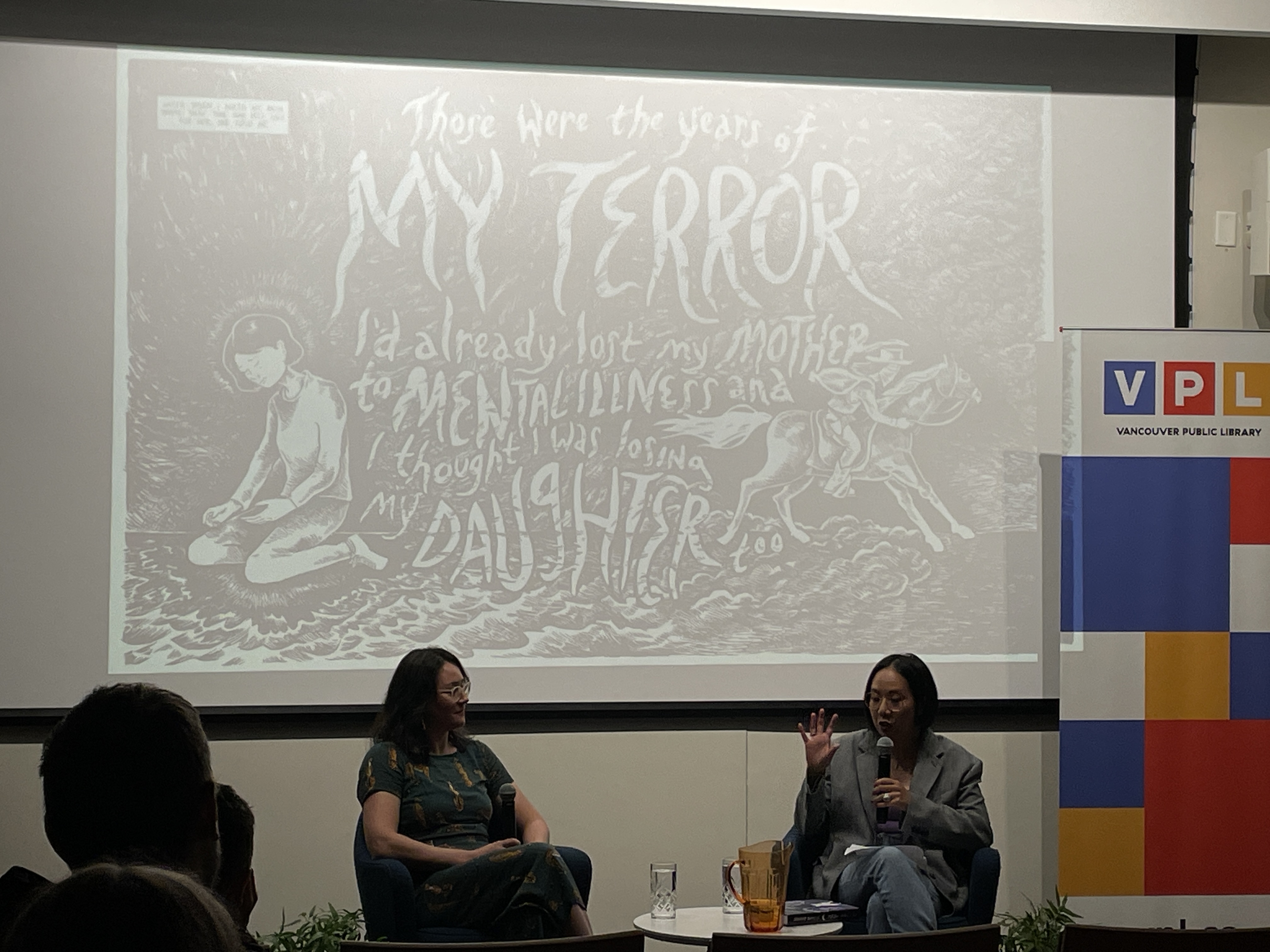
This afternoon my friend and I went to a book talk at the Vancouver Public Library's central branch downtown and the event was located on the 8th floor.

We were in a hurry so we took the elevator and rushed into the small auditorium and when we sat down it just started. Phew!

Hulls (left) chatting with Jen Sookfong Lee
The book talk was presented by the author and artist Tessa Hulls, who wrote and drew a graphic novel called Feeding Ghosts that talked about the intergenerational trauma that her grandmother, mother and herself experienced due to Chinese history, with themes of immigration, Chinese culture, and filial piety.

I first met her in 2016 when she was in Hong Kong to research the book with her mother, and wrote about what Hulls was doing. I continued to follow her and the book's progress on Instagram until finally last year after seven years of research, traveling to Hong Kong and China, learning Mandarin and lots and lots of drawing and writing, she completed the book.

When the book was released, I interviewed her again, in awe of what she had accomplished in weaving together modern Chinese history and how this impacted her family, as well as analysing her relationships with her grandmother, mother and herself.

It's an intense, honest and emotional book sprinkled with a few funny scenes. Hulls remarked at the talk that she felt that she had appeased her ghosts and is glad the book is done and doesn't wish to look at it again.

Lovely open space to read and think
After the talk was over and we had our books signed and pictures taken, we wandered outside and saw there was another floor of the library -- with a small outdoor rooftop area!

Called the Phillips, Hager and North Garden, it's a nice quiet outdoor area with trees and shrubs planted. Looking south you can admire the view of BC Place and lots of condo buildings!

Reading the VPL website, people are allowed to bring food and drink on the rooftop, and no smoking allowed. Also, it cautions visitors not to take pictures of others unless given permission. Fair enough.

The other day the rooftop area was closed when they found a family of ducks there and staff waited for wildlife conservationists to come and collect them and relocate them elsewhere before allowing humans to use the rooftop again.

What a beautiful space along with the 8th and 9th floors! A nice place to escape to when near the library.

Vancouver Public Library (central branch)

350 West Georgia Street

Vancouver


Friday, March 29, 2024

First Impressions of Hong Kong Two Years Later


Nice to be back walking along the promenade again


Woke up at 4am this morning with jet lag and couldn't get back to sleep until around 6am for another two hours. It took me a while to get organised but I finally got out the door and on a whim took the tram going west from Sai Wan Ho.

The streets were much quieter because it was Good Friday, and many people have left for the long weekend. By the time the tram reached Causeway Bay it was 11.15am and I realised Din Tai Fung was there. Vancouver is set to have one towards the end of this year, so I decided to have my dumpling fix.

Xiaolongbao looks a bit smaller at Din Tai Fung
When I got there the shutter was still down, but staff were busy in the kitchen wrapping dumplings. The restaurant actually opened before 11.30am and there were only a handful of us waiting to get the first seats.

As I perused the menu I was shocked that the prices had gone up, and not only that when the food arrived, the dumplings and other dishes looked smaller. Shrinkflation, folks. The food was still good, but for one person it cost HK$230 for pork dumplings, vegetarian dumplings and an appetiser of seaweed and beansprouts with a generous drizzle of sesame oil.

Nearby was Sogo and even though it was lunchtime it was not packed with shoppers despite encouraging its members to collect five times the points on certain products. I managed to score 20 percent off on swimming caps because I bought two.

The next stop was to see Bakehouse, a popular bakery that had opened there after I left. It was completely packed with a queue of people waiting patiently to snap up sourdough egg tarts, pastries, cookies and coffee. Amazing.

Bakehouse doing a bustling business
I then headed to Sheung Wan to buy ferry tickets to Macau in a few days. There were massive lines at TurboJet (the red ferry), while the one for Cotai (blue) was not too bad. Service was brisk with three people servicing counters for tickets to Macau as well as China. 

There weren't as many mainlanders in the city, though today is Friday. My friend and I saw a group of young people wearing the same cap with a small Winnie the Pooh stuffie on it! How ironic.

She took me to a bookshop called Mount Zero in Tai Ping Shan that will be closing at the end of the month. It has been accused by the authorities for several minor violations, including illegally occupying a space outside the shop. It's a tiny place and there were lots of people standing in front or trying to get inside to take a look. 

After that we made our trek east, walking through Central, then Admiralty towards Tamar where there were a lot of people waiting to look at... glowing eggs. It's an exhibition put on by Team Lab from Japan. There are giant eggs that you can touch and apparently make sounds and these things go all the way down the grass at Tamar into the water too. We had to fight the crowds to get to the waterfront.

Mount Zero bookstore closing soon
Almost two hours later we made it to Fortress Hill and enjoyed a Japanese meal that included grilled fugu or puffer fish, and yakitori skewers of beef, chicken, mushrooms, scallops, shishito peppers, and sweet potato, and boiled edamame washed down with sake.

Hopefully that long walk will keep jet lag at bay!

Sunday, March 3, 2024

Review: Oscar-Nominated Documentary Shorts


Chang and Yi are movie stars in Nai Nai and Wai po

With the Academy Awards ceremony just over a week away, some movie theatres are taking advantage of the time now to promote films that have been nominated. Today I had the chance to watch all of the nominees back-to-back in the Documentary Short category at VIFF.

The first one, Nai Nai and Wai Po or "Grandma and Grandma" is a loving tribute by their grandson Sean Wang. Nai Nai is paternal grandmother(Yi Yanfuei) , and Wai Po is maternal grandmother (Chang Lihua), and they live together somewhere in California.

Luckily these two elderly women get along so well they are like sisters and are roommates, even sleeping in the same bed. Soon after the film opens, one complains the other's fart smells so bad.

They dance, eat, arm wrestle, brush their teeth and do the laundry. But they admit it's more fun when their grandson is around.

But there are poignant moments, when Yi goes through her phone book and photo albums and reminisces about the fun times with her friends, many of whom have passed away. She also talks about how life was tough during the war, and how they didn't have much to eat. 

Chang seems more happy-go-lucky, but both have decided to enjoy life as much as they can without regrets. 

While the film is a bit amateurish in quality, director Wang is keen to capture the enthusiasm of his grandmas, their unique friendship and show his appreciation for them.

Arlo Washington helps his community
Next up is The Barber of Little Rock, and it follows Arlo Washington, who lives in Little Rock, Arkansas. He see the city divided into the wealthy and the poor, and the latter are mostly African Americans. They are shut out when it comes to getting access to loans.

He wants to change this. As a barber he makes good money, and starts training young people to be barbers too. One day one of his customers needed US$150. Arlo gave it to him and wasn't expecting the loan to be repaid, but a few weeks later the customer returned along with the money. So Arlo loaned him more.

Eventually he set up People Trust, a nonprofit community bank where he and his team lend out US$1,000 to US$5,000 to people who just need a break, or want to open a business, or need a few hundred dollars to pay the rent and get back on their feet.

Arlo himself lived against the odds -- his mother was pregnant with him as a teenager, but she managed to get a degree and wanted to help the community. But she died of cancer, leaving him to look after his two younger sisters. Nevertheless, he persevered and he was inspired to continue his mother's work.

Reflective doc about Taiwan and China
The third film is Island In Between by S. Leo Chiang. The island in the title is Kinmen, a stone's throw away from Xiamen, China. Kinmen was seen as a military buffer for Taiwan. As a child Chiang sang songs about how bad the Communists were, but later on, after he immigrated to the United States, he visited China and was entranced by the energy and progress of the country, that it was not evil.

However, he notes the quelling of the Hong Kong protests in 2019 and the Covid-19 pandemic resulted in the closure of the ferry between Kinmen and China, and Chiang says he probably won't be going back to China again.

The film talks about how Kinmen's role has changed over the seven decades since 1949 and how residents feel about the island. There is no talk of specific politics, like Xi Jinping's goal to have Taiwan reunited with the motherland; while there is a picture of then President Tsai Ing-wen, there is a short clip of her voice saying that Taiwan will not give into pressure.

In addition the pace of the film is slow and reflective, following the pace of life on the island. While men will be conscripted from this year to do military training in Kinmen, they may be simultaneously struck by the beauty of the place, much like Chiang.

Children question the banning of books
For a change of pace, The ABC's of Book Banning is told from the point of view of children. There is a quick summary of the book, either narrated or presented as an animation and then elementary school students ask why this certain book was banned, challenged or restricted. Some 2,500 books fall into these three categories.

One book about two male penguins looking after a baby penguin was banned and the children ask why. They are very mature in understanding some people may be gay and what's wrong with two people who love each other who happen to be men?

Another is a biography about Rosa Parks, who fought racism, and another encouraging girls to be ambitious. Why can't they dream big? The dystopian novel The Handmaid's Tale by Canadian Margaret Atwood is banned, but there is no one to speak out about it, as the children are mostly 7-14 year olds. 

There is no conclusion at the end, except that the debate continues to rage on, and the people losing out the most are children. Even more so they understand they are missing out on gaining more knowledge from books and feel they are deliberately being prevented access to it.

Finally, The Last Repair Shop was a tearjerker. In Los Angeles, there is one last repair shop that fixes broken musical instruments for children who are from underprivileged families. For them, musical instruments help them soothe their anxieties, make them happy, or give them self-confidence.

Musical instruments repaired by unseen heroes
Even more interesting are the profiles of the people who work in this repair shop. One was a guy who was gay and finally accepted his sexual orientation, and so he knows the importance of helping people fix their musical instruments because it could be their lifeline.

The only woman who fixes brass instruments is from Mexico. She's a single mom with two kids and her eyes well up when she recalls how she could not afford to rent a clarinet for her son. But she heard about a job opening at this repair shop and was the only woman who tried for the test and actually got the job that changed her life.

Another man when he was a child was desperate to buy a US$20 fiddle and that led to him being in a bluegrass band, and they got to know Colonel Tom Parker, and through him they met Liberace, Frank Sinatra and of course Elvis. They even opened for The King at his biggest concert. So this repair guy totally understands that a musical instrument can change someone's life.

Finally, the manager of the repair shop is originally from Azerbaijan, in the former Soviet Union. As a kid he remembers watching a man at school tune the piano. Years later after his father was shot dead while he was at work, he and his mother flee to the United States where they were taken in by a friendly couple, the husband was a piano tuner. He worked several jobs and then learned how to tune pianos.

This documentary is a master class in digging out a fantastic story about a shop that repairs musical instruments and each repair person has an amazing story to tell.

The Last Repair Shop definitely tugs at the heart strings, and may possibly win, though The ABCs and The Barber of Little Rock are strong contenders too.

VIFF -- Review: Our Mr. Matsura

Matsura (right) with a local in Okanogan County Frank (Sakae) Matsura, was the son of a Samurai in Hirado, Japan, but by the time he was gro...