![]() |
| Braised beef, and chicken and corn noodles |
![]() |
| The frozen packages from the box |
![]() |
| Braised beef, and chicken and corn noodles |
![]() |
| The frozen packages from the box |
![]() |
| There's a big dining space at McKiernan if you can get a table |
![]() |
| The rotisserie chicken is a must here |
![]() |
| Thinly shaved prime rib with arugula |
![]() |
| Lemon meringue pie, donuts and banana pie |
![]() |
| Giant freshly made wontons with noodles in soup |
![]() |
| Traditional dumplings in broth |
![]() |
| Braised beef brisket and tendon |
![]() |
| Fantastic Dungeness crab with steamed cheung fun |
![]() |
| Outstanding Iberico char siu here |
![]() |
| Beef tenderloin with black pepper sauce |
![]() |
| Sizzling prawns in hot pot with a spicy kick |
![]() |
| Snow pear with osmanthus jelly and oolong tea |
![]() |
| Claypot filled with large oysters and beef tendons |
![]() |
| Mini minced pork patties with lotus |
![]() |
| Stir-fried diced beef with eggplant |
![]() |
| Dassai Junmai Dai Ginjo 23, 39, 45 and Nigori 45 |
In the late 1980s sushi and sashimi came to Vancouver, and along with it, sake.
At the time Japanese restaurants served sake warm, presenting them in silver buckets meant for ice, but instead filled with warm water.
![]() |
| Bluefin tuna crudo with blood orange |
However it turns out warm sake is typically lower-grade sake to mask the harsh flavours, while premium ones are served chilled, much like white wine.
Last night I got a chance to try some sake by the brand Dassai, which I have tried a few times with Japanese food.
At the Governors Ball following the Oscars last Sunday, Hollywood elite were treated to Dassai sake to have with food prepared by celebrity chef Wolfgang Puck, along with sushi prepared by sushi chefs. And for those curious, it was Dassai 23.
But the exercise last evening was to sample the sake with Western-style food to show non-Japanese that sake can be paired with anything from cheese to pizza and steak.
![]() |
| Rice polished at different percentages |
He explained that sake has umami, the fifth sense, described as savouriness which can be found in food like tomatoes, mushrooms, soy sauce, anchovies, cheese and dashi.
The numbers on the bottles indicate how much the brown rice has been polished. In the case of Dassai 23, that means 77 percent of the rice has been polished, and for Dassai 45, 55 percent of the rice was polished. The more the rice is polished, the cleaner the flavour and brighter the aroma.
We started off with a sparkling sake which was milky in appearance, followed by Junmai Dai Ginjo Dassai 23 Centrifuge paired with bluefin tuna crudo with blood orange segments. The centrifuge helps filter the sake from the lees for a cleaner taste, or so they say. This pairing extended the sweet taste of toro and chutoro.
![]() |
| Foie gras torchon with brioche and apricot |
The main course of USDA prime Omaha striploin was rolled with proscuitto and served with stewed San Marzano tomatoes, black truffle and whipped potatoes, and was paired with Junmai Dai Ginjo Dassai 45. This was similar to Dassai 39 with a clean taste that had no trouble holding up to the strong flavours of the beef.
For dessert, Madagascar vanilla panna cotta with poached pear sauce together with Nigori Dassai 45.
After dinner, Ellis also told us that Dassai sake ingredients were sent to the International Space Station last fall to try sake fermentation in space! It returned to Earth recently and will be made into sake soon. He was hinting that if we end up living in space, the easiest alcoholic drink to make there will be sake, not wine.
![]() |
| Striploin rolled with proscuitto in tomato sauce |
I asked Yamane about how Dassai managed to get served at the Governors Ball and he explained that one of the Dassai partners is in the movie business. What a great marketing strategy! Apparently director Steven Spielberg pronounced their sake as "exceptional".
When I asked Yamane about the biggest sake market outside of Japan, he said it was China. Before it was Hong Kong, but like seafood and steaks, some of it goes across the mainland and it's hard to know exactly how much.
We also talked about Hong Kong, and he knew of a sake bar called Sake Bar Ginn that he had visited, and I had been too! Too bad it closed during Covid.
| Yamane talking to the sake crowd |
| Restaurant was an institution for over 50 years |
The latest old school restaurant to close in Hong Kong is Sammy's Kitchen in Sheung Wan. It was well known for its giant neon cow sign which was taken down in 2015 after it was deemed an illegal structure, but thankfully it is preserved at M+ in West Kowloon.
It was sad news to hear of its impending closure, but it wasn't the first time the restaurant threatened to shutter.
| One could have escargots in garlic butter sauce |
The restaurant was best known for Hong Kong style western food, like beef Stroganoff, escargots with garlic butter baked in cheese, beef Wellington and even Chateaubriand for two. Don't forget desserts like peach Alaska, souffle, and banana flambe.
It was opened over 50 years ago by Sammy Yip and his friends, who had experience working in hotel kitchens and decided to strike out on their own.
When I went nine years ago, the cavernous, dim restaurant was run down and tired. Tables were covered in plastic sheets with a Burberry tartan design.
| Hong Kong style western food on the menu |
Did no one think to at least edit down the menu a bit to make it easier for the kitchen and control food costs a bit more?
Nevertheless, perhaps there is a time and place for things and the food at Sammy's Kitchen is long past it's due date.
There are many other restaurants in Hong Kong that do beef Wellington and Chateaubriand much better, though I will concede probably cost more. And in general diners are more sophisticated and expect better quality, which is why they have also moved on from Sammy's Kitchen.
At least we'll have the neon cow sign to remember it by.
| Eating lots of seafood at Andy's Shin Hinomoto in Tokyo |
We ate pretty well in Tokyo, but probably not as good as most Japanphiles who specifically head to the Land of the Rising Sun for the marvellous food at cut-rate prices.
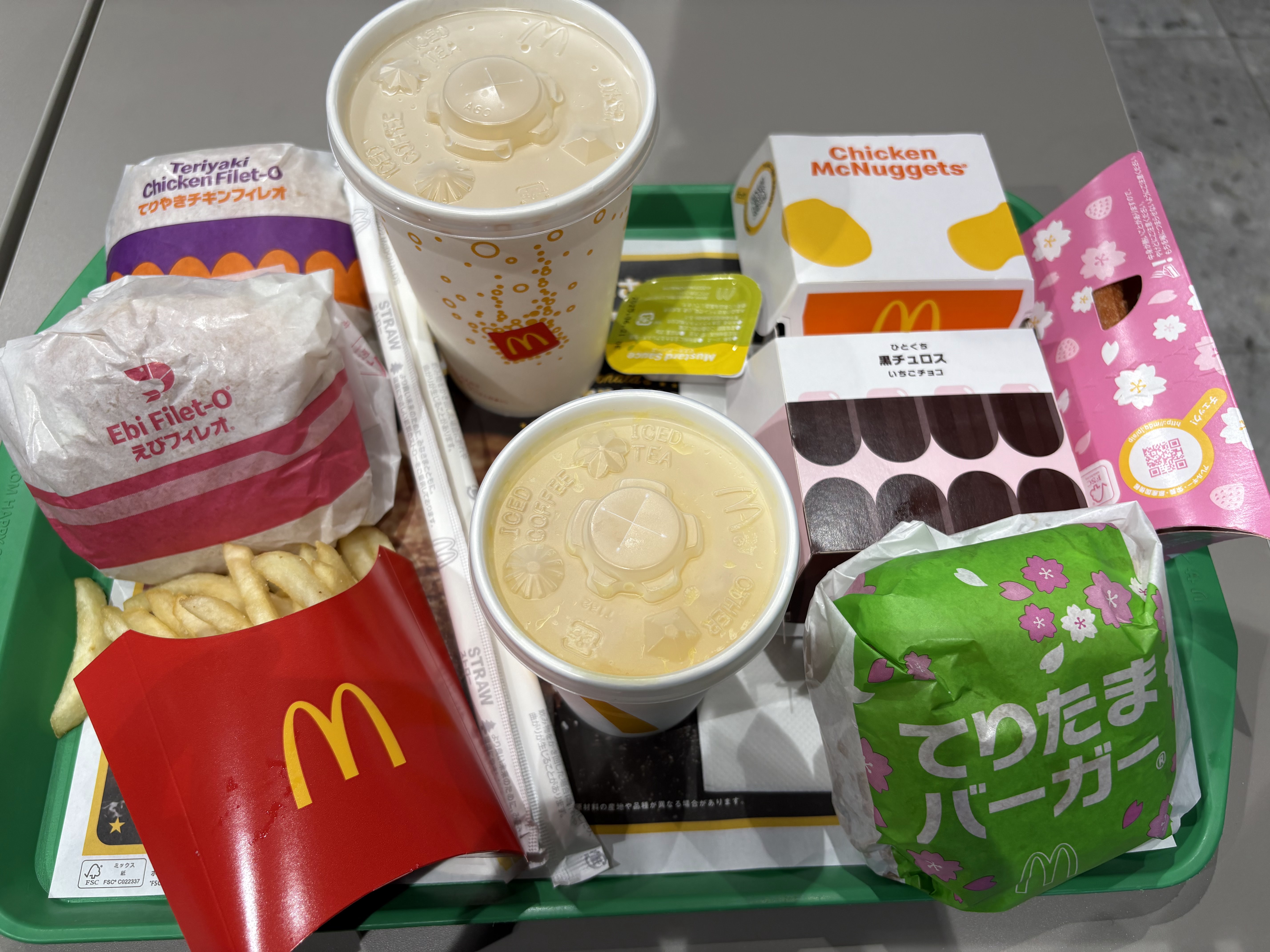
Last Thursday we arrived in the evening and by the time we checked into the hotel, it was almost 8pm. Before I went on my trip, my Japanese hairdresser suggested that I try the food at McDonald's because the items would be different than in Vancouver.
| McDonald's food in Japan is... different |
We tried an ebi filet-o or Filet-O-Shrimp, chicken teriyaki Filet-O, a grape soda, medium fries and two desserts, one that looked like mini churros with a strawberry filling, and strawberry daifuku pie in sakura pink packaging.
The Filet-O-Ebi substituted fish for shrimp with lettuce and mustard and it was not bad, tasting slightly sweet, while the chicken teriyaki burger was smothered in the dark sweet sauce to make the chicken patty palatable.
Meanwhile the Qoo white grape soda was far from natural juice, but still refreshing, though the fries seemed undercooked, but we ate them anyway.
Like other McDonald's meals, you wolf down the food, but then don't feel full. For dessert, the chocolate churros, called hitokuchi kuro churros were baked rather than deep-fried, and the strawberry filling was not jam, but artificially flavoured pink. The pie, available for a limited time, had a filling that was part mochi, part strawberry jam which was strange. Nevertheless it was the latter that made the pie taste extremely sweet. I finished off the fries to balance out the saccharine taste.
| Meaty king crab served cold |
The next evening we went to an izakaya called Andy's Shin Hinomoto in Yurakucho. It is located under a train overpass, so you can periodically hear trains going by. There are several eateries in each of these moon-shaped deep alcoves that are quite cozy.
Andy is Andy Lunt, an Englishman from Leicester, who in 1978 married the izakaya's owner's daughter and in 1986 came to Tokyo to help out with the business, and then taking over in 2010.
People can put their bags and umbrellas in little nooks or up above in fishing nets suspended from the ceiling. What a great idea to save space!
Our host had already ordered the king crab and it was boiled, but served cold, and the parts chopped up, but not cracked liked they would be in Chinese restaurants. Instead they were cut open with incisions here and there to help make it easier to extract the sweet meat aided by a skinny long metal tool.
| Large plump clams cooked in sake |
With beers, highballs and a plum drink, the total came to 26,000 yen for three. Again we walked off the meal by walking to the Imperial Palace, which had strategically placed strong headlights to prevent people from coming too close.
We walked to a place near the subway station that sells taiyaki, a fish-shaped pastry that has different fillings. We had the custard and red bean one. They were very hot out of the waffle iron, and a good way to keep warm as the temperatures began to drop.
| Tender cuts of beef for yakiniku |
We started off with thin slices of beef tongue that were delicious and then moved onto other cuts of beef that I was unfamiliar with, but everything was tender, despite not being marbled. Some cooked meats we wrapped in lettuce or shiso leaves, and grilled the odd slices of peppers.
Service was great, as after each round the staff came by to replace the metal wire rack over the charcoal. For dessert I had two scoops of soybean ice cream with a caramel sauce drizzled on top. This meal cost 2,000 yen less than the izakaya!
Our final dinner was at Savoy after our visit to Tokyo Skytree. The pizza place opens at 5.30pm and we didn't know we could make reservations so when we arrived there was luckily a short lineup ahead of us. The first group ahead of us was eight people including four young children; the parents couldn't decide if they wanted to order take away or eat in... Luckily we didn't wait too long, perhaps half an hour or so and we were the next batch of people to go in.
The best seats in the house were near the entrance where the pizza oven was located, with a roaring fire, but we were led to the back kitchen where salads were prepared and dishes were washed. It was kind of strange to have a open view of the back of house, but perhaps they felt they could take advantage of hungry diners eager for any kind of view.
| A watery Margherita pizza at Savoy |
We also had some meatballs covered in tomato sauce and some sprinkled melted parmesan cheese that were very tender and total comfort food.
Not long after we finished the meatballs the Margherita pizza arrived. It looked great, with the slightly burnt crust. But when I pulled a slice away to eat, I could see the tomato sauce was quite watery, which dulled the taste of the pizza. I still liked the crust which was airy and held up to the watery filling.
| Excellent blue fin tuna pizza |
Finally (and giving us a bit of time to digest), the Blue fin tuna pizza came with a side of wasabi and we were not disappointed! This was definitely a memorable pie. Since there's only a few slices of tuna, they were all bunched up in the middle and seared from being in the pizza oven; some bits were still a bit raw.
The combination of the slight sashimi taste of the tuna combined with cheese was so smooth and sweet, and the roughly chopped spring onions added a bit of crunchy texture. We did not need the wasabi to liven things up. It was already so good.
For dessert we didn't only have one but two tiramisus, very light, almost fluffy light and a hint of the espresso-soaked ladyfingers underneath. We walked out feeling sated and happy to make it to this place. Our total eating time: 45 minutes.
![]() |
| Here's what over 10 tonnes of frozen wagyu beef look like |
There are statistics that say Hong Kong is the largest consumer of meat per capita in the world at an average of 137kg per person daily.
That's basically five times the international average.
Are people eating tomahawk steaks for breakfast, lunch, and dinner everyday?
If so there would be even more Hongkongers dying of heart disease.
It's not true.
![]() |
| The seized speedboat with six engines at the back |
Hong Kong Customs intercepted a high-powered speedboat on September 2, in the southwest waters of Hong Kong. In the boat was about 10.1 tonnes of suspected smuggled frozen wagyu beef with an estimated market value of HK$21 million (US$2.7 million).
Customs officers had spotted a suspicious speedboat heading to the open sea at high speed with its navigation off, and immediately followed it. Officers later discovered the speedboat was equipped with six powerful outboard engines. Five men aged between 22 and 36 were arrested, and the meat was seized.
That is sadly wasted meat... it will probably be stuck in a freezer as evidence for months and perhaps destroyed afterwards?
So yes -- Hongkongers are not constantly eating beef all day. The same could be said about seafood, with highly prized fish, shark's fin, abalone, sea cucumber and so on are probably smuggled north as well!
| Showing off some cool knife skills |
We ate all our meals on the Ruby Princess this past week and I can attest as a cruiser that the novelty fades quickly; the breakfast buffet looks pretty much the same everyday, and in the fine dining restaurant, ingredients are used in different ways. It's best to eat something fresh on the menu -- and asking your waiter for tips on what's good that day.
Nevertheless we have to say running the food outlets on a cruise ship is no easy task. Executive chef Russell Clarke explained that half the staff are related to food and beverage, either cooks or waiters from some 50 different countries.
| Pastry chefs busy making cakes for the day |
On stage, Clarke quickly made three dishes for the audience of passengers: shrimp cocktail with mango salsa, lamb chops, and pavlova with berries and coulis.
However, we weren't invited to try the dishes -- the pavlova looked rock hard and dense -- but to go to the galley kitchens to take a look. Apparently this is a popular tour and some people raced to the kitchens! In the end there wasn't much to see, except lots of empty work spaces, stainless steel everywhere and only a handful of chefs working at 11am.
Perhaps the cooks were shy, or Clarke wanted the area cleared out, we could only look at a distance though some areas were decorated with creative carvings of vegetables and fruits. Some were constructed to look like mice and birds, but the flowers carved out of the side of a watermelon were most impressive.
![]() |
| A hearty slice of prime rib with potato, beans |
We were given a fact sheet on how much food is produced on the ship, and it involves ordering 110-115 tons of food delivered on a single cruise.
Three butchers clean and cut 1,700 fish into portions daily, while five butchers, three assistants and helpers prepare beef and poultry. On a cruise, 1,400lbs of poultry, 1,700lbs of beef, 1,400lbs of pork and pork products (like sausages); 300lbs of veal, and 200lbs of lamb are cooked daily.
While I had a large slice of prime rib that was pretty good on the last night, the lamb rack I had was overcooked. Interestingly the cream of whatever vegetable soup like cauliflower, or lentil, and the Alaska seafood soup were really good. These are made by 13 staff, preparing 550 gallons per day.
Some 1,600lbs of salad are served daily along with 400lbs of shrimp, 13 gallons of mayonnaise, and 1,500 sandwiches. The Caesar salad was consistently good and what I ate the most.
The bread served on board is made fresh daily by 10 bakers, including the bread rolls we ate everyday that had a light crunchy exterior and fluffy interior along with whipped butter. I did not try the pizza nor the croissants. The bakers use some 1,500lbs of flour daily! I saw some dough being proofed when we went through the kitchens.
| Breads are made daily on the ship |
Every morning I ate fruits -- honeydew, cantaloupe, watermelon and pineapple. Sometimes there was papaya. Towards the end of the trip there was more canned fruit like apricot, peach and pineapple. I ate those anyway, and once had canned figs. Around 6,000lbs of fresh fruit is served daily, while 400lbs of butter are used everyday!
For those who drink coffee, 470 gallons are consumed, 62 gallons of coffee cream, and 400lbs of sugar for the coffee.
After consuming all that food, someone has to clean the dishes. Fifty-seven people wash china, glasses, silver, and pots and pans. Everyday 70,000 dishes are washed, while 21,500 glasses are washed.
And that's just the passengers. There are also 1,1000 crew who need to eat too!
![]() |
| Whetting the appetite with pomelo and prawn salad |
![]() |
| Braised beef in a tart soupy sauce |
![]() |
| Claypot rice with Chinese sausages was spot on |
![]() |
| Roasted chicken was tender, hardly dry |
![]() |
| Really yummy congee to start the meal |
![]() |
| Pork belly fried rice with Chinese sausage |
![]() |
| Crispy turmeric cod with rice noodles |
![]() |
| Crispy beef egg noodles was hearty |
![]() |
| The mini pho bo with a sous vide egg at Linh Cafe |
![]() |
| Three mini spicy baguette sticks |
![]() |
| Delicious fried frog legs with a spicy finish |
Matsura (right) with a local in Okanogan County Frank (Sakae) Matsura, was the son of a Samurai in Hirado, Japan, but by the time he was gro...