Showing posts with label one country two systems. Show all posts

Friday, March 17, 2023

Beijing Exerts More Control over HK, Macau

HKMAO will report directly to the CCP's Central Committee

Changes are afoot at the Hong Kong and Macau Affairs Office, as it will directly report to the party's Central Committee instead of the State Council, allowing senior leadership more direct control over both special administrative regions.

Xia Baolong, director of the current HKMAO will stay on as head of the new body during the transition period as the office restructures.

Xia will continue to helm the HKMAO
According to the latest "Party and State Institutional Reform Plan" published on Thursday, the new body "would commit to the duties of investigating, researching, coordinating and supervising the implementation of the 'one country, two systems' principle, the comprehensive jurisdiction of the central government, and governance of Hong Kong and Macau in accordance with the law".

In addition the revamped office would "safeguard national security, guarantee people's livelihoods and well-being, as well as support Hong Kong and Macau to integrate into the national development plan".

The new body will be called the "Hong Kong and Macau Work Office of the Communist Party Central Committee", though it will still retain its original HKMAO name, perhaps for abbreviation.
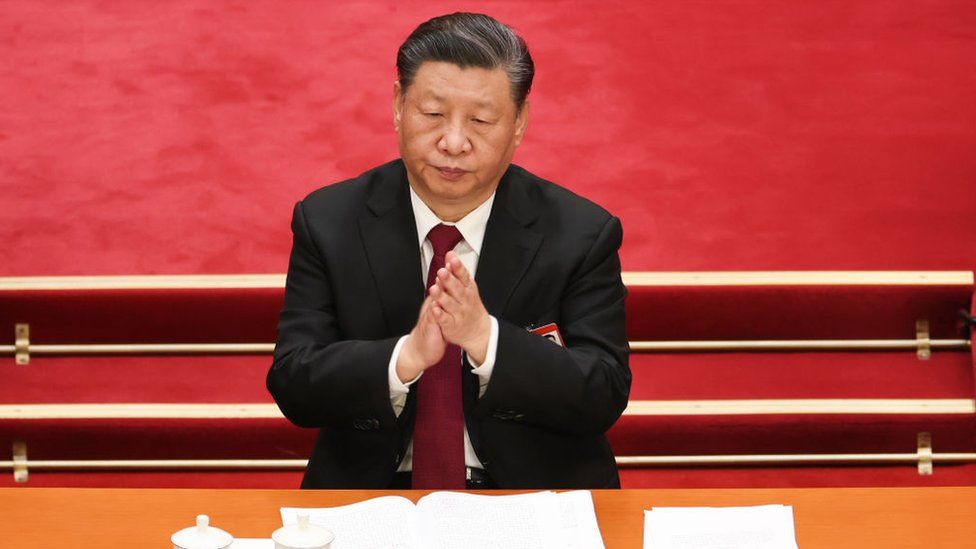
Xi will have more control over HK, Macau
In separate statements, both the HKMAO and Beijing's liaison office in the city said the change reflects the importance Chinese leader Xi Jinping placed on implementing one country, two systems in Hong Kong and Macau, as well as the strong determination and will of the party's Central Committee to uphold and improve the principle.

Hong Kong Chief Executive John Lee Ka-chiu hailed the restructuring, saying the central government worked for the good of Hong Kong and its people.

He pledged the local administration would effectively communicate with the restructured office so that the central government could better understand Hong Kong.

"[The Hong Kong government] will make good use of the distinctive advantages of enjoying the strong support of the motherland and being closely connected to the world, and more actively align with the national strategy to better integrate into the overall development of the country," he said.

Lee pledges more communication with HKMAO
Sources say the move underscores how Hong Kong affairs continue to be a key focus for the central government, while political commentators say the direct link with Beijing could secure the city from national security threats amid complicated geopolitical tensions.

This latest restructuring means that the ancient saying, "Heaven is high and the emperor is far away" no longer applies to Hong Kong. Xi will have more ears on the ground to avoid the embarrassing mistake of bad intelligence in the run-up to the 2019 district council elections where the pro-democracy camp swept 17 out of 18 districts. 

But with the national security law in place, many pro-democracy lawmakers, activists and media figures behind bars or in exile, civil society groups disbanded and media outlets shut down, surely Xi can be confident in exerting control over Hong Kong.

Apparently it's not enough with the revamp of the HKMAO office coming soon...


Saturday, October 8, 2022

Musk's Solution to Taiwan Issue


Musk says Taiwan should be under "one country, two systems"

Elon Musk seems to be playing right into Chinese hands.

He thinks he has the solution to the Taiwan issue and explained it to the Financial Times the other day.

"My recommendation... would be to figure out a special administrative zone for Taiwan that is reasonably palatable, probably won't make everyone happy. And it's possible, and I think probably, in fact, that they could have an arrangement that's more lenient than Hong Kong."

He has a Tesla factory in Shanghai
Err... we all know how that went.

Musk believed conflict with Taiwan was inevitable, and warned of its potential impact on not only Tesla, as he has a factory in Shanghai, but also in iPhone maker Apple, as well as the global economy, which he estimated would take a 30 percent hit.

Former Global Times chief editor Hu Xijin took the opportunity to comment on Musk's remarks.

"Taiwan's Democratic Progressive Party authorities will hate you. Many US lawmakers and political elites also dislike [the idea] which signs a different tune to the current US policy on the Taiwan Strait," Hu said on Weibo.

"It can't be ruled out that he may have some trouble in the future for having expressed these political views."

"It has also reflected the world's basic understanding that Taiwan is a part of China and reunification is the general trend," Hu added.

Ip was quick to praise Musk's proposed solution
That's not the basic understanding most people have outside of China.

It seems Musk has drunk the Kool-aid on this one.

It's the lao wai (foreigner) being the shill for the Chinese authoritarian regime so that he can make gobs more money. Beijing must be clapping its hands with delight at having such a compliant spokesperson.

Meanwhile pro-Beijing lawmaker Regina Ip Lau Suk-yee is on the Musk-praising bandwagon. 

On Twitter she wrote: "Elon Musk has spoken well on Taiwan suggesting it should become a special administrative region like Hong Kong! The world should pay attention to this voice of reason and pragmatism."

He is not quite the voice of reason and pragmatism when he suddenly announced he would buy Twitter for US$44 billion then backed down. The company held Musk's feet to the fire to make sure the deal would go through without anymore ifs, ands, or buts.


Monday, October 3, 2022

Patriotic Astronauts Need Only Apply


People from Hong Kong and Macau can apply for a space job

It's very intriguing that only now is the Chinese government inviting people from Hong Kong and Macau to apply for a position in the national space program -- and yes being a patriot is a requirement.

The job is for a payload expert, a scientist or engineer who manages highly complex or classified onboard equipment and carries out scientific activities, such as astronautical measurements.

A key requirement is to be a "patriot"
Male or female candidates must be between the ages of 30 and 45, be 1.62-1.75 metres tall for men, and 1.6-1.75 metres tall for women. The Hospital Authority will also confirm their physical fitness.

Applicants must have a doctoral degree and at least three years of relevant work experience, such as life sciences, material sciences, physics, chemistry, psychology, biomedical engineering, mechanical engineering, electronic engineering or astronomy.

But perhaps more importantly, the candidates must be Chinese nationals who are permanent residents, and are patriots -- along with their family members who adhere to the "one country, two systems" policy, as well as uphold state and local constitutions.

When asked what would happen if someone was a British National (Overseas) visa holder would be eligible, Hong Kong's technology minister Sun Dong replied screening would be done according to established procedures, without defining the patriot requirement.

"For applicants who want to give up their foreign identities and participate in the program, I think I will leave it to the vetting committee to handle," Sun said.

Sun isn't sure if BNO holders qualify for the job
Perhaps it was not a question they had anticipated...

Does anyone in Hong Kong and Macau fulfil all those requirements? It's possible but probably very slim pickings. The height requirement alone will eliminate a number of people! 

It's interesting China picked this time to recruit people from Hong Kong and Macau -- why not earlier? This would have been an excellent opportunity to not only discover new talent, but also bring them into the fold and give the next generation a possible path into the space industry.

But maybe better now than never?

Thursday, September 22, 2022

Two Steps Forward, One Step Back

People waiting to hear the scrapping of hotel quarantine


Lots of things happening in Hong Kong -- the latest is that Chief Executive John Lee Ka-chiu will finally announce the end of mandatory hotel quarantines, and that people self-monitor for three days at home. 

This after over two and a half years of severe quarantines that was at three weeks for the longest time, then down to one week until August 12 when it was changed to three days in hotel quarantine and four at home.

The announcement comes after mounting calls from the business sector who have seen finance types flee to Singapore, retail and hospitality suffering and in many cases shutter, while sports events have been cancelled or postponed because the government is too slow to give the green light.

Three weeks, then one week, then three days...
Interestingly Beijing has given its blessing for Hong Kong to live with Covid-19, perhaps seeing it as a test case? Or conveniently saying it's "one country, two systems"? 

Regardless it's a welcome sign for everyone in Hong Kong, which may prompt many to travel for the first time in years (if they can afford it), or even return?

Another sigh of relief for journalist Ronson Chan, chairperson of the Hong Kong Journalists Association who was granted bail after pleading not guilty to obstructing police officers and an alternative charge of obstructing other person lawfully engaged in public duty.

This development comes a week before he is to go to Oxford University for a six-month fellowship.

Chan was arrested on September 7 while on his way to report on a story. Two officers allegedly asked to see his Hong Kong ID many times and Chan allegedly refused, asking to see their ID, which is allowed by law. The officers claimed he was "uncooperative" and arrested him.

On Thursday Chan was granted bail and no travel restrictions were imposed; he had to pay HK$10,000 bail and report his future UK address and phone number to the police in Hong Kong.

Chan can go to Oxford University next week
Conveniently his trial is set for May 2023, a month after he is expected to return from the UK.

Outside the court Chan observed it was ironic that the Hong Kong government was holding an event for journalists at the Grand Hyatt Hong Kong.

"Today, at this very moment, some journalists are holding a reception celebrating National Day, while the chairperson of the Hong Kong Journalists Association had to appear in court. I guess this reflects the contrast we've seen in the news industry in Hong Kong now," the veteran journalist said.

What is is referring to is Chief Executive Lee instructing journalists how to do their jobs post-NSL.

While saying journalists should report the news in an "objective, fair and impartial manner", they should also remember they are also Hong Kong residents and therefore are "not above the law".

"I hope that all members of the press will be able to distinguish right from wrong and stay away from these camouflaged media organisations and bad apples who undermine press freedom," he said, referring to groups Lee claimed did illegal things in the name of journalism.

Lee warns of "camouflaged media organisations"
Who is he referring to here? Or is the "bad apples" a hint?

Lee urged those in the media to "tell the Hong Kong stories well".

"[The industry should] unite and tell the world the latest developments and correct information of Hong Kong," he said.

But this is what Hong Kong media have been doing all along. They are one of the institutions to make the government accountable, particularly now that the legislature is completely stacked with pro-Beijing lawmakers now.

However, it seems Lee is only interested in having media continue to tow the government line...


Tuesday, July 19, 2022

John Lee's "Press Freedom"

Lee says media can help promote "one country, two systems"

Before John Lee Ka-chiu became Chief Executive of Hong Kong, he claimed press freedom existed in the city and therefore there was no need to defend it.

"Freedom of the press always exists in Hong Kong. I think there's no need to use the word 'defend' because it exists and we attach great importance to press freedom. But press freedom needs to fulfil the requirements of the law. Hong Kong is a place with rule of law, any action or activities must be lawful," he said in April.

Apple Daily was shut down under Lee's watch
But what is the definition of press freedom? According to Merriam-Webster: "the right of newspapers, magazines, etc to report news without being controlled by the government".

May we remind him that Reporters Without Borders recently ranked Hong Kong's press freedom at 148 out of 180 countries, when last year it was at No. 80 and in 2002 at No. 18.

So it's intriguing for Lee to now say the media and him "are in the same boat", and that he hoped the news sector would help him in promoting the accomplishments of the "one country, two systems" principle to the world.

"We have to publicise the successful experience of One Country, Two Systems to the world, and [publicise] Hong Kong's extraordinary achievements under its unique advantages," Lee said during a video call at a Handover anniversary event hosted by the pro-Beijing Hong Kong Federation of Journalists.

Stand News editor arrested, later shut down
"We need to use all possible means, from newspapers, TV [and] radio to the internet, new media and social media, to promote the competitiveness of Hong Kong from all directions," Lee added.

He ended his speech saying he and journalists are "in the same family" and "in the same boat."

It's ironic for him to say that when he was Secretary for Security Apple Daily and Stand News were investigated and shut down, and other smaller independent media outlets closed out of fear of the national security law.

How are him and journalists in the same boat?

And what successes has Hong Kong had lately to merit trumpeting "one country, two systems"? In the last few years "two systems" are fast becoming one.


Lee will continue to use this kind of gaslighting language -- and how much longer will its residents withstand living in this parallel universe?

The only achievement in the last few years was to drive people and companies away from Hong Kong due to the national security law and the severely restrictive Covid-19 regulations that have strangled any opportunity to revive the city's economy...


Friday, July 1, 2022

Lee Sworn in as New Chief Executive


Lee and Xi stand together at the HK Convention Centre


Chinese President Xi Jinping came and went, and left behind a newly anointed John Lee Ka-chiu as the next chief executive of Hong Kong.

The entire swearing-in ceremony was conducted in Mandarin -- not Lee's strong suit -- but with the world watching, or rather the domestic Chinese audience watching, he had to oblige.

So many local Hong Kong and international media were barred from attending the event, and had to reply on pool feeds for pictures and video. This ensured the narrative did not veer from the script.

Lee's swearing-in was in Mandarin
After Lee was sworn in, he gave his first speech as Chief Executive. 

He said he took on the role of Hong Kong's leader with "humility", and thanked the central government for its support, and citizens for their trust, saying he would lead his team to do their best in building an "inclusive and energetic" Hong Kong.

Optimistic words, but hardly reflect the reality. Firstly, he does not have the mandate of Hongkongers, as they cannot directly vote for their leader, and how can he be "inclusive" when he helped former chief executive Carrie Lam Cheng Yuet-ngor shut down any kind of dissent from media outlets to civil society groups and political activists?

Lee added the implementation of the national security law allowed Hong Kong to return from chaos to order, and that the electoral overhaul of the Legislative Council enabled "patriots ruling Hong Kong".

Meanwhile Xi, Lee's boss, said in his speech that the "one country, two systems" framework had proven successful so there was no reason to change it.

He described it as "a great initiative with no precedent to follow", and that it is to uphold the nation's sovereignty, security and development interests, and to maintain long-term prosperity and stability in both Hong Kong and Macau.

Lee's new cabinet is hardly social-distanced...
How are Hong Kong and nearby Macau going to achieve prosperity when China refuses to open the border with Hong Kong and Macau, and that Beijing is cracking down on gambling, the dominant source of income for the former Portuguese enclave?

"Today I wish to highlight once more that the policy of 'one country, two systems' having been tested and proved time and again, meets the fundamental interests of the country and the Chinese nation and those of Hong Kong and Macau," Xi said.

"It enjoys the full support of the more than 1.4 billion people of the motherland, it has the unanimous endorsement of Hong Kong and Macau residents, and it is widely recognised by the international community. There is no reason to change such a good system, and it must be adhered to over the long run."

Ah yes, the support of more than 1.4 billion people! They had no say on how Hong Kong is governed -- they are only told how the city is governed.

But the reasoning goes if it's been endorsed by 1.4 billion people, then "one country, two systems" must be be right, right? 

It's a pity that the British side and the Chinese side have two completely different definitions of "one country, two systems", or perhaps Beijing kept its cards really close to its chest until now?

Either way it's Hongkongers who lose. Those who want to cut their losses are taking a leap of faith to leave Hong Kong and start new lives again. Those who refuse to leave feel that departing would be a sign of giving up. 


VIFF -- Review: Our Mr. Matsura

Matsura (right) with a local in Okanogan County Frank (Sakae) Matsura, was the son of a Samurai in Hirado, Japan, but by the time he was gro...