Showing posts with label Hong Kong government. Show all posts

Tuesday, May 5, 2026

Residents of Wang Fuk Court Blaze Retrieve Items


Some managed to retrieve items in their flats

It's heartbreaking to watch first-person footage of victims of the Wang Fuk inferno last November go see their burnt out flats, possibly for the last time.

Those who could walk up the stairs showed the reporters gathered what their former homes looked like. 

Some were able to find cherished items like watches, jewellery, and pictures, while others were left with charred belongings that were hard to identify.

The media ask residents about their experiences
One man brought his camera to take pictures from the window to preserve his memories of the view he used to see everyday.

Another somehow managed to find the ashes of his two cats and discovered some clothes that were not burned in the fire; even if he removed them, could he remove the smell of smoke from them?

The Hong Kong government says 6,265 people from 1,674 households registered to go to the towers, with only 50 households not participating.

According to the government's data, one family visited their flat for only four minutes, while the longest was four hours and eight minutes, longer than the three-hour stipulation.

The authorities received 800 requests to go back to collect more items. One was a man surnamed Mak who is a furniture designer who lived on the fifth floor of Wang Shing House.

He could only bring back small furniture items made of rosewood, and had to leave bigger furniture pieces and paintings behind.

"We feel quite helpless," Mak said. "But what I hope for the most is that justice is served. Those who should be held accountable must be punished, and those who should be jailed should be put on trial."

Taking pictures of burned out photo albums
A resident surnamed Wong lost his parents in the fire last November. He was hoping to salvage his mother's jewellery and any mementos.

His eyes welled up when he said his father died on his birthday.

"I did not have any chance to wish my father a happy birthday," Wong said. "I hope they rest in peace."

Meanwhile a woman surnamed Au felt overwhelmed when she returned to her home, and was only able to retrieve a charred safe and some valuables.

The mother of three was gratified to be allowed to leave food and flower offerings to pay tribute to the 168 people who died, and almost 5,000 residents displaced. 

"Every step back to the flat is very difficult," she said. "Everything we know about the court, the park, and even the lobby entrance has changed. It has become so unfamiliar to us."

This is also possibly one of the last times Au saw her neighbours, now dispersed around Hong Kong living in different places and trying to rebuild their lives. It's a tragedy that will continue for years to come.

Wednesday, December 3, 2025

Where do Tai Po Fire Survivors Go from Here?


Wang Chi House residents grabbed items from their flats


If you were only given 90 minutes to fetch things from your home, with no reassurances you could return to live there, which items would you get?

That's what happened to the residents of Wang Chi House, the only building that was untouched in the devastating Tai Po fire last week.

On Wednesday and Thursday from 9am to 9pm, two members from each household were allowed to go into their flats for 90 minutes.

Many people went back to fill suitcases full of clothes, important documents, and treasured photographs, while others even managed to extract their washing machines. One man surnamed Suen told RTHK he went back to get some household goods as well as his game console. Everyone has different priorities...

Despite some of these Wang Chi House residents reporting their homes smelled of smoke, many interviewed in the media expect or hope to move back into the building soon.

Thousands of paper cranes memorialise victims
However, their homes may be too carcinogenic for them to return to, and there is talk that the seven burned out buildings will probably have to be demolished because they may be structurally unsafe, while those who believe in restless spirits may not want to live there again.

In the meantime many of the victims of the fire are worrying about where to live next, as they can only stay in hotels paid for by the government for two weeks and other temporary housing are already full. 

According to the Hong Kong government, 1,152 residents have accommodation in youth hostels, camps or hotel rooms, and another 1, 765 residents in transitional housing units. Others are staying at the Tai Po Community Centre or the Tung Cheong Street Community Hall. One can imagine these shelters aren't exactly comfortable and cooler temperatures are settling in for the next few months.

What is the long-term plan for these residents who may have lost loved ones, lost their homes, and lost all their possessions? They not only need financial help but also psychological counselling and support. 

It will take weeks if not months for the authorities to complete their investigations and identify all the deceased, some of them found as ash. There are also concerns that charging the 21 people arrested so far with alleged manslaughter may be hard to prove with the complexity of construction law and building regulations.

In other words it's not a cut and dried case. 

Meanwhile, despite the government trying to clear the area of grassroots volunteers and their resources, mourners continue to come to Tai Po to pay their respects with flowers, handwritten notes, and paper cranes.

It shows Hongkongers continue to be shaken by the horrific man-made disaster and demand accountability. 

Going through flats to recover victim remains
Chief Executive John Lee Ka-chiu will be under a lot of pressure to find out how the fire started, and to punish those involved in causing the fire to spread to seven buildings, killing at least 159 people.

The authorities tried to clamp down on protests when 24-year-old student Miles Kwan was arrested and then later released without charge. He had started an online petition and passed out fliers outlining "four demands", which included guaranteed support for the victims and accountability for those at fault, including any government officials.

He was detained and charged for "seditious intention" for speaking out what many had been thinking.

In the meantime it is heartbreaking hearing Superintendent Cheng Ka-chun, the officer in charge of the Disaster Victim Identification describe the grim task of how he and his team have gone floor by floor to find victim remains.

"Our colleagues, in a bid to keep the bodies more intact for their return to their families, chose to dig for the bodies using their hands, touching sand, mud and polluted water," he said, when explaining why they chose to recover corpses by hand instead of using equipment.

"Their only goal was to preserve the integrity of the bodies."

This demonstrates how they are doing their utmost to respect the victims and their loved ones, taking time and care to preserve the remains the best they can.

Hongkongers looking after Hongkongers. This is the Lion Rock Spirit.


Tuesday, December 2, 2025

Hongkongers Search for Answers After Inferno

At least 156 people have died from the fire. Credit Getty Images


I have just returned from a two-week trip to Hong Kong and China, and like everyone else, am devastated by the Tai Po inferno that killed at least 156 people. As the authorities comb through the wreckage of the seven buildings, the number of dead will only continue to rise.

In the afternoon of November 26, my relatives and I had finished lunch in Macau, and then went to the Hengqin border where we were driven to Zhongshan to see my uncle's apartment.

Periodically I began getting news updates about a fire in Tai Po and it became very shocking when I started seeing the video footage of the flames engulfing the mesh that covered the bamboo scaffolding.

As the number of casualties began to rise I wondered what was going on. Did residents think fires didn't happen in concrete buildings?

Later it was revealed the buildings were undergoing an extensive renovation of the exterior, costing around HK$160,000 (US$20,546) per flat. Their windows were sealed with styrofoam material to prevent debris from damaging the glass, and much of the green mesh covering the scaffolding were not fire-resistant.

Stories subsequently came out from survivors who told of being completely unaware their building was on fire until their loved ones called them. Even the firefighters could not reach them because the scaffolding was in the way and the fire temperature was so hot.

There were reports the government wanted to phase out bamboo scaffolding in favour of metal -- this was quickly dismissed by passionate Hongkongers who made videos trying to set bamboo sticks alight, or explaining to people outside of the city that bamboo is a building material that has been used for over 100 years.

After having experienced a relatively small fire in my neighbourhood in August last year, when a six-storey wood-construction condo building was on fire. The cause is still unknown. The two fire chiefs at the scene recently told us residents that the fire was so hot, they didn't even imagine that the construction crane would melt and collapse the way it did.

So to say that metal would be safer is very hard to say; it would probably make the fire even hotter.

It took over two days for firefighters to have the flames of the Tai Po fire under control.

Meanwhile grassroots groups saw the news and began coming together with water, blankets and food for the affected residents and firefighters. They just setup near the area and gave victims whatever they needed. It was so heartening to see them rally behind these residents who have lost their homes, or worse their loved ones. Some lost their pets, unable to get inside, as firefighters and police stopped them because it was so dangerous with the falling debris and the heat.

But after extensive media coverage of how these NGOs and local groups had mobilised so quickly, donating clothes, food, water, even their electric cars for people to charge their phones, the Hong Kong government cleared everyone out; perhaps the scenes are too reminiscent of what happened over six years ago, or even 11 years ago, when protesters were on the streets...

Chief Executive John Lee Ka-chiu has pledged a judge will lead a committee to investigate the cause of the fire; perhaps his administration, particularly the Labour Department should have listened to residents' concerns about the green mesh not being fire resistant and witnessing the construction workers smoking on site. While warnings were issued by the Labour Department, it seems punishment was not enforced.

Some survivors have raged about being forced to pay HK$160,000 in renovation fees, only to have their homes go up in smoke. 

As a friend said to me, governments are not prepared for disasters, but it is how they deal with them is what matters. 

Two days ago actor Chow Yun-fat opened the MAMA Awards by speaking in Cantonese, Mandarin and English, asking the audience to stand up for a moment of silence to pay tribute to the victims of the Tai Po fire. He was genuinely upset and felt this was an important gesture for Hong Kong.

The government declared three days of mourning from Friday to Sunday. Thousands of mourners descended on Tai Po, creating a 2km line, patiently waiting to walk closer to the makeshift alter near the fire-ravaged buildings where they left flowers, handwritten notes and toys. 

Hongkongers will never forget this horrific tragedy, nor will they stop finding out who should be accountable.

A mainlander, Jiang Yaling, who writes the Follow the Yuan on Substack, commented how the Hong Kong authorities deal with victims very differently from in China. Typically if a disaster happens, the victims and families are immediately shuffled into hotel rooms and forbidden from speaking to the media; she was very surprised to see how Hongkongers were able to speak freely with emotion...

For now a lot of fundraising has been done, over HK$1.3 billion raised. But where exactly will all this aid go? Will victims get the money directly? Or will it be given to charity groups? Where are people going to live now? They can't live in hotel rooms for weeks on end. And what kind of compensation will they get? 

All eyes are on the Hong Kong authorities. Will they step up and serve the people as they have promised?

Saturday, August 16, 2025

HK Government Rethinks Water Budget

HK government tried to cut costs by buying water from China

Times are tough in Hong Kong when the government is cutting back on the kind of water it supplies to its staff.

Previously it was Watsons Water, provided by Watsons Group, in other words, a Li Ka-shing company.

But in June, Hong Kong's Government Logistics Department announced it had awarded the three-year drinking water supply contracts to mainland Chinese companies for the first time in a bid to save HK$16 million annually.

A water brand has serious quality issues
Government offices in Kowloon would continue to get water from Watsons Group, but its sub brand called Cool, while those in the New Territories would be supplied the water brand Happy Xishi from Professional Trade International Limited.

And government offices on Hong Kong Island and the Outlying Islands would get the water brand XinLe from Xin Dong Xin Trade Co., Ltd.

Local officials said the selection process used rigorous quality standards despite the cost savings.

However, media outlet HK01 reported XinLe had a history of safety concerns. From 2014 to 2017, the company was repeatedly flagged by China's food safety authorities for exceeding acceptable levels of harmful substances, including bromate, which can be a potential carcinogen, as well as microbial contamination.

So today, the Hong Kong government has announced it has partially terminated its contract with Xin Dong Xin Trade Co., Ltd.

The press release added the Government Logistics Department will decide if it will fully terminate the contract and has referred the incident with the police. 

In the meantime the government has asked Watsons Water to temporarily supply Cool water to offices on Hong Kong Island and the Outlying Islands.

Sometimes you can't be too petty on saving money when it comes to water. You can wear cheaper clothes and shoes, and take cheaper transportation, but you really can't be too cheap when it comes to what you put in your stomach...

Thursday, July 24, 2025

HK Government Doesn't Entertain Benefits of Reusable Cups


So far, Kai Tak Sports Park will be using single-use cups

The Hong Kong government prefers using single-use cups at Kai Tak Sports Park, saying reusable plastic ones will "undermine" efforts to promote carbon reduction and resource recycling.

Secretary for Culture, Sports and Tourism Rosanna Law Shuk-pui said that research by the park's operator compared local and overseas practices showed that using reusable plastic cups in Hong Kong would generate more carbon emissions and consume more resources.

But environmental NGO Greenpeace Hong Kong called on the authorities to consider using reusable plastic cups for sporting events like the upcoming Hong Kong Football Festival, and urged Law to look at other international sports organisations like the English Premier League, where 65 percent of clubs use reusable cups.

Reusable cups used at HK Sevens since 2019
However Law was not to be persuaded.

"As reusable plastic containers are not biodegradable, they do not support the plastic-free initiative and undermine Kai Tak Sports Park's efforts in promoting carbon reduction and resource circulation," she said.

"In contrast, the use of biodegradable paper cups aligns well with and makes good use of the above-mentioned waste decomposition system at Kai Tak Sports Park, leading to a better overall carbon reduction outcome."

May we point out that single-use paper cups would not decompose because they have a plastic lining on the paper so that liquids don't soak through it? Not to mention how much garbage it creates after each event?

It has been demonstrated that reusable cups at sporting events make much more sense.

A marathoner named Kristina Smithe took part in a marathon in California in 2019 and was horrified thinking about how much waste paper cups generated in one race. She calculated with 9,000 runners, some 150,000 paper cups were used once and then thrown away.

Smithe with her reusable silicon cups at a race
She went about designing a lightweight, pliable silicone cup that could be reused many times. In 2021 she launched Hiccup Earth, where she rents out 70,000 silicone cups to race organisers. 

Smithe drops off the cups by the thousand, collects them after and then washes them in her proprietary dishwasher that uses less water than a household dishwasher. 

While it's a bit more expensive to rent these cups, there is much less garbage accumulated and wouldn't people feel better using these reusable cups?

It was a proven concept at the Hong Kong Sevens in March. Greenpeace noted the sporting event used reusable cups from 2019 to 2024 and saw a 90 percent return rate of the containers.

Surely it's not too hard to implement at sporting events and concerts?


Tuesday, July 8, 2025

Dim Sum Restaurant Metropole to Close


So many dim sum options at Metropole in Admiralty

Every few days there's a story in the news that yet another eatery or restaurant chain has shuttered.

This time it's Metropole, a Chinese restaurant known for its dim sum trolleys that was in business for 35 years, but will close in September.

One of the last dim sum restaurant with trolleys
While it's a place not necessarily dear to my heart, it's where my relatives and I usually met up for Chinese New Year, or when relatives from out of town came to visit. 

The Admiralty location was convenient for most of us, right above the MTR station and near the bus stop, it catered to big groups, had a wide selection of dim sum and the prices were reasonable.

We wouldn't wait for the women pushing the dim sum trolleys to come to us -- we'd take our white card and hunt down food and bring it back to our table. 

Or we'd walk up to the middle of the restaurant, where they served dishes like radish cake and taro cake, "three fried stuffed treasures" of eggplant, peppers, and tofu, pig trotters cooked in vinegar with egg and ginger, and a dessert station that included tofu fa.

If har gao, chicken feet, spare ribs, char siu buns and spring rolls weren't enough, you could also order plates of fried noodles, congee and vegetables too.

Cheung represents the catering sector in Legco
In the end the total bill for a large table was relatively reasonable and we were all stuffed. 

An American friend living in Hong Kong wanted to know where to take visitors to have the trolley experience and I recommended Metropole. 

I warned him to make a reservation in advance because if you didn't, you'd be stuck waiting around for the next free table.

But when he went, the large restaurant was hardly full of diners.

And with people heading up north mostly on weekends to chow down on food at a fraction of Hong Kong prices, restaurants like Metropole are struggling to stay afloat, and it doesn't help that landlords aren't giving them a break on rent.

It's surprising that legislator Tommy Cheung Yu-yan, who represents the catering industry, has not raised concerns about the sector in the Legislative Council, or brought this issue to the attention of the Chief Executive and the Executive Council. 

The art of dim sum is fast disappearing in HK
And while the media has been reporting on each restaurant closing, no one has questioned the government on why it hasn't done more to save this industry, and in particular trying to help those who have lost their jobs to get the compensation they deserve.

What is particularly sad about Metropole is the amount of knowledge of producing dim sum disappearing. There are fewer and fewer people who know how to make har gao, char siu buns, steamed rice rolls and egg tarts.

Many restaurants use frozen dim sum made by factories in China because the labour is so expensive, or it's a way to cut costs. However, one can easily tell the difference between factory and handmade dim sum.

However, dim sum is practically synonymous with Hong Kong, considered a foodie city. So why is not more done to preserve this delicious piece of culinary heritage?

Metropole

4/F, United Centre

95 Queensway, Admiralty

852 2865 1988


Sunday, May 18, 2025

Review: Fallen Treasures

The film documents Hong Kong's last sawmill


This afternoon I went to see a Hong Kong documentary called Fallen Treasures at Cinematheque this afternoon. Thinking there would be a lot of people, I arrived 40 minutes early to see that the organisers, HK House hadn't even set up yet.

I waited outside and slowly a line started to form behind me, but it turns out when we were finally allowed in minutes before the screening, that only about 30 people came, though this is Victoria Day weekend, a public holiday.

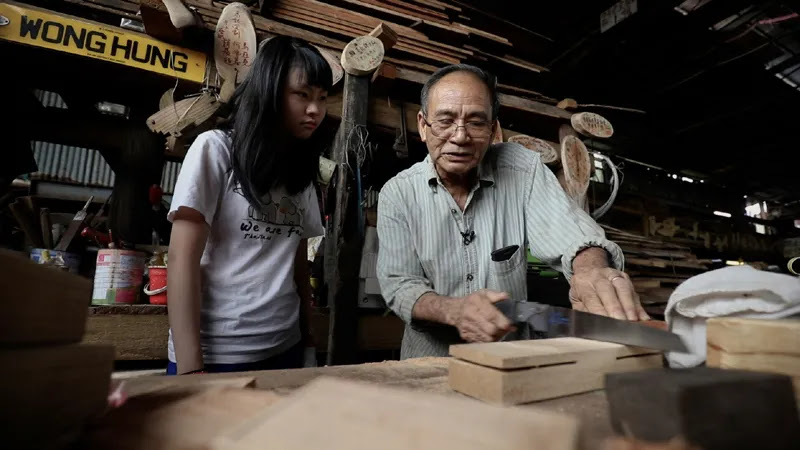
Wong is passionate about woodwork
Directed by Elyse KY Hon, Fallen Treasures follows Wong Hung-kuen, the owner of Chi Kee Sawmill & Timber, the last sawmill in Hong Kong.

Hon had interviewed Wong in 2016 for a print story, but felt she could do a more comprehensive one on film. She began shooting in 2018 when he received an eviction notice because the government was going to develop the area into the Northern Metropolis, to connect Hong Kong with the mainland, and by extension into the Greater Bay Area.

The sawmill has old equipment, but continues to run well to remove the bark from tree trunks, and then slice them into planks. Wong patiently teaches young people how to make small chairs and stools, hoping that the next generation would be interested in woodworking. 

He is so passionate about his work that everyday he wakes up at 6.30am and makes the two-hour commute from Siu Sai Wan to Sheung Shui. Wong works there with his younger sister, who cooks meals for the both of them and his employee who has been with the company for many years.

After the screening Hon talked to the audience
But the deadline of moving Chi Kee is fast approaching and one might think Wong, in his 70s, would settle into retirement and close it, but this place is his reason for waking up everyday, and is focused on finishing commissions from clients than figuring out where to move the mill.

Wong is an endearing character, who is philosophical about life. Early on he says his son died at the age of 28 in 2010, and recalls the events that led to his passing. As the audience learns this piece of information, they become connected to him and understand why he wants to keep the sawmill going.

When he goes to a school to remove a tree that fell down during super typhoon Mangkut in 2018, he lights some sticks of incense to appease the spirits in the area. He can but also freely speaks his mind, saying the government claims it is concerned about the environment, but doesn't follow through.

For Hon, making Fallen Treasures was also a labour of love; she spent five years making the film on a shoestring budget. She recounted in an online Q&A session that the day of the deadline for Chi Kee to move was the last day the cinematographer helped her on the project and had to go back to their day job. So she had to continue filming it herself, as well as writing and editing.

Wong patiently taught young people on weekends
The documentary is a profile about Wong, a record of Chi Kee's existence, and how the government handles evictions, and what it deems to be a cultural asset. Wong explains the sawmill uses only reclaimed wood and repurposes them into other useful items, which he believes is good for the environment. However, the government sees the sawmill as old, dated, and irrelevant.

Seeing Wong wanting to continue Chi Kee also gave her purpose and understanding why she was staying in Hong Kong, as she saw friends leave the city in the last few years. She feels it is important for her to stay and try to document things. When asked what she is working on now, Hon didn't specifically answer the question, but that she has found it's not easy to film things and comes across road blocks. 

Nevertheless, she explained it was hard to get the film shown; she didn't have a distribution network and Hon went into bookshops in Sham Shui Po asking them to help distribute leaflets about the film, or host screenings. She and Wong attended the screenings, and many young people remembered Chi Kee in the news about its impending eviction.

We were lucky to see the film in Vancouver, and Hon was so happy that people across the Pacific saw her work.


Tuesday, April 1, 2025

Liberal Candidate Stands Down after Controversy

Chiang has stepped down running for the Liberals

The Canadian federal election has put Hong Kong on the spotlight after Liberal candidate Paul Chiang made controversial comments suggesting people turn in Conservative candidate Joe Tay because the Hong Kong government has a HK$1 million (US$128,500) bounty on his head.

Chiang made the suggestion during a Chinese-language press conference, saying: "To everyone here, you can claim the one-million-dollar bounty if you bring him to Toronto's Chinese consulate," he said, according to the Toronto Association for Democracy in China (TADC).

The activist group later released the translated comments to English media which quickly led to the embattled Chiang to apologise to Tay, who did not accept it, and then resulted in Chiang stepping down as a candidate despite Liberal leader Mark Carney's support for him.

HK government has HK$1M bounty on Tay
"As the prime minister and Team Canada work to stand up to President [Donald] Trump and protect our economy, I do not want there to be distractions in this critical moment," Chiang wrote on X, formerly known as Twitter just before 9pm Pacific Standard Time.

"That's why I'm standing aside as our 2025 candidate in our community of Markham-Unionville."

It's quite bizarre for Chiang to suggest turning in Tay because the Liberals have denounced the bounties.

At the time, Foreign Affairs Minister Melanie Joly said. in a statement in December: "This attempt by Hong Kong authorities to conduct transnational repression abroad, including by issuing threats, intimidation or coercion against Canadians or those in Canada, will not be tolerated." 

As a result, Cheuk Kwan, co-chair of the TADC called Chiang's comments "shocking."

"Mr Chiang openly encouraged people to assist in China interference and transnational repression," Kwan said in a statement. "Rather than protecting Canadians, he betrayed them and jeopardised their safety."

Kwan raised the alarm of Chiang to English media
Chiang regrets what he said, calling it "deplorable", but this just shows how desperate he was to play up to the local Chinese media outlets, all of them practically pro-China. It's outrageous of him to even suggest something like this, even though he is a former police officer. 

Needless to say it is extremely disappointing to have this coming from a Liberal candidate. Every vote counts and now there is no Liberal running in a big Chinese riding... did no one warn Chiang about the consequences of what he said?

In the meantime Tay, who is a former TVB actor, was originally running in Chiang's riding but is now hoping to represent Don Valley North. 

Tay probably caught the Hong Kong government's attention for his YouTube channel that promotes democracy and free speech. He is also the co-founder of Canada-based NGO HongKonger Station.

Conservative leader Pierre Polieve has totally taken advantage of the fiasco, and rightly added Tay is "afraid for his life."

Tay has also said online that he has not accepted Chiang's apology and has been in contact with the RCMP about personal protection.

In any event this raises the attention of Hong Kong's transnational repression of activists abroad yet again, and with Trump threatening to take over Canada to be the 51st state, Canadians need to be aware of how precious our democracy and rights are in these dangerous times. 

Wednesday, March 19, 2025

Wok Hei at a Hong Kong Dai Pai Dong

Two chefs cooking with wok hei at dai pai dong Oi Man Sang

In Chinese cooking, particularly Cantonese, people talk about how good a dish is by the "wok hei", literally "the breath of the wok".

It involves intense heat or fire, that heats up the wok so much that ingredients are cooked and caramelised in less than a minute, resulting in a slight char or hint of smokiness that adds another layer to the flavour of the dish.

Baked casserole, stir fried beef ribs, razor clams
Most Chinese restaurants in Hong Kong have wok stations to create wok hei, but may not be able to get that intense heat that can be found in dai pai dongs, or open-air food stall. One of them is Oi Man Sang in the Sham Shui Po area, more specifically around Prince Edward district.

Dai pai dong literally means "big license stall", and they began proliferating after World War II. But decades later in a bid to clean up the streets for hygienic reasons, the government restricted the number of dai pai dongs, relocating many of them in government-run cooked food markets. 

The numbers of dai pai dongs dwindled further when the authorities only allowed owners to pass on the license to family members. 

Which brings us to Oi Man Sang, which has been around since 1956, making it one of the oldest in Hong Kong. 

Typhoon shelter crab with garlic and spices
Typically there is a massive line of people waiting for tables -- no reservations are taken -- and diners are literally eating on the sidewalk while the mobile kitchen is on the street, with two big gas burners fuelled by kerosene. As chef Lucas Sin likes to say, they use jet fuel to cook.

This was my first time to Oi Man Sang and was excited to try the food that I had read and heard so much about. We got a table set up on the sidewalk, metres away from the open-air kitchen and watched two chefs deftly manipulate the woks as they were heated up by the roaring fire underneath.

Another good thing about eating here is that there is no corkage, so we brought a bottle of sake to try with the food. 

The first dish to arrive at the table was baked fish intestines with liver in egg casserole, and here it was topped with thin slices of you tiao or savoury Chinese doughnut for a contrasting texture. This was done well, fluffy from the eggs combined with the offal.

Stir-fried cabbage with minced pork and shrimp
Next was stir-fried small razor clams, which you don't see often. The narrow strips of sweet clam meat were about two to three inches long, cooked with a tiny bit of spice, and roughly chopped onion and peppers.

We also ordered stir-fried beef ribs, very tender and attached to the bone, together with onion and peppers again, and typhoon shelter crab, which is cooked with a lot of minced garlic and spices. The meat itself was sweet, though quite messy to eat.

A favourite was stir-fried cabbage with minced pork and dried shrimps in a clay pot. The cabbage soaked up the salty flavours, and in the sizzling pot stayed warm for quite a while. 

Stir-fried prawns is considered a popular dish, though again a bit messy to eat, though the prawns were very large, meaty and sweet.

While most of these dishes demonstrated wok hei, perhaps the only dish that was disappointing with the yeung chow fried rice; the individual rice while plump, were not cooked well enough in the wok to have the wok hei flavour.

Large meaty prawns served at Oi Man Sang
Nevertheless, we were quite satisfied with our dinner. I ventured over to the kitchen to take a look and indeed the two chefs there cooked dishes in seconds thanks to the intense fire on the stove. 

At one point there was a lot of banging -- the fire was so hot that it had warped the wok and the chef had to hammer it back into shape!

The evening we went there weren't many people waiting in line, which some attribute to not many tourists coming. We hope Oi Man Sang and other dai pai dongs continue their tradition for years to come, though who in the next generation is willing to work with such heat day in, day out?

Oi Man Sang
Shop B-C, G/F, 1 Shek Kip Mei Street, Sham Shui Po
+852 2393 9315


Wednesday, February 19, 2025

HK Democratic Party to Discuss Possible Disbandment


Lo says the party will discuss its future on Thursday


Once the largest voice in the opposition camp, the space for the Democratic Party to operate in Hong Kong has shrunk to the point where its members are now discussing whether it should disband or not.

The party's chairman Lo Kin-hei announced the group's central committee would hold a meeting on Thursday to discuss a wide range of issues, including the future of the Democratic Party.

The Democratic Party was founded in 1994
While Lo said this conversation was "inevitable", it still needed to be discussed.

"Of course, we should consult all of our members before we can actually come to that conclusion," he said.

Since electoral reforms in the last few years have resulted in only patriots being eligible to govern the city, the future of the Democratic Party has been questioned, as it has had no representation in the Legislative Council since 2021.

And now it has come to the point where the party needs to decide its next steps.

"At this point in time, I don't think I can talk anymore about this issue," Lo said, though he stopped short of saying whether the party was facing pressure to disband.

"But if the day has come for the party to disband, we have to accept it."

Alan Leong of the Civic Party, which disbanded
Hong Kong's Civic Party, which was once considered the second-largest opposition party in the city, disbanded in 2023 after 17 years.

In recent days, the Hong Kong Public Opinion Research Institute (Pori) announced it would suspend all self-funded research activities indefinitely after its CEO Robert Chung was questioned by the national security police for a second time about possible links with the former deputy CEO Chung Kim-wah, who was added onto the wanted list of Hongkongers for allegedly violating the national security law.

"We see a lot of different groups and parties dissolving... So every time any kind of group disbands or they discontinue, we will have that kind of discussion for a bit," Lo said.

When asked if he thought the government was trying to marginalise the party, Lo said it would be best if the government would allow different parties to express a diversity of opinions.

"I also believe that this diversity in opinions is what made Hong Kong very nice in the past... And I hope that the government can try to be more open," Lo said.


Monday, August 26, 2024

HK Sex Education is to Play Badminton

Education Bureau teaches kids not to have sex, play badminton

Teenagers are exploring sex, whether you like it or not, which is why sex education experts in the west suggest giving advice to them on how to protect themselves with birth control, and giving them resources so they are aware of sexually transmitted diseases.

A recent CBC Radio Vancouver call-in show had a sex educator on explaining it was important for parents to accept that their children were learning about sex through their friends or online and to be open to fielding questions from them or keeping communication channels open in case they get into trouble.

However, the Hong Kong government seems to be taking the denialist view, telling students not to engage in premarital sex, and curb their sexual desires by playing badminton.

Choi says sex ed teaches kids to "love themselves"
You read it right -- play badminton if you're feeling... cocky.

Online people had a field day or should we say court day with this, commenting that "playing badminton" should be the euphemism for having sex.

Despite outrage from critics and sex educators that this strategy for taming sexual desires was "out of touch" and "unrealistic", Chief Executive John Lee Ka-chiu and Secretary for Education Christine Choi Yuk-lin dismiss these claims and insisted it was a valid way to "protect the juniors."

In a television interview, Choi said the purpose of sex education was to teach children to "love themselves, respect others and be responsible for themselves."

"Our approach is not conservative -- we wish to protect the young people and equip them with the right values to face adulthood and the complexity of society... and it's illegal to have sex with an underaged person," she added.

Indeed -- sex with a girl under the age of 16 can result in a penalty of five years in prison, and if the girl is under 13, the maximum sentence is life behind bars.

Lee supports Education Bureau sex ed advice
But the reality is, teens are having sex!

Meanwhile Lee weighed in, saying: "Although people could have very different opinions on value education, the government plays a leading role in determining the kind of society it aims to build through education.

"The education we provide should align with our visions, bringing us towards the kind of society, living environment and societal culture that we aspire to build... this is a continuous and collective effort."

Is Lee speaking from experience? He married Janet Lam Lai-sim when he was 22 years old and she was, by some reports 17 or younger... 


Monday, August 19, 2024

HK Leader Asks Public How to get Tourists Back


Lee visited Tai Po to solicit ideas to get more tourists in HK

The Hong Kong government is looking for ideas on how to entice more tourists to come to the city, and even enlisted the help of the public for suggestions.

At a gathering in a primary school in Tai Po, Chief Executive John Lee Ka-chiu and his ministers, including Secretary for Culture, Sports and Tourism Kevin Yeung Yun-hung sat in on the session attended by 120 residents.

The recommendations?

These colourful neon signs have disappeared
Have locals standing by in touristy areas like the Tsim Sha Tsui promenade to help visitors take selfies; turn Lam Tsuen River into something
similar to the Seine, and a new Hong Kong mascot, perhaps McDull and have his porcine face featured in fireworks displays are restaurants.

At the end of the sharing session, Lee observed: "Hong Kong people are smart, you have a lot of great ideas. Tell us about your projects, and we will do our best to support them."

Why are people thinking so small? 

One of the bigger issues is Hong Kong is not a city people are thinking of visiting because it's so expensive to get there compared to pre-Covid. Why is it so costly? Can the government find out and fix this problem? 

While the McDull idea is a start in terms of having a mascot, no one outside of Hong Kong knows what this pig is about. 

No one outside of HK knows who McDull is
In addition, many previous tourists remember the city for its neon signs and yet now the vast majority of these colourful lights are gone ironically for safety reasons. Nathan Road is hardly photogenic anymore.

And how about making taxis and the drivers more friendly and accessible? Cash is not something overseas tourists carry anymore -- it's credit cards or other digital payments. Taxis cannot be stuck in the past when customers are used to Uber and mobile payments. 

So many details that need to be improved on, but if prospective tourists think Hong Kong too expensive to get to, then these visitors won't be coming anytime soon...


Thursday, August 8, 2024

Last Call for Sinovac Jabs in HK


Sinovac was the vaccine of choice of mostly pro-Beijing ppl

Remember when vaccines were first available in Hong Kong during the Covid-19 pandemic and there were two to choose from -- Sinovac from China, and Pfizer-BioNTech from Germany? 

Sinovac is an inactivated vaccines, whereas BioNTech is an mRNA vaccine that doesn't use a live virus to trigger an immune response. Instead it teaches the body's cells to make proteins to trigger an immune response by making antibodies to fight the infection when the virus enters the body.

For the most part in Hong Kong, choosing the vaccine fell along political lines -- those who were pro-Beijing got the Sinovac jab, others the latter, though some people refused to get any kind of vaccination because of total mistrust of the government, which to me was mind boggling.

Then CE Carrie Lam chose Sinovac for her jab
In the end the US Center for Disease Control found in a 2022 report that receiving two or three doses of mRNA vaccine resulted in a 90 percent reduction in the risk of being infected with Covid-19 or death. Having three jabs during the Omicron wave gave 94 percent protection.

Hong Kong continued to offer Sinovac, but that offer ends soon as the government has almost finished using up its supply of Chinese vaccines.

The Centre for Health Protection said it would stop offering the Sinovac jab after its current supply expires on October 3. 

"The vaccine supplier confirmed that they will no longer produce the vaccine," the centre said.

Perhaps it's because the vaccine has been shown to not be very effective?

Interestingly the Hong Kong government is still urging those who have not yet been vaccinated this whole time to do so with Sinovac at least, and then get an mRNA vaccine after.


Thursday, July 11, 2024

Night Vibes Become Quiet Vibes

Not much activity happening at the Wan Chai waterfront

The Hong Kong government's "Night Vibes" campaign, with evening bazaars in various parts of the city has already fizzled out, as Temple Street is seeing far less crowds than when it started back in January. 

Originally it was launched by Financial Secretary Paul Chan Mo-po to entice visitors and locals alike to spend in the city, but the initial wave of interest has already faded and people aren't coming back.

It seems the government has very little idea of how to promote the city, let alone the logistics of putting these events together. If they don't know how much electricity is needed to power up food stalls and prepare for adverse weather conditions, then how will the authorities be able to handle mega events?

Chan launched the campaign last September
A local businessman who asked to be anonymous was frustrated at how the Wan Chai bazaar was organised last September when the power was cut and some stalls struggled to serve hot food, while others could not collect electronic payments. 

"That's the thing, they talk, talk, talk, but have no idea how to do it," he said.

"They should hire professional companies if they want to organise a great market for Hong Kong because, from the way they handled it, it doesn't even feel like they cared."

Indeed -- the authorities haven't even bother to measure how many visitors attended "Night Vibes" or recorded feedback; Deputy Financial Secretary Michael Wong Wai-lun dismissed the need to analyse attendance numbers, saying it was more important to look at the social impact.

Perhaps it's because they just wanted to tick Night Vibes off their "to-do list" and not be held accountable for how they spent taxpayer dollars?

Interest in the night bazaar has fizzled out
But lawmaker Doreen Kong Yuk-foon said it was necessary to look at the numbers in order to learn from mistakes and improve the next time.

"These things are necessary so we can properly monitor, assess, learn from the experience and avoid repeating mistakes," she said. "If things don't work out, that's fine. It's not that we want to blame authorities for trying something new."

She added: "The problem now is that we never do any reviews, so we keep doing the wrong thing once, twice, and a third time."

Kong's other piece of advice was for the government to listen to the public.

"If you want to gain the trust of Hongkongers and increase their happiness, public engagement is very important," she said.

Unfortunately that's not what motivates government officials these days, but rather praise from Beijing. Yet another sign of how things operate in Hong Kong...

Wednesday, July 3, 2024

HK's Economy Strugging in the Doldrums

Hong Kong's economy won't be recovering anytime soon

Hong Kong's economy isn't going to be bouncing back anytime soon with the latest numbers.

According to the Hong Kong Immigration Department, the statistics are as follows:


Following the Covid-19 pandemic, there's even more Hongkongers leaving the city than five years earlier, and a 39 percent drop in mainlanders coming to Hong Kong.

These numbers are not a good sign, and when Beijing has announced that permanent residents who are not ethnically Chinese can now apply for a five-year visa to the mainland, there's going to be a greater exodus from Hong Kong.

What is the Hong Kong government going to do about it, besides chasing mega events as if they were women?

Kevin Yeung Yun-hung, Secretary for Culture, Sports and Tourism must be relieved that he just needs to focus on collecting two pandas from Sichuan to bring to the city within months. That will involve him leading a delegation to go there to discuss the logistics of transporting the pandas, quarantine and naming them.


Tuesday, May 21, 2024

HK Taxis Still Attacking Popular Uber


When will the government finally decide on Uber in the city?


It is really quite amazing that the Hong Kong government STILL has not resolved the issue of having ride-hailing apps in the city ever since Uber entered the market in 2014.

How can it be that the so-called "world's international city" has made ride-hailing services like Uber illegal?

Residents prefer taking Uber over taxis
As a number of people take Uber, they like the service because the vehicles are clean, the drivers are courteous and get them from point A to point B without the smell of cigarettes, listening to taxi drivers' rants and uncomfortable seats. Oh and they have seatbelts that work too.

Everyone is also made accountable -- the customer can rate the driver and vice versa. And the rides are paid via credit cards. Only a few Hong Kong taxis are accepting Octopus cards...

When it comes to taxis, there is no outlet to complain effectively and in a timely manner. Nor is there any kind of punishment let alone motivation for taxi drivers to improve their behavour and the condition of their vehicles.

The biggest complaints of taxis are refusing to take a potential customer, and overcharging; and why is it that they all seem to be unavailable at 4pm?

And yet the authorities seem to be at the mercy of the taxi industry. Recently, some taxi drivers have posed as Uber customers and instructing them to drop them off where the police are to get the ride-hailing drivers into trouble.

The public finds this tactic reprehensible and more annoyed with taxi drivers in general, and yet the government has not stopped them, or found a viable solution.

Taxi drivers worry about value of licenses
For taxi drivers it boils down to how much they had to shell out to buy a taxi license, which is now valued at HK$3 million (US$384,490); there are concerns that legalising Uber would devalue the taxi license.

Some say there is enough room for everyone to co-exist, while others say the government is reluctant to affect the value of the taxi licenses. Why is it that a taxi license has become an investment commodity? And we're in 2024, taxis do not have the monopoly when it comes to getting around, with the MTR, bus, tram, Star Ferry and now Uber.

The other issue is that the government officials who need to decide on this issue have not taken either mode of transport -- they have their own chauffeured cars. If they have experienced what it's like to take a taxi and an Uber first hand, then they will see why people prefer the latter over the former...


Friday, May 3, 2024

So Long, KITEC

KITEC is a large complex with offices, concert space, banquets


When I think of Kowloon Bay, it reminds of me of the first two jobs I had that had offices there, and later on the headquarters for the MTR. It is also where there is a giant complex called KITEC, which stands for Kowloonbay International Trade & Exhibition Centre.

It's about a 15-minute walk from the MTR station, or if you can catch it, a five-minute free shuttle bus ride. It's where students used to take classes at a college there, and for Chinese New Year, large companies would hold their banquets there for staff, since they could hold about 1,000 people.

Many companies held their CNY banquets here
And for indie music fans, KITEC was the medium-sized venue where they heard bands such as Rubberband, Miyavi, Laufey, Tom Odell and Dean Fujioka to name a few. 

It was also the venue for other events -- Funassyi fanatics saw the pear fairy there in 2018, and nine years earlier Hello Kitty fans got to see their favourite feline in a special exhibition there marking her 35th anniversary.

It was recently announced KITEC will close permanently at the end of June, after it was bought for HK$10 billion by a consortium led by Billion Development and Project Management in 2021.

Last March, the Hong Kong government approved the reconstruction of the site into three commercial buildings that includes an industrial exhibition space, and commercial and engineering facilities.

The mid-sized concert venue will be sorely missed
Built in 1995, KITEC was originally owned by Hopewell Holdings and has 1.76 million sq ft in space. 

There goes a multi-use building that attracted a diverse group of people! 


VIFF -- Review: Our Mr. Matsura

Matsura (right) with a local in Okanogan County Frank (Sakae) Matsura, was the son of a Samurai in Hirado, Japan, but by the time he was gro...