| Walking in Pacific Spirit Park |
| Douglas Fir trees are second growth |
| The park covers 860 hectares |
| Mostly Douglas Fir in the forest |
| Walking in Pacific Spirit Park |
| Douglas Fir trees are second growth |
| The park covers 860 hectares |
| Mostly Douglas Fir in the forest |
![]() |
| This book has clear, incremental ways to change your habits |
If you've got some goals and wondering how to achieve them, James Clear has the answer for you -- Atomic Habits, incremental changes to your daily habits that must might help you succeed.
Clear grabs your attention right away by describing a horrific freak accident in high school that almost left him for dead. He had had dreams of becoming a baseball player, but this accident was a massive setback not only physically but academically too.
However, with good habits, from cleaning his room everyday to studying not only got him back on track to be named a top athlete in college, but also win academic honours too.
![]() |
| Clear gives examples of changing his life |
Clear tells another great story about the British cycling team and how they were not very good. But a new coach tried to make incremental improvements of 1 percent here and there, from the bikes to the uniforms to how they were training and strategy that led to British cyclists winning the Tour de France.
Basically Clear explains we have good habits and bad habits, so try to change your bad habits into good ones.
That means trying to make good habits easier to do, and bad ones harder. He gives the example of watching television. If you want to watch less, you can only turn it on if you can name the show you want to watch. Or unplug it so you have to plug it in. Or lock it in a cabinet, or place out of sight so you have to move it to be able to watch it.
Another interesting point he makes is we make goals such as wanting to lose weight. How do you do that? Clear says we should try to be the person we want to be. If we want to lose weight we should start to think about how a healthy person thinks. Does a healthy person eat chocolate? Maybe you should put in extra steps instead, or eat an apple.
To build more good habits, stack them with ones you already have. For example, once you wake up in the morning, make your bed and then take a shower. Other possible good habits to add on are, if you see a set of stairs, climb them instead of taking the elevator, or if you want to buy something over $100, wait 24 hours before buying it.
In order to increase the chances of changing or improving your habits is to change your environment so that you will have a higher chance of doing them. He says if you want to draw more, put pencils, pens and paper on your desk, or to exercise more, have your workout clothes set out to change into, and to eat healthier, chop up vegetables and fruits and put them in containers so you won't turn to junk food.
Starting something may seem daunting to people, and Clear suggests the two-minute rule or at least opening a book and reading a page or working out for five minutes; in this way you have shown up which is a big part of starting good habits.
He also writes about a young man who became very successful in sales very quickly. How did he do that? He had two jars on his desk, one filled with 120 paper clips. Each time he finished a sales call, he would put one paper clip in the empty jar and so on until all 120 paper clips were in the second jar. It was a physical reminder of how much he had accomplished in one day. That's why things like journals can help people keep track of what they have eaten or done.
Atomic Habits is very easy to read with clear relatable examples that make you think there are some small ways you can improve yourself in all aspects of your life.
I borrowed the book from the library, but had to wait a while as there were over 90 people ahead of me wanting to read Atomic Habits too!
![]() |
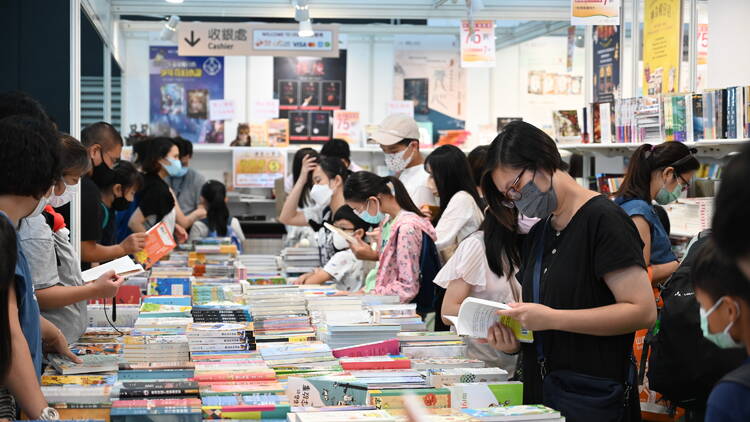
| Customers eager to snap up books at the Book Fair |
It was announced that the annual Hong Kong Book Fair will be held for a week starting on July 19 at the Hong Kong Convention and Exhibition Centre in Wan Chai, and that exhibitors could show books as long as they weren't banned.
The Hong Kong Trade and Development Council would not pre-screen books, "as long as the titles didn't breach the law, including the national security law.
![]() |
| Pick your books carefully, no breaking the law |
So she is basically saying there are no banned books, but if you sell anything the government deems illegal then you'll be arrested. The authorities don't have a list of the books, but surely you know what they are...
It's like the chicken and the egg -- which came first?
But clues can be found of what may probably not be displayed. In May some 200 books were taken off the shelves of Hong Kong libraries, many of them written by pro-democracy activists.
Most people would rather err on the side of caution than walk a fine line.
This is what Hong Kong has become, a place full of invisible red lines that are a minefield to navigate.
![]() |
| How would the government react to these titles? |
![]() |
| Libraries have removed books related to Tiananmen Square |
![]() |
| Chu says the move impacts government credibility |
![]() |
| Ma's novel is still available in the library |
Matsura (right) with a local in Okanogan County Frank (Sakae) Matsura, was the son of a Samurai in Hirado, Japan, but by the time he was gro...