Showing posts with label Greater Bay Area. Show all posts

Sunday, May 18, 2025

Review: Fallen Treasures

The film documents Hong Kong's last sawmill


This afternoon I went to see a Hong Kong documentary called Fallen Treasures at Cinematheque this afternoon. Thinking there would be a lot of people, I arrived 40 minutes early to see that the organisers, HK House hadn't even set up yet.

I waited outside and slowly a line started to form behind me, but it turns out when we were finally allowed in minutes before the screening, that only about 30 people came, though this is Victoria Day weekend, a public holiday.

Wong is passionate about woodwork
Directed by Elyse KY Hon, Fallen Treasures follows Wong Hung-kuen, the owner of Chi Kee Sawmill & Timber, the last sawmill in Hong Kong.

Hon had interviewed Wong in 2016 for a print story, but felt she could do a more comprehensive one on film. She began shooting in 2018 when he received an eviction notice because the government was going to develop the area into the Northern Metropolis, to connect Hong Kong with the mainland, and by extension into the Greater Bay Area.

The sawmill has old equipment, but continues to run well to remove the bark from tree trunks, and then slice them into planks. Wong patiently teaches young people how to make small chairs and stools, hoping that the next generation would be interested in woodworking. 

He is so passionate about his work that everyday he wakes up at 6.30am and makes the two-hour commute from Siu Sai Wan to Sheung Shui. Wong works there with his younger sister, who cooks meals for the both of them and his employee who has been with the company for many years.

After the screening Hon talked to the audience
But the deadline of moving Chi Kee is fast approaching and one might think Wong, in his 70s, would settle into retirement and close it, but this place is his reason for waking up everyday, and is focused on finishing commissions from clients than figuring out where to move the mill.

Wong is an endearing character, who is philosophical about life. Early on he says his son died at the age of 28 in 2010, and recalls the events that led to his passing. As the audience learns this piece of information, they become connected to him and understand why he wants to keep the sawmill going.

When he goes to a school to remove a tree that fell down during super typhoon Mangkut in 2018, he lights some sticks of incense to appease the spirits in the area. He can but also freely speaks his mind, saying the government claims it is concerned about the environment, but doesn't follow through.

For Hon, making Fallen Treasures was also a labour of love; she spent five years making the film on a shoestring budget. She recounted in an online Q&A session that the day of the deadline for Chi Kee to move was the last day the cinematographer helped her on the project and had to go back to their day job. So she had to continue filming it herself, as well as writing and editing.
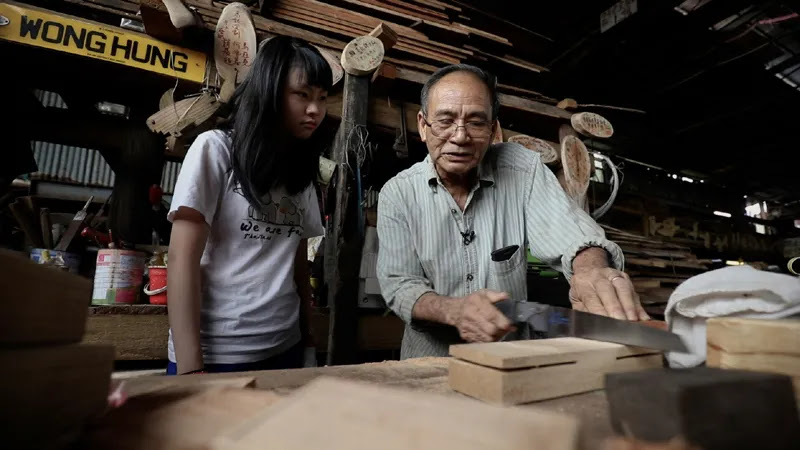
Wong patiently taught young people on weekends
The documentary is a profile about Wong, a record of Chi Kee's existence, and how the government handles evictions, and what it deems to be a cultural asset. Wong explains the sawmill uses only reclaimed wood and repurposes them into other useful items, which he believes is good for the environment. However, the government sees the sawmill as old, dated, and irrelevant.

Seeing Wong wanting to continue Chi Kee also gave her purpose and understanding why she was staying in Hong Kong, as she saw friends leave the city in the last few years. She feels it is important for her to stay and try to document things. When asked what she is working on now, Hon didn't specifically answer the question, but that she has found it's not easy to film things and comes across road blocks. 

Nevertheless, she explained it was hard to get the film shown; she didn't have a distribution network and Hon went into bookshops in Sham Shui Po asking them to help distribute leaflets about the film, or host screenings. She and Wong attended the screenings, and many young people remembered Chi Kee in the news about its impending eviction.

We were lucky to see the film in Vancouver, and Hon was so happy that people across the Pacific saw her work.


Wednesday, October 23, 2024

Promoting Construction with Construction

The Kau Yi Chau project will create 1,000 hectares of land

The Hong Kong government is pushing ahead with developing the New Territories with the Northern Metropolis and creating manmade islands called Kau Yi Chau Artificial Islands to build new housing and boost the economy, as the city integrates further into the Greater Bay Area.

Kau Yi Chau will create 1,000 hectares of land, but environmental groups are concerned about how the construction of the islands will impact the natural habitat, not to mention the cost, at the price tag of HK$580 billion over 10-15 years.

The Development Bureau is banking on these two massive infrastructure projects that it is proposing to shell out a whopping HK$600 million (US$77.2 million) to build an exhibition hall in Wan Chai to promote these projects by 2027.

Last year's policy address highlighted the need for exhibition space to showcase these two projects and Wan Chai North Promenade was chosen, directly across from the Hong Kong Academy for Performing Arts.

The space, which is about 5,000 square metres, will house a building that will be three to four stories high with a total area of about 8,000 to 10,000 square metres.

Construction will begin next year to open sometime in 2027.

What happens to the building after those two projects are completed?


Tuesday, September 17, 2024

Will a Cooking Competition Bring Back Diners?

The restaurant sector is holding a culinary competition

With fewer visitors coming in and locals going across the border or overseas on short jaunts, Hong Kong's hospitality sector is desperately trying to lure more "bums in seats", and has come up with a snazzy idea to try to tackle the problem.

The restaurant industry has come with a cooking event called the "Golden Chopsticks Creative Culinary Competition" where dining establishments need to come up with new dish ideas by October 31.

Lawmaker Tommy Cheung Yu-yan admitted the competition will not be able to "tackle all ills", but will encourage restaurants to try new things.

"We have had complaints from our customers in the last couple of years, and they probably could not see anything new compared to... if they travel to the Greater Bay Area," he said.

"[We want to] stimulate restaurateurs and hoteliers to think of new dishes so that customers from Hong Kong, where they come to our restaurants, they would have something new, and they probably want to come back again."

But isn't that what restaurants do periodically, come up with new dishes to entice diners to come back and try? Or have Hong Kong eateries been resting on their laurels this whole time and not had to think of new dishes to serve?

As much as the catering sector is trying very hard by holding this competition, it's not going to bring customers back by the droves; consumers are very price sensitive these days with inflation and high interest rates. So when dining out is at a fraction of the cost across the border because ingredients and labour are so much cheaper, how can Hong Kong restaurants compete with such low prices?

It could be back to the drawing board again soon...

Sunday, May 12, 2024

Will Visitors from Eight Mainland Cities Boost HK's Economy?


Can tourists from other parts of China revive HK's economy?

Hong Kong can boost its tourism numbers now that Beijing has approved visitors from eight mainland cities. They are... drumroll please...

These visitors can stay for up to seven days
Taiyuan, the capital city of Shanxi province
Hohhot in Inner Mongolia autonomous region
Harbin in Heilongjiang
Lhasa in Tibet
Lanzhou in Gansu province
Xining in Qinghai province
Yinchuan, capital city of Ningxia Hui autonomous region
Urumqi in Xinjiang

From May 27, residents from these cities will be able to apply for the Individual Visit Scheme to travel to Hong Kong and not need to join a group tour and can stay for seven days at a time.

The Individual Visit Scheme has been around since 2003 post-SARS in a bid to kickstart Hong Kong's economy. 

But will adding visitors from these eight cities help boost the city's businesses?

Does HK need more poseurs on the streets?
Tourism officials are projecting these tourists will visit Hong Kong for at least three days, meaning they will stay in hotels, but will they find the prices acceptable? They might do what others in the Greater Bay Area have done -- spend the day in Hong Kong and stay overnight across the border...

Are these the tourists who will spend money? 

Seems the Hong Kong Tourism Board has given up on long-haul visitors even though they are the ones who have the money to spend...

Sunday, December 17, 2023

Trying to Revive the Restaurant Industry


The revamped Temple Street market attracted massive crowds

The Hong Kong government is doing its part to save the restaurant industry by giving away HK$20 million (US$2.6 million) in HK$100 vouchers to the public, but one industry leader says this is but a "small Christmas gift" for the sector.

The first batch of coupons will roll out on Wednesday, with the second batch on January 10. 

But Simon Wong Kit-lung, a lawmaker and chairman of the Quality Tourism Services Association says the vouchers are hardly useful for both the diner and the restaurant.

Anyone want a HK$100 dining voucher?
"I do not think residents would make special arrangements to go out and dine solely because they want to use the vouchers, or change their travel plans and stay in Hong Kong for Christmas," he said.

A HK$100 voucher ain't much, considering how much it costs to eat out these days, it really isn't much of a motivation.

Instead, Wong said the government should do more to attract more residents from Shenzhen and the Greater Bay Area to visit Hong Kong as the city has become more "quiet".

He suggested reviving the multiple-entry permit, but it was suspended in 2015 when Hongkongers complained about parallel traders taking advantage of this permit and making numerous crossings daily to buy goods in Hong Kong to sell across the border.

Fish balls to Turkish coffee at Temple Street
Meanwhile nowadays Hongkongers are going up north to Shenzhen to spend their money to eat because it is much cheaper, there's more variety and lots to do and see.

Or maybe the government should take a page out of the recent Temple Street revamp which saw a massive crowd of people on the first night on Friday.

There are 32 food stalls, selling items from fish balls to imitation shark fin soup, and even French-style rack of lamb. 

People will check it out for the first few weeks, but if there aren't other new things to try, then it won't be sustainable for long...

Saturday, October 14, 2023

Insatiable Demand for Yo-Yo Ma


Ma returns to Hong Kong next month after a 7-year absence

Cellist Yo-Yo Ma will be performing in Hong Kong on November 8 with the Hong Kong Philharmonic, but demand for tickets to the concert is so intense on the secondary market that they cost as much as HK$17,000 (US$2,170).

The last time he was in Hong Kong was in 2016, which may partly explain why fans are willing to pay premium prices to see him -- though now local audiences are also competing with wealthy mainlanders in the Greater Bay Area who are more than able to shell out.

Ma (left) performed in Hong Kong in 2016
"Bay area billionaires want tickets," a source said, referring to Beijing's initiative to combine Hong Kong, Macau and nine cities in Guangdong into an economic hub.

Tickets were originally sold out on August, and now some people are trying to profit on the demand to see the virtuoso live. 

"If a fan pays HK$17,000 for a concert ticket, he or she may be better off by buying an air ticket to fly to the United States, book a nice hotel and join his concert," remarked Hong Kong cellist Eric Yip Chun-hei. 

Originally the tickets ranged from HK$480 to HK$1,980 and the concert is to celebrate the 60th anniversary of the founding of Chinese University. Ma has a personal connection to the university, as his late uncle, Li Choh-ming was its founding vice-chancellor, and the cellist also received an honorary doctorate of literature by the university.

Ma with pianist Stott
However, Ma's fans will have another opportunity to hear him as he will be performing two days earlier on November 6 in a duet recital with pianist Kathryn Stott at the Hong Kong Cultural Centre. Tickets for this concert go on sale October 18.

There will probably be yet another mad rush for these tickets...


Tuesday, July 25, 2023

Quote of the Day: MTR Chairman's Meaty Business

Auyeung says MTR will expand further into the mainland


The MTR Corporation has expanded its services to some cities in China and abroad, including the United Kingdom, Sweden and Australia.

And the semi-privatised company's chairman Rex Auyeung says MTR Corp will continue to extend its services in China, particularly in the Greater Bay Area, connecting Hong Kong and Macau with nine Chinese cities.  

But he says Hong Kong remains the bread and butter of the company, or rather a meatier metaphor.

"Hong Kong is our filet mignon, I cannot afford to lose sight of the Hong Kong business," Au said in a recent interview with a local newspaper.

We thought bread and butter was a staple, but perhaps for Auyeung, filet mignon is a must-have in his diet?


Sunday, September 4, 2022

Young People Leaving in Droves

Ming Pao's chart showing departure statistics


There is further evidence that a slew of young people have left Hong Kong for good.

Political economist and sociologist Hung Ho-fung posted a chart from Ming Pao listing the various age groups and how many have departed Hong Kong from December 2021 and June this year.

No surprise those in the 15 to 19 years group and 20 to 24 years group have seen the biggest departures at 11.8 percent and a whopping 23.4 percent respectively.

This is only a short time period and he believes there will be many more sending underaged kids overseas for school or fresh grads leaving this summer (that ends labour day, September 5 in North America).

He sarcastically adds: "I bet most of them have left for the great opps [opportunities] in the Greater Bay Area. Horray!"

Other age groups saw a drop:

25-29 (8.6 percent)
30-34 (2.1 percent)
35-39 (5.2 percent)

But for those 40 and older, that age group somehow increased.

40-44 (0.9 percent)
50-54 (4.5 percent)
60-64 (4.5 percent)
65 and above (12.5 percent)

In time we will find out where all these people have gone in the respective countries' census counts, and Canada is now more sensitive about finding out exactly where all the ethnically Chinese people came from, including an option for Hong Kong and mother tongue as Cantonese.

The Hong Kong government cannot frame this as a minor or temporary blip. These are permanent moves by people who are voting with their feet and wanting to have a better life elsewhere even if it means a big sacrifice of leaving the city they love so much.


VIFF -- Review: Our Mr. Matsura

Matsura (right) with a local in Okanogan County Frank (Sakae) Matsura, was the son of a Samurai in Hirado, Japan, but by the time he was gro...