Showing posts with label University of British Columbia. Show all posts

Tuesday, September 1, 2026

History Lesson About Pacific Spirit Park


Walking in Pacific Spirit Park


Several times a week I walk in Pacific Spirit Park, which covers 860 hectares, with 55km of trails, but didn't know much about the history of it until last week. 

Ryan Regier of the Pacific Spirit Park Society gave a talk recently to some neighbourhood residents and I sat in on most of the presentation.

Douglas Fir trees are second growth
He first showed a news video of the park's official opening on April 23, 1989, with then Premier Bill Vander Zalm and his wife Lillian booed by the Musqueam people, who inhabited this land long before Europeans settled in British Columbia, but had no say about the park, let alone its name.

It didn't seem like Vander Zalm thought to consult the Musqueam, or assumed they would use the land to build casinos, and thought he would pre-empt them by declaring the area a provincial park.

As Regier tells it, trees there used to be some of the tallest in the world before settlers came; it's because the Musqueam would only harvest the bark, and then the trees would grow back the bark and become bigger.

However, after the Europeans arrived in the 1850s, they saw the forest and by the 1890s chopped down all the Douglas Fir trees in what is now the park and used the wood to build most of the houses in Vancouver. Those trees were known as the old growth forest, and the ones standing today are called second growth, which are quite tall, but very skinny.

The park covers 860 hectares
An interesting fact is the Musqueam were living in the area for at least 5,000 years, if not up to 8,000 years ago. Camosun Bog gives us a good idea of what happened to the forest because the trees develop pollen, which falls into the bog and kind of like glacier ice, you can analyse what trees existed in the forest over time. How cool is that?

There are still some old growth trees left, but they are standing on the cliff above Wreck Beach, not the best place for them to flourish.

Regier says when the loggers chopped down trees, they would pour kerosene over the blade as a lubricant... not surprisingly it caused many fires in the forest! There was a large forest fire in 1919 that burned one-quarter of the park, and thankfully because of Camosun Bog, it stopped the fire from spreading to the residential area nearby.

The bog used to be quite large, but then when the University of British Columbia was building Sedgewick Library (now Koerner Library), the dirt that was dug up for the below ground library was dumped in Camosun Bog!

There is a group of volunteers called "crazy boggers" who are trying to restore the bog every Saturday  morning for two hours. 

Mostly Douglas Fir in the forest
It's great to see so many people love the park like me (perhaps much more!) and that we have a common goal of preserving it as naturally as possible.


Monday, May 4, 2026

Hong Kong Diaspora Get Together


The Mister Softee ice cream truck's jingle drew in customers


Today was the fifth Hong Kong Fair held at The Shipyards in North Vancouver today. It's become an event that brings together the Hong Kong diaspora, from those who immigrated decades ago, to recent arrivals, all with the common love of the city.

I tried to get there right after my Pilates class via bus and then Seabus. Already there were many people lining up for food, which is what I should have done, but I mistakenly walked into the cultural section first; when I tried to leave, a volunteer warned me I would not be able to get back in after I left! They really need to make this clear when walking to the entrance...

Does this describe a Hongkonger in Vancouver?
So I wandered around the stalls, many of them selling Hong Kong-related trinkets, like crochet versions of egg tarts and pineapple buns, milk tea kits, dog treats, postcards or prints of scenes of the city, tote bags with designs of White Rabbit candy or the old school Airplane game, jewellery, and books.

There was one picture book of Hong Kong that really resonated with me and probably many others -- the hand-drawn illustrations captured the flavour of the city. But instead I bought a 1,000-piece puzzle featuring a city scene of Hong Kong.

I finally left the culture area and tried to find the stall selling seafood congee. Holy Duck Chili Oil teamed up with Eat Fish seafood supplier and Masterchef runner-up chef Dez Lo to make two kinds of congee, seafood (featuring wild BC fish and seafood like jumbo prawns) seasoned with halibut stock, and shimeji mushrooms with vegan XO sauce.

Seafood congee was delicious
The queue was much longer than I thought and in the heat! It snaked along further so I must have waited about 45 minutes so I was very hungry by the time I got to the front. Dez was there, running off her feet, but in good spirits.

The seafood congee was ready to eat so I ate it as I waited for the mushroom one. I also chatted with the owners of Holy Duck Chili Oil, who were also selling their sauces as well as T-shirts. 

Both congee were fantastic -- the seafood one choc full of salted chunks of fish, giant prawns, and octopus, while the mushroom one was full of umami and had lots of mushrooms in it to give it a meatier texture. I later heard they were sold out of congee by 2pm! 

After having stood in line for so long I was not motivated to do that again and looked for the shortest queues. Snackshot had a very short line so I had some curry fish balls. There was a modified Mister Softee ice cream truck playing the same recognisable jingle, serving soft serve sundaes. 

Then I wandered into a large covered area where people were playing mahjong at several tables, and I saw my friends at the UBC Cantonese table. One showed me how to type Cantonese using Jyutping, the romanisation system for Cantonese that was developed in 1993.

Tote bags with nostalgic designs
She showed me how to download an app called Type Duck (打得) and the spelling is not what I'm used to, but it immediately shows different characters with similar sounds so it helps you learn more words. I will try to play around with it more.

It was almost 3pm when I decided to go home... and I was exhausted!

Sunday, May 3, 2026

Icelandic Pianist Olafsson Wows Vancouver


Olafsson received many standing ovations


The first Icelandic musician I knew of was Bjork, and then most recently Laufey. But I should have probably known of pianist wunderkind Vikingur Olafsson, who gave a spellbinding performance at the Chan Centre at the University of British Columbia last night.

The 42-year-old Icelandic musician has received numerous accolades recently, including a 2025 Grammy Award for Best Classical Instrumental Solo for his interpretation of J.S. Bach's Goldberg Variations, and a Gold Medal from the Royal Philharmonic Society, is the highest honour given to an artist for their musicianship, and previous recipients include Johannes Brahms, Sir Edward Elgar, Sergei Rachmaninoff, Richard Strauss, Leonard Bernstein, Isaac Stern and Yo-Yo Ma.

He is praised for his musicianship
Olafsson started learning piano at an early age, taught by his mother, and then he later studied at Juilliard School in New York. 

In 2023 he started touring, just performing Bach's Goldberg Variations -- 88 times. Later that year he made a recording which was released by Deutsche Grammaphon.

Not only does Olaffson interpret music on the keys, but also educates the public about it through TV and radio programs. After he finished performing for an hour and a half straight, he was very comfortable coming back on stage and speaking to the audience.

What's also interesting about him is that he has synesthesia, a perceptual phenomenon where he can see colours in musical notes. For example, he associates F minor with blue, A major with yellow, and B major with purple.

Last night he performed a program featuring Bach, Beethoven, and Schubert with pieces all in the key of E (which he sees in green). 

Olafsson comfortable speaking to the audience

Prelude in E major BWV 854 by Bach

Sonata No. 27 in E minor, Op. 90 by Beethoven

Partita No. 6 in E minor, BWV 830 by Bach

Sonata in E minor, D 566 by Schubert

Sonata No. 30 in E major, Op. 109 by Beethoven

He performed them one after the other without any breaks. At times he would lower his head so far down that as I was watching from the far left, it seemed as if his head was missing! If he finished a piece he would lean back dramatically with fingers on the keys lingering for an extra moment before launching into the next piece.

At first we the audience were trying hard not to move too much, but after a while we realised his style of performing was without any breaks so people would shift slightly when he started a new piece or movement. It's hard for people, particularly seniors to sit completely still!

Nevertheless, they were all excited when he finished the program and everyone jumped to their feet to give him a standing ovation several times.

Laufey and Olafsson!
And he obliged with three encores, two of which were his own arrangements: Bach's Air on a G String, and Icelandic composer Sigvaldi Kaldalons' version of Ave Maria. The third piece was Rameau's Rappel des oiseaux.

He's not just strictly classical either -- on the internet I discovered Olafsson enjoys Chinese-Icelandic Laufey's music and he has even reinterpreted her song Bewitched!


Saturday, April 4, 2026

Maria Ressa Warns Democracy is Fragile

Ressa (left) shared the stage with CBC anchor Arsenault


Last night I had to opportunity to listen to journalist and Nobel Laureate Maria Ressa speak at the University of British Columbia in Vancouver.

Held at the Chan Centre for Performing Arts, the almost sold-out audience gave her a standing ovation as she walked on stage, and she was so excited by the warm reception.

It's not easy to have Ressa come half way around the world, when she still has charges in court to fight; Ressa explained to CBC host Adrienne Arsenault that every time she wants to travel, she has to ask the courts for permission.

The talk was held at UBC in Vancouver
She didn't explain whether all her travel requests are granted or not, but we were thrilled to have the democracy activist and tech geek on stage.

The first time I heard Ressa speak was in 2018 at the SOPA or The Society of Publishers in Asia, where I received an Honourable Mention for my story. As the keynote speaker, she talked about her media company Rappler and how they use Facebook to disseminate their stories.

However, they found there were opposition voices on the social media site, proxies that would spread disinformation about their stories on Facebook, and those posts got more attention, thanks to algorithms. This created distrust in Rappler, and media in general. It was frightening to hear.

While Ressa and her Rappler team have been able to systematically analyse how this all happened, things have gotten substantially worse in the virtual world, as she outlined in last night's lecture.

Through her powerpoint presentation, Ressa showed how the opposition created horrible memes of her -- putting her face on top of a scrotum -- and showed us the image -- though she joked that her skin wasn't that dry.

The intensity of the personal attacks have gotten worse, and her team has found that it is particularly bad for female journalists, and even worse for female journalists of colour.

Ressa's 2022 book
She also talked about how seeds of disinformation are planted years in advance in social media, and then constantly repeated; once a real event happens, those bogus seeds quickly sprout and spread online like wildfire and it's near impossible to rectify the situation.

Why is this all important? Ressa believes facts, truth and justice are crucial in a democracy. When you have the facts you have the truth, and when you have the truth, you can pursue justice.

However, why is it that over 70 percent of countries today have authoritarian governments? And just south of us, Ressa noted that Donald Trump has turned the United States into a dictatorship within his first 100 days in office. She said former Philippine President Rodrigo Duterte did it in six months.

Sounds chillingly familiar to Hong Kong after the national security law was enacted in 2020.

In the case of Trump, he has managed to sideline the media, senate and judiciary, and use social media to promote his policies without any checks and balances. He signed 142 executive orders in 100 days; in his first term he signed 220 EOs.

Already in the first term Trump discredited the media, saying they were fake news. Now he just disseminates his thoughts on his own social media platform, Truth Social.

Ressa asks why Canada has not built its own social media platform! Why rely on tech bros like Mark Zuckerberg and Elon Musk to spread journalistic stories online? They had prime time seats during the inauguration! 

Zuckerberg removed fact checkers from Facebook too, and refuses to allow people to post legitimate media stories online. What we are left with are opinions of people that are without integrity.

More people joining No Kings protests
But there is some optimism. Ressa says the No Kings protests are getting bigger each time. she cited Harvard political scientist Erica Chenoweth's research that it takes around 3.5 percent of the population actively participating in protests to ensure serious political change.

Last week some 8 million Americans took part in the latest No Kings protests in all 50 states; perhaps the next one will galvanise 12 million people, or 3.5 percent of the US population...

Ressa says we are lucky in Canada to still have democracy... do we? She warns us to be vigilant and to stand up to things we believe are wrong, otherwise it will be normalised.

Many in the audience bought a copy of her 2022 book, How to Stand Up to a Dictator, and they quickly lined up after the talk, waiting for her to sign their copies.


Sunday, October 19, 2025

Cantonese Humour on Show in Chinatown

Sio and Mahbubani answered questions from the audience

Two Cantonese-speaking stand-up comics came to Vancouver and I watched them perform this afternoon at the Chinatown Storytelling Centre and had a good laugh listening to their humour.

Vivek Mahbubani is South Asian and born and raised in Hong Kong. Several years ago he was an anomaly because he speaks fluent Cantonese, and not only that, he won in the Cantonese category for Hong Kong's funniest person in 2007, and then in English the following year.

His jokes are mainly inspired by his experiences and observations as a South Asian living in Hong Kong. He still gets a lot of shocked expressions from locals when he opens his mouth. In his routine he started off by saying he went to eat at a cha chaan teng, and because it was busy, he had to share a table with a young couple.

Watched the Cantonese version of the show
Mahbubani looked at the menu and said, "Waiter can you take my order?" in Cantonese, to which the young woman across from him pointed and exclaimed, "You can speak!"

Her boyfriend tried to shut her up. "If he can speak then he can understand what you're saying!"

Another time he got into the MTR carriage and saw there were three seats in a row that were empty. He sat in the middle one -- and adds no one sat next to him because of racism. Ouch! But probably true.

Then two girls who were friends entered the carriage chatting, and then sat on either side of him and continued talking to each other as if he wasn't there. 

Then one said, "Hey this guy has a beard and hasn't shaved."

It's then that Mahbubani says this is when he waits to find the right moment to reveal that he understands what they're saying.

So he waited and then pulled out his phone and said, "Wei?"

And then added, "Yes I'm going to buy a shaver today."

He also gives the usual Hong Kong observations of how everyone stands on the right of the escalator so that those who are in a hurry can walk up the on the left. But there's always someone who insists on standing on the left, holding up the person behind (usually him). Time is money, right?

The other comedian is Joanna Sio, who grew up in Hong Kong too, went to UBC and is married to a Czech husband with two kids.

Both comedians are from Hong Kong
She started off by saying the couple decided early on not to learn their spouse's native language because you never know if you're going to divorce soon. But since they moved to the Czech Republic a few years ago she has learned for a year or so.

But most of her routine was about her growing up in a 400 sq ft flat with eight people in the family. Sio talked about how her father had a terrible temper and would take it out on... a watermelon.

"He knew kungfu -- from watching TV -- and would use his hand like a knife to chop the watermelon in half. We would watch and not say a word," she recalled.

Then one time he was really angry and took out a watermelon and Sio said they watched as his hand went down on the watermelon, but it didn't chop in half like usual. His hand was sore and retreated into his bedroom for hours.

"I was the only person who knew why he couldn't chop the watermelon in half. That's because I had put it in the freezer earlier."

She also talked about how they bought live chicken at the market, but didn't kill it right away. They waited a day or two to see if it was healthy. It was her grandmother who did the dirty deed. She would cradle the chicken in her left arm tightly and then cover its eyes before she used the cleaver to chop its neck and let the blood drain so that they could use it later for other dishes.

After several years, her grandmother was too old to kill chickens, so the task fell to Sio's mother -- who had never done it before. So she grabbed the chicken in her left arm, held it tight and covered its eyes. But she couldn't bring herself to kill it. "She said, "Kids we're not eating chicken tonight."

But because she was holding the chicken so tightly, it had died.

Many people in the audience were second generation Chinese-Canadian and told the comedians they could understand most of what they said, which was heartening for them to hear. One asked how Mahbubani got into comedy and he said it was because of the show Seinfeld.

He said the show opens with Jerry Seinfeld on a stage telling jokes and Mahbubani wondered what that was and how he could do that. He got into it in 2007, but had to do a lot of odd jobs to keep his dream alive. Now he can pick and choose which gigs he'd like to do.

Someone asked about the differences between comedy in English and Chinese. Mahbubani says in Chinese because of the fear of losing face, he never singles out people in the audience. Instead he talks about "we" or "I" when telling stories.

Sio says if people don't get her jokes she takes it personally and will rewrite them to try to improve. She admitted that she has a fear of speaking in front of an audience which is why she went into improv and then stand-up to build confidence. When her routine goes well it makes her very happy and gives her more confidence to speak in front of people! 

Monday, May 12, 2025

HK Immigrants Gather at HK Fair


A semi-outdoor area featured numerous stalls to buy items

Today was the fourth annual Vancouver Hong Kong Fair and I finally checked it out for the first time. Just like last year, the fair was held at The Shipyards in North Vancouver and I'm glad I went. It's the closest thing for like-minded Hongkongers to meet up, share and enjoy their culture.

I was on a tight schedule with a concert to attend in the early afternoon, so I took the bus downtown just before 9.30am and caught the seabus at Waterfront station to get there at 10.30am before it opened half an hour later. There was already a small line for ticket holders that already formed though the signage wasn't very clear.

Back copies of Apple Daily were for sale
The fair opened a few minutes after 11am and they scanned my QR code and gave me a bright pink bracelet before I could wander around the outdoor fair in a covered area. It's a good space, and I was glad I went early because I can see how it can get crowded very quickly.

There were all kinds of stalls selling handmade beauty products, cookies like salted egg yolk shortbread, treats for dogs shaped like egg tarts (my cousin's dog wolfed them down later), Chinese books, jewellery, Lion Rock T-shirts and tote bags, Hong Kong-themed coasters, key chains and artwork.

One stall was run by activists who are raising money to help people back in Hong Kong. There was a stack of Apple Daily newspapers, and included the copy of the last publication of the paper for C$50. Manning the booth was former Hong Kong radio host "Giggs" Edmund Wan Yiu-sing, who was jailed for 32 months for sedition and money laundering who are raising money to help people back in Hong Kong. 

Curry fish balls with peanut sauce
Another section was food one could buy and eat there, like curry fish balls, various sweet drinks with sago in them; I tried one with durian, coconut milk and sago. Hong Kong milk tea was also available as well as mango mochi.

Recently re-elected NDP MP Jenny Kwan was at the opening ceremony and gave a bilingual speech explaining that she was originally from Hong Kong and grateful to be in Canada. She promised she would help ensure the Canadian government would approve all Hong Kong immigrants' applications for permanent residency. She got a big round of applause.

In an indoor space was the cultural section, where UBC Cantonese had a booth, an area showing the black and white photographs of legendary photographer Chan Kiu, who passed away in Vancouver last year at the age of 96. There were pictures of Vietnamese refugee children eating from basins, the funeral of Bruce Lee, and Queen Elizabeth II's first visit to Hong Kong.

There were also mahjong tables for people to play the game, or learn how to make paper lanterns. An interactive exhibit featured various places in Hong Kong with photographs matched with scents from those areas.

MP Jenny Kwan spoke in Cantonese
I also got to meet up with some people I had met before and catch up with them, and get to know what others are doing in Metro Vancouver, from holding Cantonese summer camps to drawing workshops.

After about an hour and a half, I made it back to the seabus with two minutes to spare. As I was leaving there were more people lined up to go in, and even more spilling out of the seabus. Now I know why people make an effort to go because settling in Vancouver isn't easy; at this event they feel strength in numbers, and feel understood and appreciated.


Thursday, April 17, 2025

Russian Pianist Wows Vancouver Crowd


The stage was set for Kissin to perform at the Chan Centre


Tonight the crowd at The Chan Centre for Performing Arts at the University of British Columbia were treated to not one, not two, but three encores after an exceptional performance by Russian-Jewish pianist Evgeny Kissin.

This is not his first time performing in Vancouver. Apparently his first concert here was at the Orpheum and it was sold out. 

I wasn't familiar with Kissin, 53, but a quick online search revealed the Muscovite was recognised as a child prodigy at the age of six and made his professional debut at the age of 10. 

He made his overseas debut in 1985 in Eastern Europe, and performed in Japan a year later.

Kissin soaking in the adoration
Kissin is also a composer and enjoys reciting poetry, both Russian and Yiddish poems.

When the war in Ukraine broke out in 2022, he and other Russian artists signed a letter against the invasion and even composed a piano trio in response to the invasion that Kissin premiered in Amsterdam in October 2022. 

Needless to say, two years later the Russian government declared Kissin a foreign agent. 

He lives in Prague with his wife. During the concert this evening, the crowd was rapt watching Kissin play the piano which was hardly shiny and new -- he specifically chose to play a piano from the music department at UBC. It has seen better days, the black lacquer rubbed off in many areas revealing its wear and tear.

But Kissin gave the instrument a lot of love -- he wasn't interested in sleek-looking pianos and theatrics, just pure joy in performing. And the audience loved him back, jumping to their feet and clapping practically non stop. Perhaps that's why he was easily swayed into giving the crowd three encores!

Every time he bowed, he made a point of looking up at the audience, soaking in the admiration. 

Performing could be his form of resistance and we should appreciate his courage too.

Partita No. 2 in C minor BWV 826 by Johann Sebastian Bach 
Sinfonia
Allemande
Courante
Sarabande
Rondeau
Capriccio

Nocturne in C# minor Op. 27 No. 1 by Frederic Chopin

Nocturne in A-flat major Op. 32 No. 2 by Frederic Chopin

Scherzo No. 4 in E major Op. 54 by Frederic Chopin

Piano Sonata No. 2 in B minor Op. 61 by Dmitri Shostakovich
Allegretto
Largo
Moderato
Adagio

Preludes and Fugues Op. 87 by Dmitri Shostakovich
No. 15 in D-flat major

Preludes and Fugues Op. 87 by Dmitri Shostakovich
No. 24 in D minor

Tuesday, February 25, 2025

Remembering Roberta Flack

The singer and pianist Flack died today at the age of 88

When I was in my freshman year at university, the Asian club I was a member of held a karaoke contest so I joined.

The song I chose to sing? Killing Me Softly with His Song, famously sung by Roberta Flack.

In order to sing it well, you need to enunciate the words and with emotion.

Flack was also a school teacher
Also it's not an easy song to sing, the phrasing is long, which means you need to take a deep breath to get all the words in.

In the end I didn't win the top prize but was in the top 10; it's a 1970s song that wasn't familiar to the crowd of teenagers and 20-somethings in the early 1990s.

I dig up this memory today to pay tribute to Flack, who died today at the age of 88. Three years ago she was diagnosed with ALS (amyotrophic later sclerosis).

The obituary in the New York Times describes her as a virtuoso classical pianist who liked to sing in the choir. Her repertoire ranged from Bach, Handel, Verdi and Mozart, to what she described as "Negro spirituals." 

Later on her approach to performance was to reveal herself through her voice.

"I want everybody to see me as I am," she told The National Observer in 1970. "Your voice cracks? OK, darlin', you go right on and keep giving it what you've got left, and the audience ignores it and goes right along with you. I've found out the way to get myself through to people is just to unzip myself and let everything hang out."

This album made her world famous
She became a grade school teacher in North Carolina, but after a year she went to Washington and taught in junior high, and in the evenings sang in nightclubs. Flack caught the attention of people like Burt Bacharach and Johnny Mathis, and even played a duet with Liberace.

In 1972 she heard the recording of Killing Me Softly with His Song by Lori Lieberman. Flack played it over and over again in her headphones and developed her own version of the song, which she sang as an encore while opening for Marvin Gaye. The crowd went wild.

Producer Quincy Jones was in the audience and counselled her to record the song before she sang it again in public. 

A year later she released the song that would become Flack's signature song for the rest of her life. 


Saturday, February 15, 2025

Flying the Flag of Defiance

Canadians will be waving the flag proudly on Flag Day


On Saturday we will mark the 60th anniversary of Flag Day, when the red and white flag of the maple leaf was unveiled.

Flag Day has even more importance now with American President Donald Trump constantly threatening to turn Canada into the 51st state.

The latest Leger poll found 85 percent of Canadians are proud to be Canadian.

Earlier this week five former prime ministers: Joe Clark, Kim Campbell, Jean Chretien, Paul Martin and Stephen Harper signed a joint statement encouraging Canadians to fly the flag as "never before" with pride.

"Let's show the world that we are proud of our history and proud of our country," the statement said.

Bradley Miller, associate professor of history at the University of British Columbia, said the design of the flag, with no military or religious symbols, makes it adaptable.

"It represents whatever we want it to represent," he said. "Having a symbol, a flag, that is as much a blank slate as ours is an advantage to a country that needs to be able to accommodate."

In the current situation, he said the flag is a symbol of defiance.

"As often happens in history, an external threat can resolve our internal doubts," Miller said. "I think that's happened here, at least right now."


Friday, December 27, 2024

UBC Under Fire for Renting Space to HK Govt


UBC Robson Square campus recently rented to HKTEO

It was recently reported that the University of British Columbia rented out a room to the Hong Kong Trade Economic Office for a recruitment exam, much to the horror of activists in Vancouver.

On December 7, the HKTEO rented a room at the UBC Robson Square campus to conduct a recruitment exam, and in it were questions regarding the national security law. It is not clear what jobs were being recruited.

The sign says: "Common Recruitment Examination and Basic Law and National Security Law Test Joint Recruitment Examination".

Recruitment exam related to NSL and Basic Law
An organisation called Chinese Canadian Concern Group on the Chinese Communist Party's Human Rights Violations wrote a letter to UBC President and Vice-Chancellor Dr Benoit-Antoine Bacon on December 22 expressing their disapproval of renting the room to the HKTEO.

"Successful candidates for this examination are required to swear allegiance to the Hong Kong, and by extension Chinese governments," said the letter.

"Allowing this recruitment activity on UBC's campus raises serious national security concerns for Canada, especially in the context of potential conflicts between the two governments. Such actions could pave the way for the infiltration of foreign authoritarian influence into our society."

New Democrat MP Jenny Kwan also criticised UBC for renting the space to the HKTEO; while she said the university can rent their space to anyone, it should have some ethical standards when doing so.

Meanwhile UBC acknowledged people's concerns, but said the exam didn't violate any of its rules, and that it rents space out to many groups, but doesn't mean it endorses their views.

Kwan says UBC must have ethical standards
Kwan says the response is "completely inadequate".

"It's just basically saying, well, it doesn't matter. We're blind to all of these issues," she said. 

"As a global institution, which is what UBC is, you would think that they would have a little bit more thought than to say, 'We will just follow the regulations of basic rental requirements.' That's not good enough."

She said the Chinese government is trying to recruit people to work in Hong Kong and China, and the applicants must demonstrate their understanding of the national security law.

"UBC of course can rent their space to anybody. However, from my perspective, I think that you should be looking at some ethical standards that should apply," she said. 

"In the very minimum, one would think that any organisation, any institution that's going to rent out a space to a government that is a regular, persistent, violent human rights violators, that they would apply some standard to it."


Monday, November 18, 2024

Review: Arthur Erickson: Between the Lines


Erickson was considered one of the best architects in Canada

This afternoon watched a fantastic biographical film called Arthur Erickson: Beauty Between the Lines produced by Black Rhino Creative which is based in Vancouver. The film debuted a few weeks ago at a local architecture festival and was sold out for all three dates.

I was hoping to have a chance to see it and Viff is showing it now.

The Museum of Anthropology at UBC
Arthur Erickson was a well known Vancouver-born architect, and he designed a number of key buildings in the city, from Simon Fraser University, to the Museum of Anthropology, the Law Courts with Robson Square, and MacMillan Bloedel Building, renamed Arthur Erickson Place three years ago.

His designs were also in Toronto like Roy Thomson Hall, the Government of Canada pavilion at Expo '70 on Osaka, Japan, and the Museum of Glass in Tacoma, Washington State.

The film brings Erickson to life from a lot of television interviews together with his niece and nephews (two of whom are architects), and former colleagues and staff that give a more rounded picture of him.

It turns out Erickson was able to compartmentalise his life, as he hid that he was gay for a long time, and knew being gay was bad for business at the time; however he had a partner he loved very much who sadly died of Aids in the 1990s.

Campus of Simon Fraser University
When Erickson was young he was a talented artist, but in World War II he was in the army, where he learned Japanese in a bid to avoid combat. After the war he was keen on joining the diplomatic corps, but then a friend showed him a picture of Frank Lloyd Wright's architecture and Erickson was amazed and wanted to learn how to create buildings in nature.

Erickson studied architecture at the University of British Columbia and in McGill in Montreal where he became friends with the future Prime Minister Pierre Trudeau. 

Afterwards Erickson taught at UBC and began designing houses. He later met Geoffrey Massey and the pair went on to win the commission to build the SFU campus which was innovative at the time. They looked to the Acropolis for inspiration, how higher learning was found on the top of a mountain. They also created quadrants so that students and academics of different disciplines would interact with each other. 

One of the complaints was that in winter it was so dreary on campus that a professor once complained to Erickson about it. He replied that since the building elicited emotion, then the architect had done his job.

Roy Thomson Hall in Toronto
He was already very understanding of Indigenous culture, and the Museum of Anthropology demonstrates this, with the museum and totem poles facing the sea and how natural light affects how visitors see things in the space. 

From there they got a number of commissions inside and outside of Canada, but Massey was getting annoyed with Erickson's frivolous spending habits to please his partner, Venezuelan Francisco Kripacz, who designed furniture, went bankrupt and then Erickson took him in as an interior designer. 

Kripacz added flair to Erickson's designs, which made them a good team, but he had extravagant taste and influenced the architect to spend a lot of money. One time a party in their Los Angeles office cost $50,000 -- just for flowers.

Financial problems caused Erickson and Massey to break up their practice, and later on Erickson broke up with Kripacz. Erickson had another boyfriend, but then a mysterious disease called Aids was killing gay men, and his boyfriend died, as well as Kripacz's.

The two reunited, but Kripacz was infected as well. This was also around the time that Erickson declared bankruptcy in 1992, unable to pay all his bills. It was devastating because it meant he was unable to keep his license as an architect and would have to literally start all over again taking courses -- Erickson of all people who had taught architecture!

He refused, so he gave up his license, but was pretty much broke. In the 1990s Erickson phoned around, asking doctors for any kind of experimental drug that would help his partner; Erickson found some uncashed traveler's cheques and went to give them to Kripacz, but discovered he had committed suicide.

Kripacz was Erickson's longtime partner
His niece and nephews said Erickson could not get over this, and towards the end of his life began developing dementia. He would sit in his office with a magazine and forget about appointments and things he had to do. In the end his relatives had to put him in a home, where he did not last long, and died in 2009 at the age of 84.

I learned a lot about Erickson's life and career, as well as his approach to the various projects he worked on. Vancouver is so lucky to have many of his buildings, pockets of his vision around the city. It also helped that governments were willing to invest in big infrastructure projects like the provincial law courts and Robson Square to create public spaces for people.

Arthur Erickson: Between the Lines was a lovely tribute to him and showed that even when facing adversity, he did it with style. Even when he was announcing his bankruptcy he never let on his disappointment or frustration; he just carried on, dressed in his sharp suits.


Saturday, October 26, 2024

Anthony Wong Yiu-ming in Vancouver


Wong performed last night in Vancouver


Last night I attended my first Cantopop concert! In all my years living in Hong Kong I never went to one because I wasn't familiar with the music, no one asked me to go, and it felt inaccessible.

But a friend asked me to go see Anthony Wong Yiu-ming in Vancouver and I shelled out for a pretty good seat, only metres away from the stage at The Centre downtown. I'm surprised that since 2013 the building, which used to be owned by four brothers from Hong Kong is now owned by Westside Church! Nevertheless it's a great venue, clean and comfortable seats. Several Hong Kong bands and artists have used this place, partly because the staff are not in a union.

He was last in Vancouver five years ago
I was expecting a band with dancers, but it was very scaled down, Wong with two musicians who mostly played synthetizers, and one periodically played guitar, the other played the accordion for one song. 

Wong's fans were excited to see him -- one near the front even had a bright sign lit up with LED white lights that said "明哥" or "Ming Gor", a term of endearment. Many wore either his current concert tour T-shirt, or previous ones.

I don't know the songs that he sang, but later in the show he sang Joni Mitchell's Both Sides Now. Wong explained that when he goes to a different place he likes to sing a song from there. As French is also spoken in Canada, he sang a song by Edith Piaf.

He explained he admired Jean Cocteau, a Renaissance man in his day, who was a poet, playwright, novelist, designer, film director and visual artist. He was good friends with Piaf. She died October 10, 1963, and Cocteau died the day after.

Wong noted that Anita Mui Yim-fong was born October 10, 1963...

Early on in the show fans rushed to the stage to give him flowers. My friend had heard earlier that Wong had asked his fans not to give him flowers but money instead. Possibly a joke? But Wong was grateful to receive the flowers and read out a few of the cards, though these fans had written very long letters to him and he couldn't read them all.

He sang a mix of new and old songs
On stage, Wong drank a lot of liquids, as he coughed a bit. But after he seemed to end the show, and the audience clamoured for him to come back. He finally appeared and seemed to have his second wind and sang songs that Joseph Koo Kar-fai had written, again explaining it was because the legendary composer had lived in Vancouver (until he died last January). Wong seemed to be excited and told the audience he was singing yet another song that he didn't perform in Toronto, which got his fans all cheering.

The show started at around 8.20pm and didn't end until 11pm!

This evening, he came to the Asian Centre at the University of British Columbia to talk about his work in Cantonese. Again the room was filled with fans, almost all from Hong Kong, with a few from China.

Someone asked him if he would stay much longer in Hong Kong given the situation, and his brushes with the law. Wong admitted that he had thought about leaving, but he said his loved ones are in Hong Kong which is why he will stay. He added that he feels like he doesn't belong anywhere in particular and that's fine with him.

Another asked about his songwriting process and this was where Wong praised his collaborators, the two musicians who were on stage with him, along with a few others. He said it was a collaboration, where he might have some ideas and they try to realise it for him, and it's a back-and-forth collaboration; Wong insisted he could not do it by himself as he does not know how to read music, let along write it, but he has ideas, and these musicians have the technical ability to help him.

Fans asked Wong questions at UBC
One woman asked about his influences and how he curated them. He said there were too many to say what they were, but explained that when he was a child, he helped his father with his work and for that he got some pocket money. Wong would spend it watching movies in a theatre that changed films every two days so he watched a lot of them. He also listened to a lot of music too and from there he said he has been exposed to a lot of different things.

A fan asked about why Cantopop is not as globally popular as K-pop and he said it's because the Cantopop songs are very Hong Kong, it's about the place, the people, the circumstances... with K-pop it has a melody that is accessible and the lyrics are generic, that everyone can relate to.

Wong was gracious with his time and answered each question with lengthy replies; other celebrities might just answer with a word or a quick sentence or two. His fans hope he will come back again soon -- his last concert in Vancouver was five years ago!


Friday, June 21, 2024

Stumping Jeopardy! in Cantonese

A Cantonese question made it on Jeopardy!


A local instructor in Cantonese at the University of British Columbia is grinning from ear to ear tonight after seeing a question he helped develop be read on tonight's segment of Jeopardy!

For $1,000 the question was: "As the word for this number sounds like it means "certainly death", Cantonese speakers have a collective case of tetrakaidekaphobia."

The first contestant said, "What is 13?"

Nope, but that is the meaning of tetrakaidekaphobia...

The next one said, "What is 4?"

Also incorrect, but on the right track.

The final contestant said, "What is 52?"

No...

"What is 14"....

The backstory is that two years ago a writer from the game show had the question and reached out to the university department to confirm the accuracy of it. The instructor revised it and now it's a question that will be remembered for stumping all the contestants!


Friday, May 17, 2024

Promoting Recycled Chopsticks at YVR


Come get your recycled chopstick coasters at YVR!

At YVR or Vancouver International Airport I was surprised but pleased to see a Vancouver business featured in the duty-free gift shop.

The company is called ChopValue which collects used bamboo chopsticks and washes them and repurposes them into all kinds of products from coasters to tables, and wall panelling. 

Need a cribbage board? Here's the one for you
It's the brainchild of Felix Bock, a German wood engineer who was in Vancouver pursuing a PhD in bamboo composites at the University of British Columbia. Living in the west coast city he became addicted to sushi and realised he was throwing away a lot of disposable chopsticks. 

He had wanted to tackle urban wood waste and thought recycling chopsticks would be a good start and founded ChopValue in 2016.

Today the company has recycled some 30 million chopsticks, each week processing some 350,000 chopsticks. Restaurants collect the used chopsticks which ChopValue collects and then processes them. The company works with clients to see how they can design specific furniture or other items for them out of the recycled chopsticks.

ChopValue explains what they do
But in the airport gift shop, ChopValue was selling sets of coasters and cribbage boards. The coasters explain each one is made of 75 recycled chopsticks, and 343 for the cribbage boards.

Still it's a neat way to not only promote what the company is doing, but also showing what recycled chopsticks look like.

Wednesday, July 12, 2023

More Hongkongers to Arrive in Canada


More young Hongkongers can consider moving to Canada

A friend contacted me tonight, excited about the news that Canada has made it easier for Hongkongers to immigrate.

Previously only young people who had graduated within the past five years could apply for a work permit to work for a year and then be eligible for permanent residency, or study a post-secondary degree.

But now anyone who has graduated within the past 10 years from a recognised Hong Kong tertiary institution can come to Canada, work for a year and get permanent residency.

Chiang made the announcement this morning
The move was announced this morning and will come into effect on August 15.

"Removing this requirement means more Hongkongers who have worked in Canada will be eligible for permanent residency, easing the transition to permanent status for those who are already working in Canada under the open work permit program," Paul Chiang, parliamentary secretary to the minister of housing and diversity and inclusion, said on behalf of the immigration minister.

He added those employed under the "working holiday program" were also eligible to apply for permanent residency after a year.

The move came after those who previously would not be able to apply because they graduated in 2016 and 2017, lobbied the government to widen the eligibility to include them. They formed a concern group that numbered in the hundreds, and so they were thrilled to hear the news this morning.

"Our demand was just to expand the scheme to cover 2016 and 2017 graduates, but it turned out the result is better than expected," said Connie Chan, a 29-year-old who graduated in 2016.

There are now 76,000 Hongkongers in Vancouver
University of British Columbia student Christopher Ng says the loosening of the requirements now makes it easier for Hongkongers to decide where to migrate.

"It's also opening another door for people my age to consider Canada as an option other than the UK and Australia. And it's definitely the easier way," he said.

From 2016-2021 there has been a 6.1 percent increase of Hong Kong-born people in Metro Vancouver to make the total number of Hongkongers 76,000. 

The program runs until 2025. In the meantime from mid August Canada should expect a flood of applications, but at the same time the government needs to ensure there is enough housing and support for these young people. 

They are currently dealing with a repressive government in their hometown; Canada needs to step up in welcoming them with supports to enable them to flourish here.

Monday, May 29, 2023

June 4 Remembered in Vancouver


"Don't Forget June 4" written in chalk on the ground


The Vancouver Society in Support of Democratic Movement commemorates the June 4 Tiananmen Square massacre every year, with not only marches to the Chinese consulate on the anniversary day, but also events leading up to it. 

This year the group moved up the march to May 27, where New Democratic Party MP Jenny Kwan participated. She was recently cited as one of two politicians a Chinese diplomat allegedly targeted. The diplomat was subsequently sent back to China. 

Meanwhile two remembrances were held today in two locations. 

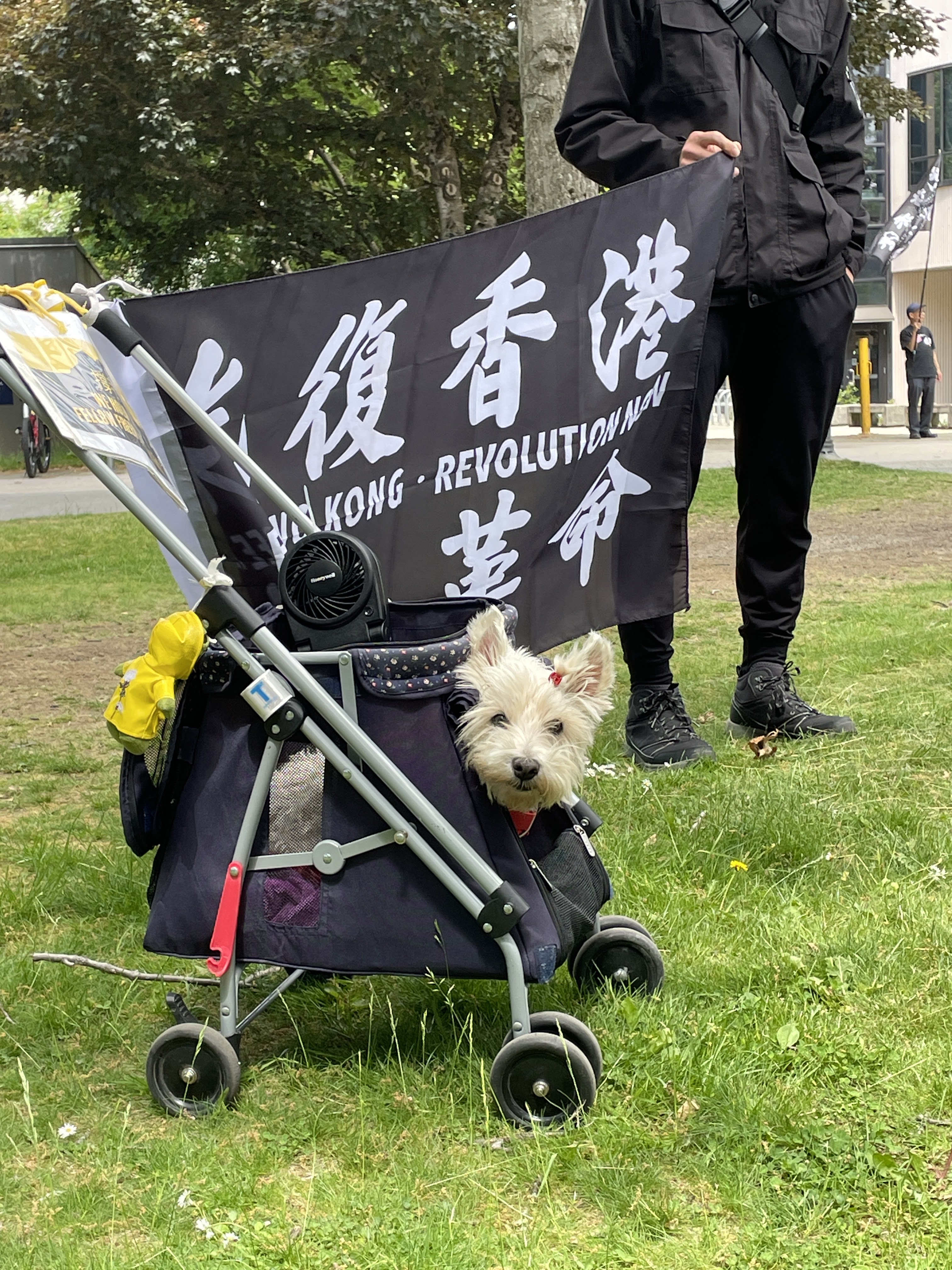
A terrier took part in the event
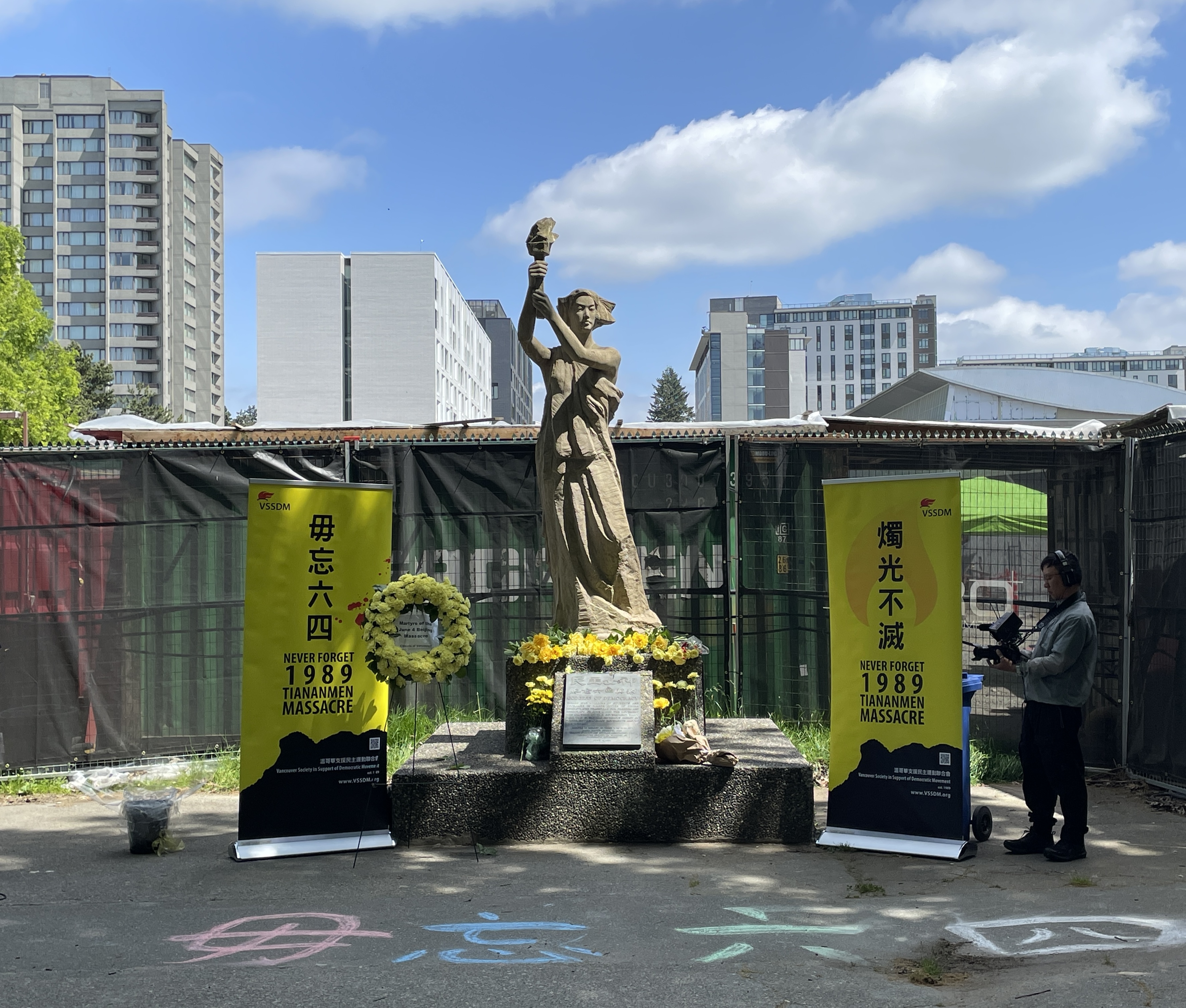
In the morning there was a ceremony held at Forest Lawn Memorial Park, a cemetery in Burnaby, and at around lunchtime another by the small Goddess of Democracy statue that stands near the Student Union Building at the University of British Columbia.

Sadly a fence was an ugly backdrop, as there is a construction site right next to the Student Union Building and there are fears the statue may be moved again.

Originally, Mabel Tung, chair of the VSSDM, had tried to get the statue placed in Chinatown, but it was vehemently opposed to the proposal. It was eventually accepted at UBC in 1991.

About 30 people showed up at the latter event, almost all wearing black, masks and sunglasses. The majority were middle-aged, along with a few young people, and one or two young families. 

Tung led the mini ceremony, first asking attendees to stand for a minute of silence. She then gave a quick speech to recount what happened 34 years ago, and how there used to be a candlelight vigil in Hong Kong's Victoria Park every year until 2020. 

The activist said as a result it was even more important for the Hong Kong diaspora to continue to remember not only the victims of the bloody crackdown, but also the Tiananmen Mothers group, and the victims of the 2019 protests in Hong Kong.

Most attendees took a group photo together
Attendees were given either yellow carnations or roses and asked to line up one by one to pay their respects to the Goddess of Democracy. Many bowed three times in front of the statue before placing the flower on the pedestal. There was also a wreath of yellow carnations for the Tiananmen Mothers.

Nearby was a makeshift memorial with flowers and photocopied drawings of Chow Tsz-lok, the 22-year-old student who fell to his death on the third storey of a carpark in Tseung Kwan O on November 4, 2019 during the Hong Kong protests. 

Another portrait was of Li Wenliang, the doctor in Wuhan who alerted the world about Covid-19 in December 2019 and died in February soon after he was infected.

The third person remembered was Peng Ming, a pro-democracy activist and Christian who founded the China Development Federation in 1998. Later that year the authorities banned the group and Peng was sentenced to 18 months of re-education through labour.

Upon his release in 2000, Peng went to Thailand with his parents where they were granted refugee status. He later moved to San Francisco and re-established his federation again, calling for the end of one-party rule and replacing it with democracy.

A memorial for activist Peng Ming
Four years later during a visit to his parents in Thailand, Peng was lured into Burma by Chinese special agents and abducted into China where he was convicted on trumped-up charges. In 2005 he was sentenced to life in prison in Hubei, but 11 years later the prison authorities announced he had died suddenly at the age of 58.

Next Sunday VSSDM will hold a candlelight vigil at Dr David Lam Park from 4pm onwards. 

VIFF -- Review: Our Mr. Matsura

Matsura (right) with a local in Okanogan County Frank (Sakae) Matsura, was the son of a Samurai in Hirado, Japan, but by the time he was gro...