Showing posts with label Pablo Picasso. Show all posts

Tuesday, March 25, 2025

Picasso's Tenuous Link with Asia


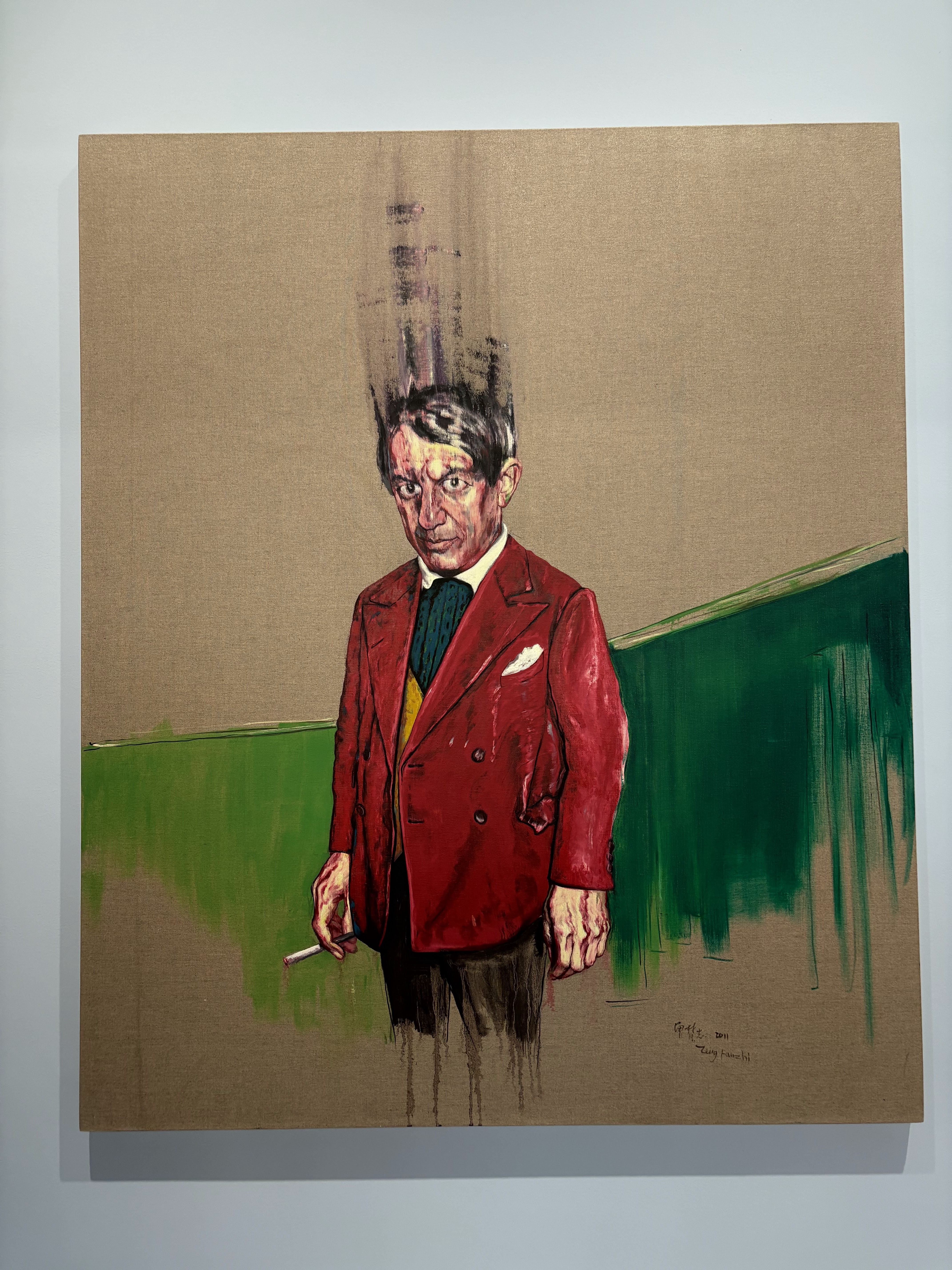
Zeng Fanzhi's portrait of Picasso


I managed to squeeze in some time this afternoon to go to M+ in West Kowloon to see the Picasso exhibit called "Picasso for Asia: A Conversation" that's on until mid-July.
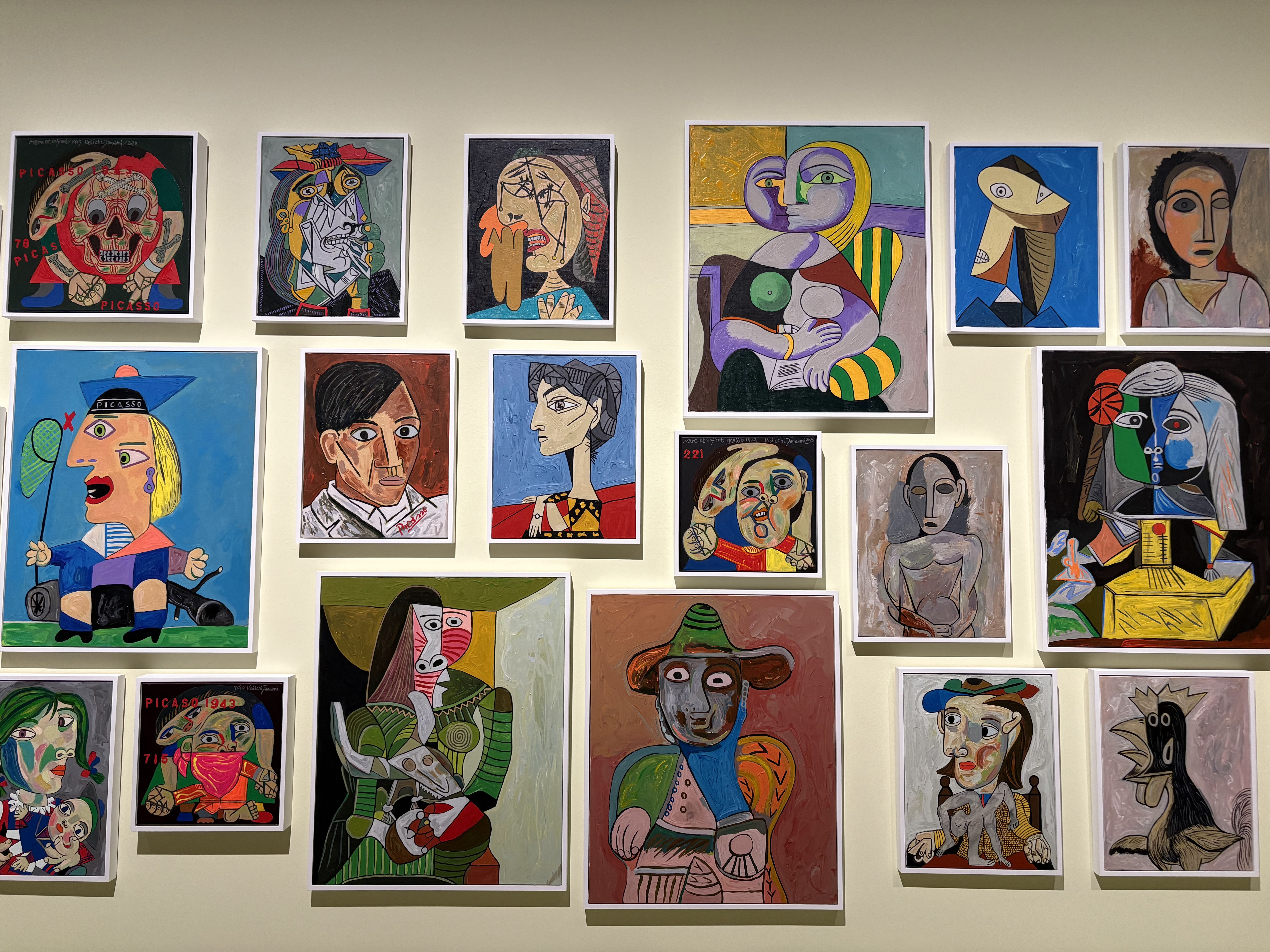
Tanaami Keiichi's interpretations of Picasso's art
The Spanish artist was a giant in the art world and has influenced so many following behind him, that this show not only showcases his work and how it evolved in his different periods, but also how other artists have been inspired by him.

More than 60 of Picasso's works were loaned from Musee national Picasso-Paris, which holds the largest and most significant collection of his art, and they are compared and contrasted with around 130 pieces of art by 30 Asian artists.

The opening painting is a portrait of Picasso by Chinese artist Zeng Fanzhi painted in 2011. It depicts Picasso as very intense with large eyes his hands muscular, and casually holding a cigarette in his right hand. 

Picasso's study of a horse for Guernica
The show is a good introduction to Picasso for those not familiar with his work. It first explains he learned to paint from his father, Jose Ruiz y Blasco, who was an art teacher and painter. Blasco quickly saw his son's artistic talent and helped him develop it.

In addition, the exhibition briefly addresses Picasso's detrimental relationships with women he considered his muses; he identified with the story of Pygmalion, a sculptor in Greek mythology who carved a statue of a woman so perfect that she came to life. He also identified with the Minotaur also in Greek mythology a character with a man's body and a bull's head, that was at times vulnerable or blind, or sexually charged and violent.

There are paintings that show his sketches for his masterpiece Guernica, and paintings of doves that soon became the global symbol of peace. The exhibition even points out that China used Picasso's paintings of doves on stamps and other propaganda.

The start of Picasso's Blue Period
Picasso's Blue Period from 1901 to 1904 is explained -- he was depressed following the suicide of his close friend, artist Carles Casagemas. Picasso expressed his sorry by painting him in Portrait of a Man. There are also works from Picasso's cubism period, how he began to see things in shapes that became more and more abstract.

One of the rooms invites visitors to sit down and watch videos of Picasso freely painting on glass, a vase of flowers, a bull, or a dove. At one point he stops and looks at the viewer before walking away. It's fun watching him painting quickly and easily, very sure of himself and carefree.

The show also demonstrates how Picasso was greatly influenced by masters before him, and shows his interpretations of paintings by other artists, like Francisco Goya and Edouard Manet. In that way the exhibition wants to show that Picasso wasn't just considered a master, but always an apprentice wanting to learn more from others.

Meanwhile Picasso's link with Asia is tenuous -- he made one painting that was related to the Korean War called Massacre in Korea, where one can easily see how he has made direct associations to Goya's work, The Third of May1808, and Manet's paintings depicting the execution of Emperor Maximilian.

Picasso painting a vase for the viewer
Nevertheless, while a few of the Asian artists' work are directly related to Picasso, others aren't so much, which makes the associations to him not quite credible...

The Hong Kong Jockey Club Series: Picasso for Asia -- A Conversation
Until July 13, 2025
M+


Saturday, December 3, 2022

Palm Springs: Eye-Opening Contemporary Art

Endless fascination with Anthony James' art


After visiting Mt San Jacinto via the Palm Springs Aerial Tramways, we headed down for some lunch then went to the city's art museum for a look.

It focuses on contemporary art, and has an impressive small collection of Henry Moore statues outside the Palm Springs Art Museum. Inside the staff at the entrance suggested we look at the two current exhibitions on show featuring local artists, but we did manage to cover pretty much everything else as it's not a big place.

Smith examines how light is affected by shapes
The first one we checked out was Phillip K. Smith III: Light + Change. He's originally from Los Angeles but grew up in the Coachella Valley and now works in Palm Desert, very close to Palm Springs. His work revolves around his study of light and colour, and how we as viewers interact with them.

He creates various colour choreography as the museum describes it, either concentric circles that are hypnotic, or blocks of intense colour that change every few seconds. Smith also creates cylinders that have various shapes jutting out like cutting snowflakes out of paper so they are even in shape and size, and then seeing how light is affected by them.

The other artist is Petra Cortright, who was born in Santa Barbara and lives in Los Angeles. In her earlier works she cut out images from magazines, like a flower arrangement and then rearranges the florals into another shape. She later graduated to photographic images that she manipulates using Photoshop, sometimes adds motifs like a collage and then "paints" strokes on top of that so there are literally several layers to her work.

Cortright manipulates images and "paints" them
She mostly chooses images of nature and landscape, as well as still life and works with canvas, anodized aluminium, Belgian linen and various types of paper.

Her canvases are very large and in a way pioneers a new way to create art, integrating both the digital and real world together. It's her colour palette that we appreciate, the shades of green, mauve, pink, grey, and beige.

We were completely mesmerised by Anthony James' 80" Great Rhombicosidodecahedron, 2020. It's a kind of ball shape, and within it are endless numbers of geometric circles and squares thanks to the use of stainless steel, specialised glass and LED lights. You wonder how he came up with this idea and actually executed it so well. In the end it might be a simple setup, but made complex by the placement of mirrors. Who knows!

Hyperrealistic couple that look like visitors
The rest of the museum has an eclectic collection of glass and sculptures, including Louise Bourgeois' Spider II which is perched way up high on the ceiling, a large Alexander Calder mobile, a Picasso bronze of Angry Owl, and the nocturnal bird really does not look happy.

There's a couple sitting on a bench, but then you do a double take and realise -- they're art! It's a lifelike sculpture of Old Couple on a Bench by Duane Hanson. Even though it was completed in 1995, the clothes they are wearing are not considered out of fashion!

American artist Angela Ellsworth created what looks at first like a stunning piece, a bonnet made of pearls. But when you look closer, you realise it's also full of pins poking inside where the wearer's head should be, making it a delicate but also vicious headdress.

Art made from aluminium cans on satellite dish
Nearby is Gerald Clarke's Continuum Basket: Pivat (Tobacco). From a distance it appears to be a folk art design with a green star in the centre. As you walk closer to it, you see it's actually made up of squashed aluminium cans that are carefully arranged on a satellite dish -- all, 1,884 of them. Clarke has created the symbols for tobacco flowers and bats inspired by traditional motifs from his Indian band called Cahuilla.

Nice to see the museum has a small collection of African artists too.

Outside across the street from the museum is a car lifted vertically and looks like it's about to dive into a pool of water. It leaves a fantastic reflection in the pond. It's called History of Suspended Time (A monument for the impossible) by Gonzalo Lebrija. 

The Mexican artist originally did a performance art of dropping a car into the water and then filmed it at the moment just before it hit the lake's surface. He then recreated it, using a 1968 Chevy Malibu that weighs 2,500 pounds.

Palm Springs Art Museum
101 Museum Drive
Palm Springs
(760) 322 4800


VIFF -- Review: Our Mr. Matsura

Matsura (right) with a local in Okanogan County Frank (Sakae) Matsura, was the son of a Samurai in Hirado, Japan, but by the time he was gro...