Showing posts with label SARS. Show all posts

Friday, March 6, 2026

Review: Chinese Lessons


Pomfret's memoir about China from the 1980s


In 1981, 22-year-old John Pomfret was the in the first cohort of American students to study in China. He recounts his experiences living in a dorm with seven Chinese men at Nanjing University, trying to make up for lost time following the Cultural Revolution that upended their lives.

Pomfret chronicles his experiences, and those of his classmates over the decades in his memoir, Chinese Lessons: Five Classmates and the Story of the New China. He writes about the lives of his five classmates, four men and one woman in unflinching accounts about how dirt poor they were, or how their parents or grandparents were tortured or murdered by the Red Guards, and how they were sent down to the countryside, and the only way out was to get into university.

He studied in Nanjing University
Their early lives are so tragic and horrific, but Pomfret believes it's critical to explain this background to readers so that they understand why his classmates individually did what they did later in life. These students were the next generation post-Cultural Revolution who tried to ride China's economic boom in the 1990s and 2000s, with varying degrees of success depending on their idealism or pragmatism.

At the same time Pomfret weaves in his own personal experiences, most notably how people reacted around him as a foreigner; he honestly recalls his sexual desires to meet women, and these memories are endearing but also pretty funny.

Following graduation, Pomfret went back to the United States and began working as a journalist and because of his Mandarin skills he eventually returns to Beijing to work for the Associated Press in the late 1980s.

Pomfret (left) during the 1989 protests in Beijing
The pivotal moment in the book is his account of what he saw and experienced during the 1989 protests in Tiananmen Square, followed by the shocking and bloody massacre on the evening of June 3. It's riveting reading, as he remembers so many details, from riding his bike down alleyways to avoid the tanks to witnessing live gunfire and wounded demonstrators.

Soon after he was accused of having alleged links with student leaders and soon after was expelled from China. As a result Pomfret situated himself in Hong Kong, but was covering all kinds of conflicts in Bosnia, the Democratic Republic of Congo, Rwanda, Sri Lanka, Afghanistan, Iraq, Iran and Turkey.

A few years later in 1992 The Washington Post manages to get approval for Pomfret to return to Beijing as the bureau chief and he reunites with his classmates separately to see how they are doing as well as track how China has changed post-Tiananmen.

His Chinese press credentials in China
Throughout the book he touches on topics as family, marriage, the one-child policy, jobs that were attached to work units, the free market economy, buying apartments, and entrepreneurism through the experiences of his classmates. It really gives a good on-the-ground view of what it was like for locals navigating the system.

Towards the end of the book Pomfret writes about marrying and having a child born with health issues, but then soon after a mysterious virus begins to spread. It's SARS. Reading it now, a few years after the Covid-19 pandemic, one can see the similarities of how the virus spread almost exactly the same way, during the Spring Festival, and how the Chinese government dealt with it. We still don't know exactly how it started, let alone SARS.

Pomfret is a journalist I followed during the 2019 protests in Hong Kong; he is a rare old China hand who managed to adapt and understand the city and how it differs from the mainland. Many China journalists who were parachuted into Hong Kong during the protests did not have a firm grasp of how the city and its people are not the same as those in China and so their stories were not as nuanced as Pomfret's.

He writes passionately about China
His writing in Chinese Lessons is straight-forward and at times stark, but also sprinkled with wry humour -- the reader is constantly on this rollercoaster ride of emotions that range from depressingly bleak to suddenly light and hilarious. But one can see his love for the country and its people, as well as the funny quirks of the place.

It's a fantastic first-hand look at the rapid changes in China through not only Pomfret's eyes, but also those of his classmates who were willing to tell their stories not only to him, but to the world.
Tuesday, July 23, 2024

Dr Yuen Warns of Another Impending Pandemic

Yuen warns world leaders must fight infectious diseases


We are still going through waves of the Covid-19 virus and Hong Kong microbiologist Yuen Kwok-yung warns we will inevitably encounter yet another pandemic that will be even worse, he outlines in his latest autobiography.

"Both the public and [world] leaders must admit that another pandemic will come, and probably sooner than you anticipate," he said in an interview.

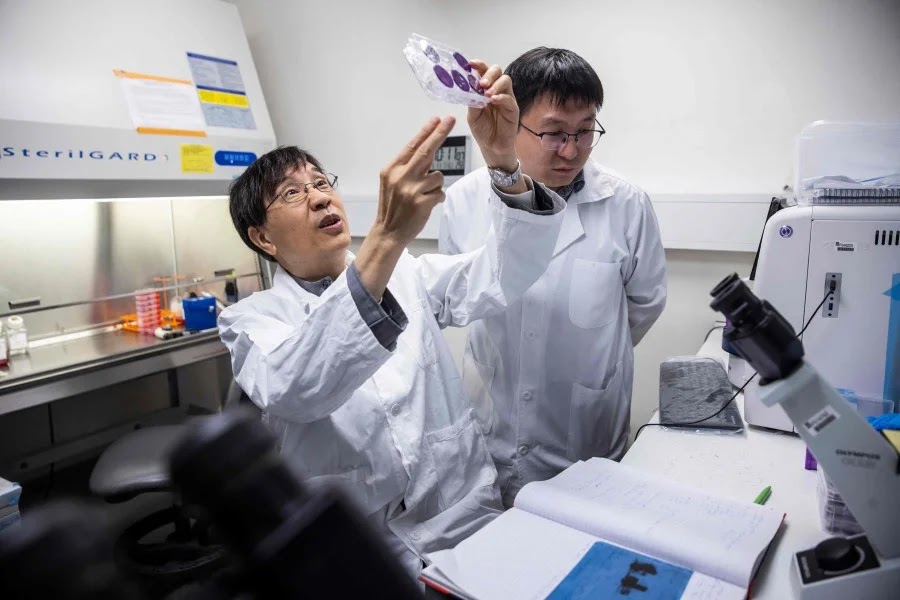
Yuen has released an autobiography of his career
"Why I make such a horrifying prediction is because you can see clearly that the geopolitical, economic, and climatic changes are changing so rapidly."

In his autobiography, My Life in Medicine: A Hong Kong Journey, Yuen warns politicians must "come to their senses" and solve "global existential threats".

He says world leaders seem more focused on "national or regional interests", when a rapidly changing climate together with emerging infectious diseases should be a top priority.

"This is something so important that we should not ignore."

Over 20 years ago he and his team isolated and identified severe acute respiratory syndrome known as SARS that started in southern China and spread to Hong Kong and globally. The virus killed nearly 300 people in two months.

So it's not surprising he was on guard when the first reports of a mysterious virus was spreading in Wuhan, China.

Yuen's team tackled SARS in 2003
"We benefited from the 20 years of study that followed the SARS outbreak," he wrote in his book. "Until factors beyond our ability to stop or overcome -- fear, ignorance, poor messaging, and deliberate misinformation -- the measures were effective" in buying Hong Kong time until the vaccines were developed.

During the Covid-19 pandemic in Hong Kong, more than 13,800 people died and recorded some 3 million people, almost half the population. 

Yuen still thinks it's important to find out the origins of Covid-19, saying it is "important to properly do an investigation in a very open, transparent manner" so lessons can be learned for future pandemic prevention, he said.

"If we do not talk about it... then another pandemic comes, we have to pay a huge price again."

Don't say we haven't been warned...

Sunday, May 12, 2024

Will Visitors from Eight Mainland Cities Boost HK's Economy?


Can tourists from other parts of China revive HK's economy?

Hong Kong can boost its tourism numbers now that Beijing has approved visitors from eight mainland cities. They are... drumroll please...

These visitors can stay for up to seven days
Taiyuan, the capital city of Shanxi province
Hohhot in Inner Mongolia autonomous region
Harbin in Heilongjiang
Lhasa in Tibet
Lanzhou in Gansu province
Xining in Qinghai province
Yinchuan, capital city of Ningxia Hui autonomous region
Urumqi in Xinjiang

From May 27, residents from these cities will be able to apply for the Individual Visit Scheme to travel to Hong Kong and not need to join a group tour and can stay for seven days at a time.

The Individual Visit Scheme has been around since 2003 post-SARS in a bid to kickstart Hong Kong's economy. 

But will adding visitors from these eight cities help boost the city's businesses?

Does HK need more poseurs on the streets?
Tourism officials are projecting these tourists will visit Hong Kong for at least three days, meaning they will stay in hotels, but will they find the prices acceptable? They might do what others in the Greater Bay Area have done -- spend the day in Hong Kong and stay overnight across the border...

Are these the tourists who will spend money? 

Seems the Hong Kong Tourism Board has given up on long-haul visitors even though they are the ones who have the money to spend...

Friday, March 24, 2023

Hearing Chris Patten's Thoughts on HK


Patten (left) and Vines have a good chat over dim sum

Green Bean Media was started by former Hong Kong journalists who have migrated to the UK and want to keep reporting on news about their hometown.

They have followed people making the big move to the UK as well as developments in the 47 defendants charged in allegedly subverting the state for organising primaries, and Cantonese food.

Their latest video has garnered a lot of attention because it's an interview with Chris Patten, the last governor of Hong Kong. One might assume members of Green Bean Media were terrified of interviewing him themselves so they rounded up fellow exile journalist Steve Vines to do it.

The video is here: https://www.youtube.com/watch?v=MoA8iMymy8c&t=561s

And they aptly arranged to have the video interview in a cha chaan teng in London. The small cafe pulled out all the stops, giving "Fat Pang" the opportunity to eat some HK-style food, including his favourite egg tarts.

Patten's book on HK
Personally doing food interviews, it seems rude to eat while someone is asking me questions, but Patten seems very happy to dig into the dishes even as Vines is asking him something! 

The 29-minute video focuses on Patten's thoughts about Hong Kong in his book called The Hong Kong Diaries, from his personal diaries he kept when he was governor from 1992 to 1997.

In it he says foreign secretary and ambassador to Beijing Percy Cradock believed Patten should not have caused so much trouble trying to fight for democracy for Hong Kong, that he should have just done his five years as governor and then left quietly.

"He wrote the Chinese leaders may be thuggish dictators, but they're men of their word," recalls Patten. "We know that they were thuggish dictators, but one thing we know for certain is that they weren't men of their word."

Patten remembers speaking to British and Hong Kong businessmen who believed the average person was not interested in democracy, only in making money, and yet these elites had foreign passports tucked in their back pockets. 

"It was always interesting when I looked at some of my critics just to think through what they would do if things went wrong," he says.

Cradock believed Chinese would keep their word
He adds some of them have since passed, but did not reveal any of their names in the interview, which he should have done for the record.

Meanwhile Vines shares a conversation he had with a friend back in Hong Kong, as they previously believed through crises like SARS and the economic downturn that the city would bounce back, but this time they didn't have this optimism anymore.

"I think the reason why he and you are more pessimistic now is what the Chinese Communist Party wants is Hong Kong without Hongkongers," Patten says. "Maybe you have a city but you don't have a thriving city, you don't have a city with any heart."

He talks about how young people from Hong Kong come up to him and ask if they should go back and Patten says he has no answer. While he has seen from history authoritarian states have disappeared at the snap of fingers, he doesn't know when that will happen in China. 

Vines mentions the BNO scheme, that has allowed over 140,000 Hongkongers to migrate to the UK with the possibility of settling there permanently.

Patten believes it is successful because people understand the plight of Hongkongers, and that they will be a boon to the UK economy.

Patten in Hong Kong on June 30, 1997 
The former governor cites the example of meeting one man in his late 20s who had just qualified to become a doctor and was on his way to a job interview with the local health authority in Oxford. 

"People from Hong Kong will make this a more successful country," he says. "They will be strong members of civil society."

He adds sardonically that perhaps the UK should thank the Chinese for giving them all these Hongkongers.

Vines' plight is also worth highlighting. He was a well known correspondent in Hong Kong, was the founding editor of the Eastern Express newspaper and Spike magazine, a commentator and interviewer on RTHK and author.

But after the national security law was implemented in July 2020, Vines began feeling the pressure of watching what he was saying and doing, even though he had written a book about the 2019 protests.

While he says in the video he found it unhealthy to be constantly watching his back, Vines did receive calls hinting it would be best if he left Hong Kong.

Within months he sold his food business and his flat in Sai Kung, packed up 34 years' worth of possessions and moved back to the UK in July 2021. 

Vines was well known commentator on RTHK
He is active in the Hong Kong community in the UK and says there isn't a day where he isn't talking to someone from the city or writing about it.

What comes through most in the interview is Patten's genuine love of Hong Kong and its people, and how he has carried the burden of wondering if he had done enough for them since 1997.

Which is why he is constantly advocating and doing whatever he can from his privileged perch, from writing to the Prime Minister about Jimmy Lai, to greeting migrants settling in their new home.

But once the interview is over, that good food can't go to waste, and Patten reaches over to pick up a slice of pork belly with his fingers.


Wednesday, March 15, 2023

Remembering the SARS Doctor Whistleblower

Jiang was hailed a hero but then spoke out about Tiananmen

We are sad to note the passing of Dr Jiang Yanyong, the doctor who blew the whistle on the SARS epidemic in 2003. He was 91 years old.

Can you believe it's been 20 years since SARS and now we're coming out of the global Covid-19 pandemic?

The death of the respected military surgeon was reported in Hong Kong media and abroad, as well as some friends in China, but not in state media.

The Metropole Hotel where SARS started in HK
When SARS broke out in early 2003 in China, it was played down by the government, and Jiang felt this was a public health emergency that people needed to know. 

It had also spread to Hong Kong via a mainland Chinese doctor who stayed in the Metropole Hotel in Kowloon. There were 1,755 cases, of which 298 people died in Hong Kong.

The then retired doctor wrote a letter to several news organisations refuting the official line, and accused China's then top health official Zhang Wenkang of "abandoning even his most basic standards of integrity as a doctor."

"I was telling the truth," Jiang told the state-run Beijing News in 2013. "I believed the government would treat me fairly."

Foreign journalists caught wind of the letter which led to the World Health Organisation extending its stay to inspect hospitals where Jiang said there were hidden cases, which put pressure on the government to fire Zhang and the mayor of Beijing.

Jiang was briefly hailed nationwide as an "honest doctor", and he used the respect garnered to write another letter, calling on the Chinese leadership to acknowledge the 1989 crackdown in Tiananmen Square was wrong, and that the student movement had in fact been a "patriotic movement."

Jiang wrote about the fatal wounds he saw
He wrote about what he saw at No. 301 Military Hospital in Beijing the night of June 3 after the tanks rolled into the square and People's Liberation Army soldiers fired live ammunition at student protesters.

Jiang saw many of the wounded civilians in his hospital, hit by bullets designed to break apart after impact and shred internal organs.

"My brain buzzed and I almost passed out," he recalled. "Lying before me this time were our own people, killed by children of the Chinese people, with weapons given to them by the people."

But after this letter was released, Jiang and his wife were detained. He underwent several interrogation sessions and was not allowed to leave the country, basically under house arrest.

Jiang didn't stop pressing for accountability. Even in 2019 on the 30th anniversary of the crackdown, he wrote a letter to Xi Jinping demanding justice for the "crime" in 1989. Then 87 years old, Jiang was under house arrest again.

Li may never be remembered in China again
And now his heroic efforts of speaking out about the SARS epidemic are largely wiped out of textbooks.

In a 2017 test-prep school multiple choice question asked about Jiang's decision to come forward about SARS. The "correct" answer was B: Doing so was wrong, because it harmed the interests of the nation, the society and the community, and he should be subject to legal punishment.

Sadly Li Wenliang, the doctor who sounded the alarm about Covid-19 will never even get a mention. 

History repeats itself, almost 20 years later.

Thursday, January 26, 2023

Dr Yuen Calls for Independent Inquiry into Handling Covid-19


How well did Hong Kong handle the Covid-19 pandemic? 


Infectious diseases professor Yuen Kwok-yung is calling for an independent inquiry into Hong Kong's handling of Covid-19 so that the city can better prepare the next time another pandemic comes around.

During a radio program, Yuen explained that after the 2003 SARS outbreak (20 years ago this March!), an inquiry was held, which led to the establishment of the Centre for Health Protection. 

Yuen and his duck mask that made him endearing
The centre has since put more resources into research and this helped to fight against Covid, he said.

Yuen said there was definitely room for improvement in contact-tracing and isolation arrangements during the current pandemic.

"We saw 12,000 to 13,000 deaths. Why don't we conduct a thorough investigation and clarify what we should do in the future? Speaking for myself, if I'm lucky, as an infectious disease expert, I might see a third pandemic during my lifetime. Hong Kong must be prepared for it."

Does Yuen realise the political implications of calling for an independent inquiry and where it will go? If the government agrees to it -- and that's a big IF -- the scope would probably be so limited to ensure the authorities look good.

An independent inquiry is definitely needed -- not only in the medical handling of this pandemic that led to one of the highest death rates in the world, but also the cost from the financial handouts, to the construction of those isolation units that are now collecting dust all over the city.

Hospitals overwhelmed with infected elderlies
How many of those pandemic kits were handed out, that had N95 masks, rapid antigen tests and that Chinese herbal medicine Lianghua Qingwen? How much did that cost? And the PCR tests conducted in the community testing centres. How many vials of vaccines were wasted?

The inquiry could also give insight into the communications between the infectious disease experts like Yuen and the government, and possibly hints if Beijing played a role in Hong Kong shaping its Covid policy.

We await to see the response...

In the meantime, Yuen is suggesting that masks come off at the end of March when the weather gets warmer and the virus has a shorter life cycle.

He warned there could be another surge of Covid-19 and other respiratory disease infections after people take off their masks, but says this is an inevitable part of opening up.

Get boosted in October, November says Yuen
"Once we take off our masks, the situation may get quite serious. But we have already said in February and March 2020 that this virus will stay with us... We have to open up sooner or later, and it's better to open up sooner after enough people are vaccinated," he said.

Yuen said people should get another Covid booster by October and November to prepare for a possible rebound in the winter.

Ah, it's never ending...

VIFF -- Review: Our Mr. Matsura

Matsura (right) with a local in Okanogan County Frank (Sakae) Matsura, was the son of a Samurai in Hirado, Japan, but by the time he was gro...