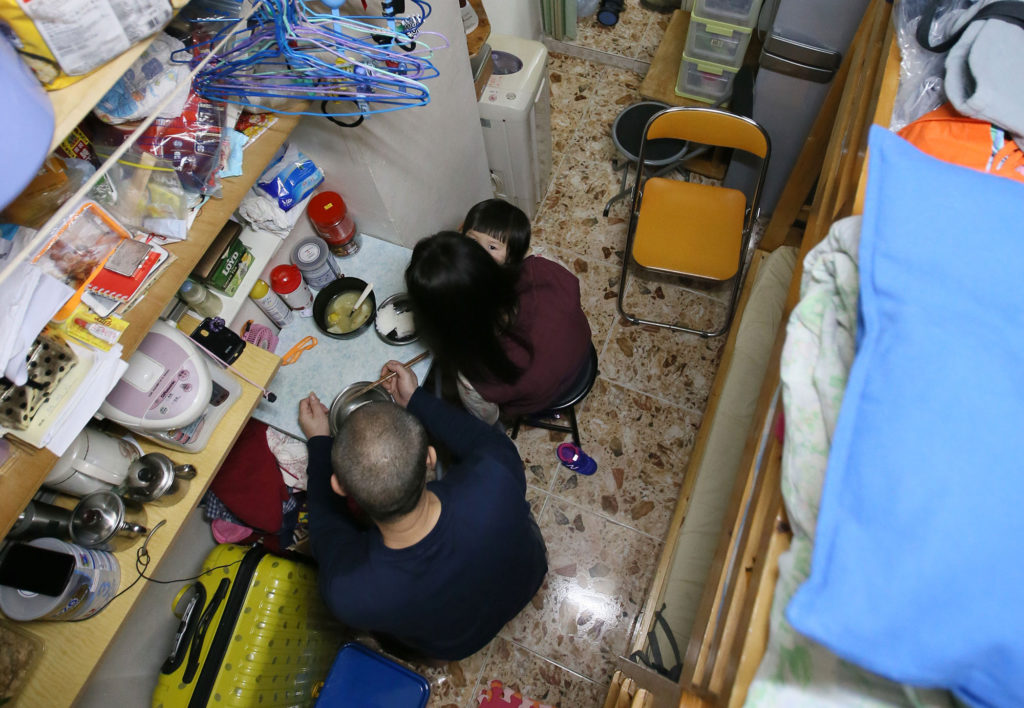
Showing posts with label housing. Show all posts

Wednesday, December 3, 2025

Where do Tai Po Fire Survivors Go from Here?


Wang Chi House residents grabbed items from their flats


If you were only given 90 minutes to fetch things from your home, with no reassurances you could return to live there, which items would you get?

That's what happened to the residents of Wang Chi House, the only building that was untouched in the devastating Tai Po fire last week.

On Wednesday and Thursday from 9am to 9pm, two members from each household were allowed to go into their flats for 90 minutes.

Many people went back to fill suitcases full of clothes, important documents, and treasured photographs, while others even managed to extract their washing machines. One man surnamed Suen told RTHK he went back to get some household goods as well as his game console. Everyone has different priorities...

Despite some of these Wang Chi House residents reporting their homes smelled of smoke, many interviewed in the media expect or hope to move back into the building soon.

Thousands of paper cranes memorialise victims
However, their homes may be too carcinogenic for them to return to, and there is talk that the seven burned out buildings will probably have to be demolished because they may be structurally unsafe, while those who believe in restless spirits may not want to live there again.

In the meantime many of the victims of the fire are worrying about where to live next, as they can only stay in hotels paid for by the government for two weeks and other temporary housing are already full. 

According to the Hong Kong government, 1,152 residents have accommodation in youth hostels, camps or hotel rooms, and another 1, 765 residents in transitional housing units. Others are staying at the Tai Po Community Centre or the Tung Cheong Street Community Hall. One can imagine these shelters aren't exactly comfortable and cooler temperatures are settling in for the next few months.

What is the long-term plan for these residents who may have lost loved ones, lost their homes, and lost all their possessions? They not only need financial help but also psychological counselling and support. 

It will take weeks if not months for the authorities to complete their investigations and identify all the deceased, some of them found as ash. There are also concerns that charging the 21 people arrested so far with alleged manslaughter may be hard to prove with the complexity of construction law and building regulations.

In other words it's not a cut and dried case. 

Meanwhile, despite the government trying to clear the area of grassroots volunteers and their resources, mourners continue to come to Tai Po to pay their respects with flowers, handwritten notes, and paper cranes.

It shows Hongkongers continue to be shaken by the horrific man-made disaster and demand accountability. 

Going through flats to recover victim remains
Chief Executive John Lee Ka-chiu will be under a lot of pressure to find out how the fire started, and to punish those involved in causing the fire to spread to seven buildings, killing at least 159 people.

The authorities tried to clamp down on protests when 24-year-old student Miles Kwan was arrested and then later released without charge. He had started an online petition and passed out fliers outlining "four demands", which included guaranteed support for the victims and accountability for those at fault, including any government officials.

He was detained and charged for "seditious intention" for speaking out what many had been thinking.

In the meantime it is heartbreaking hearing Superintendent Cheng Ka-chun, the officer in charge of the Disaster Victim Identification describe the grim task of how he and his team have gone floor by floor to find victim remains.

"Our colleagues, in a bid to keep the bodies more intact for their return to their families, chose to dig for the bodies using their hands, touching sand, mud and polluted water," he said, when explaining why they chose to recover corpses by hand instead of using equipment.

"Their only goal was to preserve the integrity of the bodies."

This demonstrates how they are doing their utmost to respect the victims and their loved ones, taking time and care to preserve the remains the best they can.

Hongkongers looking after Hongkongers. This is the Lion Rock Spirit.


Thursday, May 22, 2025

A New Sign Lights Up Kits

A new sign has popped up in Kitsilano thanks to Chip Wilson

There's a new neon sign up on the corner of West 4th Avenue and Yew Street in Kitsilano. There are various arrows pointing to Jericho Beach, Kits Beach, Sunset Beach and Wreck Beach, as well as Love and Peace (in different directions).

The retro-style sign was put up by Low Tide Properties, owned by Lululemon founder and billionaire Chip Wilson, who says it's a nod to his family's love of the neighbourhood.

"My wife, family and I have been in Kits since the 1986 World Fair. We live and breathe everything that's Kitsilano -- from the beach to tennis to volleyball to the amazing people who have a way of living that elevates the world," Wilson said in a statement.

The neon sign gives off 1950s Las Vegas vibes
"Our family has been involved in the ownership of 23 locations on West 4th. The unveiling of Kits Corner is the icing on the cake after nearly 40 years of living, working and investing in this neighbourhood. From Westbeach to lululemon, Ride Cycle Club, Peak Performance, Arc'teryx, Kit and Ace, TurF and more, we're committed to keeping the spirit of Kits alive."

Perhaps that explains why Lululemon's headquarters is on Cornwall Avenue, and is Wilson naming some of his tenants?

Apparently the corner of 4th and Yew is where many run clubs finish their runs, and cyclists end their rides, while the sign gives off Las Vegas 1950s vibes with the neon signs.

Kits Corner also appears to be the name of the apartment building nearby. Units in the building are about C$2,800 for a 595 square-foot, one bedroom place, or C$3,600 for an 870 square-foot, two-bedroom unit...

Thursday, May 15, 2025

Immigrant Frustrations and Hopes

Though expensive, Vancouver attracts many immigrants

Whenever I take Uber, I like to chat with the driver and it makes the ride more interesting.

This evening a 38-year-old Iranian immigrant picked me up from downtown Vancouver so we had a good 20 minutes to chat.

He drove a Toyota bZ4X, an electric SUV, which he said he has been driving for three years and likes the car very much. It can go 430km before the battery needs to be charged.

Before moving to Vancouver, he lived in Montreal for four years, but couldn't stand the winters. He loves Vancouver very much, despite the city being expensive to live in.

I asked if he liked driving Uber and he admitted it was a necessity now because he was laid off his job last week. For two years he worked at a company that makes aluminium doors and window frames. He not only designed them, but also worked on the shop floor. 

"Life is better for second generation, not immigrants," he said, and then revealed that he was actually a trained architect in Iran, but could not get work in his field here because he did not have the license and stamp.

I suggested he could still work in architecture, and he said he could as a draftsman, but those jobs only pay around C$22 an hour, and he has a daughter who is three years old to support.

Nevertheless he was proud to say that his daughter was Quebecois, as she was born in Montreal, and it seemed like he was putting his hopes on her to succeed further than him in Canada.

With Mark Carney as Prime Minister and plans to build some 500,000 homes every year, perhaps my Uber driver would be back to making aluminium doors and windows, I suggested, as we were nearing my destination.

He didn't sound hopeful, but I was. Carney is intent on building homes and definitely using Canadian building materials.

I left saying I hoped he would be back at his old job soon. He seemed grateful at least someone was rooting for him.


Wednesday, May 14, 2025

Can Former Vancouver Mayor Tackle Housing Nationwide?

Carney revealed his new cabinet today at Rideau Hall, Ottawa


Canadian Prime Minister Mark Carney unveiled his cabinet this morning and there was surprise when it was reported Gregor Robertson, the former mayor of Vancouver would become the Minister of Housing and Infrastructure. 

While he's a federal rookie, Robertson has served in municipal and provincial politics -- one time as an NDP MLA. In the recent federal election, he handily won in the riding of Vancouver Fraserview - South Burnaby. 

But can he tackle the portfolio of housing? That's what critics are wondering.

Robertson reading out his oath of office
Carney's election platform was that the Canadian government would focus on building homes, promising to double the rate of residential construction in the next decade to 500,000 homes per year across the country.

"We're going to have to change how we build. And a lot of that expertise, not exclusively, but a lot of it has been developed in British Columbia," Carney said.

"Minister Robertson is very familiar with it. We're going to incorporate that, but in a pan-Canadian strategy to really drive this."

It's a big challenge, with the cost of building materials and labour constantly rising, but people do need roofs over their heads. 

But is Robertson the best person for the job?

Looking at his track record as mayor from 2008-2018, data from Canada Mortgage and Housing Corporation shows the average price of a single-family and semi-detached homes rose 179 percent across the broader Metro Vancouver area.

The number of homeless people also went up from 1,576 in 2008 to 2,181 in 2018.

Robertson says now at the federal level, things are different, because as mayor he was dependent on federal and provincial funding, and claimed the then Stephen Harper government was not interested in tackling housing affordability, and he also had to deal with the 2008 financial crisis.

"What's different now is that we've got a prime minister and a new government here in Ottawa who are saying we need to double the rate of construction, we need to work across all levels of government, we need to engage the private sector to do this," Robertson said on the CBC's Power & Politics. "We didn't have any of that going back to 2008."

We'll have to see what plans Carney and Robertson have to build this country and as fast as possible. 

Tuesday, April 8, 2025

Vancouver Mayor Reflects on By-Election Results


Will Sim take the office of the Mayor more seriously now?

Today Vancouver Mayor Ken Sim gave the impression of swallowing some humble pie, saying he and his party would reflect on the results of Sunday's by-election when two progressive candidates were elected by 15 percent of the city's population.

"Regardless if it's a by-election of not... the reality is we listen to the residents of Vancouver every single day," he said. "There are enough of them that said they're not necessarily happy with everything that's going on. We're going to take a really hard look at ourselves."

Sean Orr of COPE received 34,448 votes, while OneCity's Lucy Maloney got 33,732. A total of 67,962 votes were cast.

Orr (left) and Maloney were elected yesterday
When Orr and Maloney are sworn in on April 9, there will be six ABC councillors, former ABC-turned-independent Rebecca Bligh, and Green Party's Pete Fry.

Maloney, an environmental lawyer and transportation activist, said voters sent a strong message to the incumbent party.

"I think that ABC have lost touch with what ordinary Vancouverites are concerned about," she said, adding housing and affordability are the top priority of residents.

COPE's Orr is a housing activist, landscaper and dishwasher. He believes US politics may have influenced Vancouver voters.

"People are very upset," he said. "People are scared, and people are starting to kind of connect the dots with what's going on down south. You're seeing what Elon Musk and Donald Trump are doing there. They're kind of seeing how the rich buy their way into office."

Meanwhile city manager Paul Mochrie apologised to voters for having to wait over an hour to exercise their right to vote.

Mochrie apologised for way by-election was run
"I want to acknowledge that voting wait times that many electors experienced yesterday were unacceptable," he said in a statement.

"The extended wait times at many voting places reflected flawed planning assumptions for this by-election that informed staff decisions and the plan presented to Council. Recognising the effort by the City's elections team to promote and execute this plan, it was clearly insufficient to accommodate the electorate in accessing an efficient voting process.

"These shortcomings are deeply regrettable and I apologise to all voters impacted by delays, as well as to candidates and civic parties. I, along with City staff, are committed to ensure that lessons from yesterday's by-election inform the planning and execution of the 2026 general municipal election and all future City of Vancouver election efforts."

This afternoon Mochrie went on CBC Radio Vancouver's afternoon show to apologise again and explain that the plan was formally adopted in January and there was not enough time to alter it when they saw how many people showed up for advance voting and for mail-in ballots. 

People are more civically engaged than ever, and realise how important it is to make their voices heard through the ballot box. And this by-election in particular was their way of showing the mayor how they felt about his two years in office. 

More residents would have turned out if they had known about the election -- some thought that because they hadn't received a voting card they were not eligible! And there was not enough information about priority lines, and how the disabled could vote. Quite a messy affair. At least Mochrie owned up to it.

Watch out for 2026. It's going to be a a good turnout for sure.

Friday, December 20, 2024

Metro Vancouver to Hit 4 Million by 2045

Metro Vancouver is projected to have 4 million people by 2045


There are projections that Metro Vancouver will grow to a population of 4 million by 2045, nine years earlier than predicted.

An average of 50,000 new residents come to the city, with most of them from outside Canada. There are expectations there will be more deaths than births by 2035.

To house all these new residents are 21,000 new living units built each year until 2051, with two-thirds of these being apartments, and Vancouver and Surrey absorbing 45 percent of the future growth.

In addition 22,000 jobs will be added annually.

"Accurate data like this helps us work together to better understand the growth pressures our region will face in the future, and help ensure collective planning efforts are consistent with the goals in the regional growth strategy, Metro 2050," said Eric Woodward, chair of Metro Vancouver's regional planning committee in a statement.

And the jobs that will be in the most demand in the next three decades? Professional, technical health and welfare sectors.


Tuesday, December 3, 2024

HK Golf Course Won't be Turned into Housing


High Court ruled the golf course not be turned into housing

When there was a consultation that recommended the government to take over the Hong Kong Golf Club at Fanling and build housing on the land in 2018, it immediately sparked a debate between the haves and have nots, as members, who are part of the elite class wanted to keep their prestigious club along with the green space, while those who waited for a roof over their heads are still waiting with no end in sight.

But it was finally decided when the High Court ruled against developing the city's oldest golf course into public housing. One could probably audibly hear the sighs of relief of Fanling golf club members.

That means 9.5 less hectares of land for flats
That means the government will have 9.5 less hectares to build housing, though Chief Executive John Lee Ka-chiu believes this setback won't have a significant effect on the overall housing supply, even though that means 12,000 fewer flats that were planned to be built on the golf course.

He spun it as a proposal by the previous administration.

"Now that the environmental assessment report is overturned, the government must do a comprehensive assessment and public consultation again," Lee said before meeting with the Executive Council.

"This will greatly affect the number of flats, the density and the completion date of the project."

But Lee believed the government was still on track to build 300,800 homes over the next decade.

Lee says the govt has enough land for housing
"The government has sourced enough land to construct more than 308,000 flats," he said. "The single change in the site's development will not have a huge impact on Hong Kong's overall housing supply."

So where else is Lee going to find more land to develop flats? It's an ongoing refrain that the city has numerous brown sites, land that has buildings that were for previous uses like schools or warehouses, and yet the government has not considered these, perhaps because they are too small.

But Hong Kong is not a place where it should neglect any possible sites -- land is scarce and any that is left vacant should be considered. Beijing is putting pressure on the Hong Kong government to house its citizens and in this case should comply with some creative solutions.

Friday, November 22, 2024

Subdivided Rooms in Metro Vancouver


A one-bedroom unit here was subdivided into three bedrooms

I thought subdivided flats were only a Hong Kong phenomenon, but it turns out it's happening in Metro Vancouver too.

In a rental building in New Westminster, someone -- it's not clear if it's the landlord or the tenant -- was trying to convert a one-bedroom into three subdivided rooms with makeshift walls so that each had a bed and big-screen TV, though the three tenants would share the kitchen and bathrooms. Rent would be over C$1,200 each.

A screen-capped listing of the subdivided unit
A tenant living in the building heard the construction noise and armed with video evidence of the subdivided rooms, complained to New Westminster City Hall.

"I got scared, I got nervous," he said. "The first thing I thought of was my security in the building."

Soon after the same tenant heard noise again, and this time the temporary walls were taken down.

The building is run by Canadian Apartment Properties REIT, or CAPREIT. When contacted by the media, CAPREIT didn't respond to a request for an interview, only saying that units must comply with all safety standards, including those in the National Building Code of Canada and the BC Fire Code.

However, a tenant advocacy group says municipal governments need to have more oversight over rental housing.

Meanwhile, the tenant who first complained about the subdivided apartment says he's heard from other residents in the area who tell him similar things are happening to their buildings.

"It needs to be an election issue across the country," he said.

Possibly, but the main thing is some kind of oversight and regulation by municipal and possibly provincial authorities to stop this from happening, particularly in rental buildings. 

Wednesday, October 23, 2024

Promoting Construction with Construction

The Kau Yi Chau project will create 1,000 hectares of land

The Hong Kong government is pushing ahead with developing the New Territories with the Northern Metropolis and creating manmade islands called Kau Yi Chau Artificial Islands to build new housing and boost the economy, as the city integrates further into the Greater Bay Area.

Kau Yi Chau will create 1,000 hectares of land, but environmental groups are concerned about how the construction of the islands will impact the natural habitat, not to mention the cost, at the price tag of HK$580 billion over 10-15 years.

The Development Bureau is banking on these two massive infrastructure projects that it is proposing to shell out a whopping HK$600 million (US$77.2 million) to build an exhibition hall in Wan Chai to promote these projects by 2027.

Last year's policy address highlighted the need for exhibition space to showcase these two projects and Wan Chai North Promenade was chosen, directly across from the Hong Kong Academy for Performing Arts.

The space, which is about 5,000 square metres, will house a building that will be three to four stories high with a total area of about 8,000 to 10,000 square metres.

Construction will begin next year to open sometime in 2027.

What happens to the building after those two projects are completed?


Friday, October 18, 2024

Tackling HK's Problem of Subdivided Flats

People with few resources end up in subdivided flats

In his policy address, Chief Executive John Lee Ka-chiu wanted to (finally) tackle the issue of subdivided flats -- where a space is subdivided to the point where tenants literally live in cupboard-like spaces, sharing bathrooms and kitchens, and there are hardly any windows for air circulation, let alone fresh air.

During his speech, Lee said about 30 percent of the 110,000 subdivided flats were "improper", and would be phased out with upcoming legislation, and that there would be time for landlords to upgrade these flats to meet the requirements of what the government believes is a decent living space.

How does Lee know it's about 30 percent? Deputy Financial Secretary Michael Wong Wai-lun said after it didn't necessarily mean the other 70 percent were in full compliance with the requirements.

Lee says 30 percent of subdivided flats "improper"
With the new legislation, subdivided flats that have been registered and meet the requirements will be designated as basic housing units and will be allowed to be leased.

That means the flat needs to be at least 86 sq ft, with a ceiling height of 2 metres, have a toilet and ventilation system, and meet fire and structural safety standards.

If landlords don't meet this new code, they could go to jail for at least two years.

It'll be interesting to see how this registration process works and what it will reveal in terms of the state of these subdivided flats. 

The big problem though, is that while it would be good for these living spaces to be upgraded, where will the current tenants live temporarily and also will their rents increase to pay for these renovations? Has the government thought of that?

That's Vera Yuen Wing-han's concern, an economics lecturer at the University of Hong Kong. She says the government phasing out the smallest subdivided flats could lead to higher rents for other subdivided homes as long as there was a demand.

Will tenants be forced to pay more for upgrades?
After all, people live in these poor-quality spaces because they can't afford to live anywhere else.

She also said landlords would have to pay for the renovations to meet the requirements and pass down these costs to tenants.

"If the government does not do anything, [tenants] will have to be squeezed into one unit with dividers," she said. "[This] kind of model happened in Hong Kong, like in the 1950s and 1960s when a lot of families were living in one unit, sharing the living room and the kitchen."

The government will launch the consultation process in December and start the legislative process next year, while the registration will begin in the fourth quarter of next year until the fourth quarter of 2026. Once legislation is passed, then the government will decide the time frame and targets for enforcement action against landlords. 

The Concerning Subdivided Units Alliance said the government's time frame for enforcement action against landlords was "too vague" and gave the latter too much flexibility. 

"It is unclear when the government will take the enforcement action," the alliance's Lai Kin-kwok said.

Lai also questioned the effectiveness of implementing the legislation without a clear enforcement plan, suggesting landlords could continue to rent out flats with poor living conditions.

Subdivided flats in Hong Kong are a difficult topic to deal with, as people are desperate for places to live in, and yet they are practically inhumane... 


Monday, September 30, 2024

VIFF Review: Secret Mall Apartment


The secret apartment where eight artists lived for four years

The Vancouver International Film Festival kicked off a few days ago and I've already seen five films, all wonderful as I had hoped.

First on my list was the documentary, Secret Mall Apartment directed by Jeremy Workman. Indeed, as the title suggests, there was a secret apartment in a shopping mall in Providence, Rhode Island in the early 2000s.

Michael Townsend is an activist artist -- he believes that art is not a pretty picture, it has to have meaning, otherwise what is the point? A giant shopping mall called Providence Mall was being built in the neighbourhood he was in and as he watched it being built he could see there was a space that didn't seem to be earmarked for anything.

After the mall opened, he tried to find this space and did, telling three other artist friends about it. In the end there was a total of eight people who knew about this space, how to get there, but they had to keep it a secret.

The 750 square-foot space didn't have windows or running water, but it was a place they wanted to inhabit. So they bought furniture at thrift stores and undetected, managed to haul them into this space and live there -- for four years.

Secret Mall Apartment also talks about how these artists were influenced by Townsend, that they would facilitate art projects in a children's hospital, encouraging the young patients to make art with marking tape, and even paying tribute to the 9/11 victims by creating silhouettes of them with the marking tape around New York City.

The documentary also delves into the issues of housing, gentrification, the conflicts between developers and neighbourhoods, and displacement, by talking to people who were stakeholders when the controversial shopping mall was being approved by city hall and when it was being built.

What makes Secret Mall Apartment fascinating too is that there is proof it existed because they recorded themselves with tiny digital cameras and had some 20 hours of footage. It's grainy and not professionally shot, but it's a record of what they did, and many of the clips shown are amusing.

Apparently many people had approached Townsend about making a film about the secret apartment, but none of them were as genuine as Workman, researching not only the history of gentrification of the area, but also tracking down every one of the eight artists and finding out how much this secret apartment experience has influenced them as a person and their own art today. 

Thank goodness for Workman, who told this story beautifully, creatively and interviewed some people who were thrilled to go back in time with him.

Secret Mall Apartment

91 minutes

Directed by Jeremy Workman

Starring Michael Townsend

Sunday, September 22, 2024

BC Election Countdown

Voters are going to have a hard time deciding who to lead BC

The writ has dropped in British Columbia with less than 30 days to go before the provincial election.

In the last few weeks we've had so much drama -- in particular BC United suddenly ending its campaign and leaving its candidates orphaned -- that it gives the Conservatives an even closer edge to the incumbent NDP.

BC United leader Kevin Falcon has numerous missteps, from insisting the BC Liberals had to change to BC United, and then many of his star candidates defecting to the Conservatives. They want to win a seat, not be the opposition, if that.

The Conservatives have come out from nowhere in the last two years with John Rustad taking the reins after he was kicked out of BC United for not believing in climate change.

Meanwhile the Premier David Eby has squandered two years in power, making promises and not following through in issues like drug addiction, healthcare and housing. Now the province has mandated that all cities must densify and some municipalities are fighting back because one model doesn't fit every situation.

The healthcare system is on life support, with many hospitals in remote areas having to close on the weekends because there aren't enough doctors. Heck there isn't even enough family doctors so that emergency wards won't be overflowing.

Eby probably wishes he had called a snap election two years ago while he was ahead...

So it's neck-and-neck between the Conservatives and the NDP, though candidates who were unceremoniously left behind by BC United are running as independents on shoestring budgets. If they are elected they could form a new party.

Meanwhile, where does this all leave the voters of British Columbia? Very little choice. Either way they have to hold their noses to vote the lesser of two evils. 

People should still vote anyway because the parties need to know where BC residents stand on issues. But before then, the parties really need to listen to them and present platforms that provide real solutions. We're beyond promises.


Monday, September 16, 2024

Picture of the Day: Happy Boulder

A happy boulder sitting at the end of the street

The City of Vancouver has been working in our neighbourhood for over a year now, installing badly needed sewer pipes to replace those that are over a century old.

It's also because the city (and the provincial government) intend to densify neighbourhoods with up to six units on one lot, and our area is on the target list.

Every morning work starts at 7am, making the construction noise a jarring alarm clock, and the work goes on all day until 3pm.

Sometimes when they are digging up the roads they find massive boulders. A few months ago there were two giant ones near our home and they were hoisted up by a forklift onto a truck that took them away.

The other day another giant boulder was dug up at the end of the block.

Someone decided to personify it with eyes, nose and a mouth!


Tuesday, July 16, 2024

When Your Goal in Life is Public Housing


Some young people climb housing ladder by public housing


Young Hong Kong people continue to "lie flat" by making it their goal to get into public housing, even taking lower-paying jobs or adjusting their salary on the application to be eligible.

Chief Executive John Lee Ka-chiu has disapproved of these tactics, telling them to chase their dreams instead.

"If you waste your possibilities and your dreams for a public housing unit, I believe that [young] people will regret it. For a lot of people, their success today is created from their own struggle and their own hard work," he said.

Lee says aim for public housing is "inappropriate"
"The final result of what they achieve [with hard work] is better than what they imagined in the first place."

He said that instead of working hard, Lee noted some young people have deliberately adjusted their income to be eligible for public housing, and he called this "inappropriate".

"Having a roof over your head is important, but one should not waste their development potential and opportunities simply for a public housing unit," he said.

"That's because it is possible that your final results and achievement will be a hundred times or even unlimited times greater than what that unit would give you."

Does Lee know how much a flat costs these days? A tiny 300 sq ft one-bedroom flat is at least HK$5 million. Those who can afford to buy one have wealthy parents who have either given them a down payment or have bought a flat outright for them.

HK tops list for least affordable homes
If they don't have a rich family, the next option for a young person is to try to get a public housing flat. When they get one, they can rent it for a few years and save up money to buy a place. 

The government is not doing enough to help young people get their foot in the door of the housing market, and Lee is chastising them for not chasing their dreams? When people have housing, then they feel secure to focus on their work, get married, have a family and so on. But if they can't even get a roof over their heads because it is so far beyond their reach, they either give up and live with their parents, or they are "ambitious" by trying to get a public housing flat. 

According to Demographia, in 2023, the least affordable market in the English-speaking world was Hong Kong, followed by Sydney, and Vancouver in third place. 

Singapore has the highest homeowner rate at 89 percent, then Ireland with 70 percent and Canada at 67 percent. Hong Kong was at the bottom at 51 percent.

Perhaps Lee and his administration should look at these numbers and wonder why its homeownership rate is so low compared to Singapore? If he wants to improve people's livelihood that would be a great place to start.


Tuesday, June 4, 2024

Learning about Abandoned Spaces Part 2

Molson brewery has been vacant since 2016

Another space we visited during the photo walk was the former Molson Brewery on 1550 Burrard Street.

It's a place I have passed by in the car so I have never looked at it up close before. Many of us on the tour hadn't either. So we looked through the large windows to see the giant steel vats and walls tiled with shades of indigo blue to aquamarine. It also looked very dusty inside and sadly deserted.

Giant containers that used to store beer!
We were told by museum staff that this was the original site of 6 Capilano Brewery that was established in 1953 by a Sikh family from Alberta. They had first opened on 1445 Powell Street before they relocated to the foot of the Burrard Street Bridge.

It previously had a number 6 neon sign that also gave the weather, much like the Molson sign that came later.

After five years, the brewery was sold to Molson, which at its heyday had 260 employees. Molson operated here for 60 years and then in 2016 the 7.4-acre site was sold to a developer for a whopping C$190 million.

The developer had plans to build a high density, mixed-use building that also generated employment (ie shops and offices on the ground floor), but the site has been left idling ever since because developers are still waiting for its rezoning application to get the green light from City Hall. Hello Mayor Ken Sim???

Large vats and pipes inside
Museum staff point out that even though Vancouver is short of land for housing, space for industrial use is even smaller. Ideally for a city of Vancouver's size the ratio should be around 4 percent, but in reality it's only 0.16 percent... is it any wonder there is no industry in this city?

For example, goods shipped to Vancouver need to be stored in Alberta because there is no space, and then delivered back to Vancouver. What a waste...

Monday, June 3, 2024

Learning About Abandoned Spaces Part 1

Construction at Senakw, by the Burrard Street Bridge


Yesterday I went on a photo walk with a group of strangers and led by staff from the Museum of Vancouver. It has an exhibition called Mirage: Disused Public Property in Taiwan by photographer Yao Jui Chung that is on until September 2. 

For 14 years he and his students documented abandoned government-funded buildings all over Taiwan not only to draw attention to them, but also hold the government to account and challenge the authorities to reuse them, or allow others such as NGOs, artists, the elderly or young people to repurpose them.

Some of these photographs are shown in the exhibition, which encourages visitors to pin point unused spaces on a map of Vancouver.

On Saturday the museum staff invited some amateur and professional photographers to come and investigate some neglected places in the city (well those near the museum).

After visiting a run-down house that has been left empty for years, we went to see a plot of land with many construction cranes near the Burrard Street Bridge.

On Musqueam, Squamish and Tsleil-Waututh land, the development is called Senakw or "the place".

Museum staff explained that the indigenous people lived here, but in 1869 they were forced to move to the North Shore. They were told they would get C$100 cheques each when they got to the other side and were only given a short time to pack their belongings. When they did reach the North Shore, their cheques were void -- in other words fake.

We were also told the place was multicultural. In 1908 the first gurdwara or Sikh temple in Vancouver was built in Kitsilano; it was taken down and interestingly Canadian architect Arthur Erickson designed the Ross Street Temple in 1970.

Japanese-Canadians also lived in the area before they were interned in World War II.

The large towers at Senakw will add a lot of housing and services to the area; neighbours are concerned about what's coming in, while others are optimistic about the land use and look at it as a model for future development in Vancouver...

Friday, March 8, 2024

Fact of the Day: Public Housing Wait Gets Longer

The wait for public housing is now an average of 5.8 years

People waiting to be able to rent a public housing flat now have to wait 0.2 years longer at an average of 5.8 years, according to the Housing Authority.

Last year around 13,700 public rental flats were allocated, much fewer than the 26,400 in 2022. The Housing Authority said it was because there were fewer rental flats to allocate, the "lowest in recent years".

The government body explained it was due to construction delays, such as one accident in 2022 when a crane in Sau Mau Ping collapsed and killed three workers, causing other construction projects to be suspended for inspections.

Meanwhile, the average wait time for elderly one-person applications increased by 0.1 years to four years.

Nevertheless, the Housing Authority said more public housing flats were on the way in Tuen Mun, Tung Chung and the New Territories that would be completed in two years.

Dealing with the housing issue was among those mentioned by Chinese leader Xi Jinping when he visited Hong Kong in 2022.

"Currently, the biggest aspiration of Hong Kong people is to lead a better life, in which they will have more decent housing," Xi said at the time.

Interestingly the number of applicants for public housing has fallen in recent years, from 155,100 at the end of 2017 to 129,400 at the end of last year, and yet the wait has risen.


Thursday, February 29, 2024

Canadians Crowdfund to Pay for Living Expenses

Over 200,000 fundraising campaigns set up on GoFundMe


In a sign that average Canadians are struggling to get by with the increased cost of living, many are turning to crowdfunding to help pay for food and housing.

According to data from GoFundMe, over 200,000 fundraising campaigns were set up in the last three years raising more than C$480 million combined.

The fundraising platform says this is a 274 percent increase in campaigns that mention "cost-of-living" since 2020.

C$480M donated to pay for living expenses
Between 2020 and 2023, 214,912 campaigns were created, which raised C$480,212,706 to help pay for cost-of-living expenses, mostly food and housing.

Toronto, Calgary and Vancouver were the cities with the most cost-of-living campaigns during this period.

The GoFundMe data also shows that in 2023, around 35,500 campaigns solely focused on helping to pay rent.

Even the Parkdale Community Food Bank in Toronto has a GoFundMe campaign, in addition to collecting donations on its website and other charities. It has raised just under C$17,000 from 2020 to 2023.

It's a sad reality when people are virtually panhandling just so that they can pay basic living costs. There's not much relief in sight, though interest rates are expected to fall this year. 

But by the same token it's amazing there are others who have opened their wallets to donate to these people in need. C$480 million is not chump change. Every little bit helps.


Thursday, February 22, 2024

Housing Stresses Out Vancouver Renters

High rental rates have some people with lower life satisfaction

While Vancouver is a highly desired place to live with its westcoast vibe, lots of outdoor activities and vibrant dining scene, once people discover the rental housing situation, they get stressed out.

So much so they are more likely to have worse mental health and life satisfaction than other residents and in particular homeowners in British Columbia.

Eby has kicked in government land for housing
The survey by Statistics Canada sampled 20,000 households across the country from 2021 to 2023. It found those living in Metro Vancouver during that period reported lower life satisfaction and worse mental health than others in BC, and had a lower sense of "belonging to their community."

In Metro Vancouver, sense of belonging is at 45.2 percent compared to 47.8 percent in BC, and 46.9 percent in Canada.

Mariah Javadi, a volunteer with the Vancouver Tenants Union says renters' mental health is severely impacted due to housing instability. "[It's] to the point where they hear a knock at the door, they think it's their landlord, they immediately go into panic attack."

Cost of living is another worrying issue for Canadians. In 2021 Statistics Canada said fewer than 19 percent of Canadians reported difficulty making ends meet, but it rose to nearly 27 percent in the second quarter of 2023.

The agency added in 2021 nearly 30 percent of people in Metro Vancouver spent half their income on housing.

Vancouver has highest rental rates in Canada
In the Canadian Mortgage and Housing Corporation's annual report, Metro Vancouver had the highest average rent for a two-bedroom place for C$2,181, and the highest price for a newly rented two-bedroom for C$2,601; the lower mainland also had the lowest vacancy rate among the country's major cities at 0.9 percent.

While all three levels of government are making housing a priority issue in BC by throwing money into the problem, they still need to be built and there's not enough labour to construct them all... a drop in the bucket but at least they're trying?

Thursday, February 1, 2024

Vancouver Has Highest Rents in Canada

Vancouver home ownership continues to be further out of reach

Vancouver continues to be the city where average rents are the highest in the country.

Canadian Housing and Mortgage Corporation comes out with an annual report that includes important data on rental figures that were just released today. CHMC says the average rent in Vancouver for a two-bedroom place is C$2,181 per month, Toronto is second with C$1,961, and Victoria close behind at C$1,839.

Montreal is a bargain at C$1,096, cheaper than St John's at C$1,198.

The city leads in the highest rents in Canada
This average is for all rental units, including those who have had the same tenant for years.

When it comes to new two-bedroom rental units, Vancouver is still on top at C$2,601, followed by Toronto at C$2,405, and Victoria at C$2,351. Kelowna is in fourth place at C$2,073.

Looking at the vacancy rate, Vancouver is the lowest in the country at 0.9 percent, and Halifax in second place at 1 percent, and Kelowna at 1.3 percent.

Why is this happening?

Because of high interest rates and inflation, home ownership is even further out of reach of people who want to buy and so they continue renting. They also want to avoid moving to another rental because that may mean higher rents. Another reason is high population growth last year which kept demand high and supply low.

While Vancouver is such a beautiful city, trying to afford to live here is a terrifying reality...


VIFF -- Review: Our Mr. Matsura

Matsura (right) with a local in Okanogan County Frank (Sakae) Matsura, was the son of a Samurai in Hirado, Japan, but by the time he was gro...