Showing posts with label recycle. Show all posts

Sunday, June 30, 2024

Seattle Sights


An iconic element of Seattle's skyline

During my one-day trip to Seattle I didn't really see the sights, but a good place to start is the Space Needle. In that vicinity are various places to check out that are all walking distance from each other.

There's the Space Needle itself where visitors can go up the 605 ft (184.4m) tall tower and have a 360-degree view of the city below. It was built for the 1962 World's Fair, where the theme was "The Age of Space".

International Fountain with its space theme
And the Chihuly Garden and Glass, where people can get a taste of glass artist Dale Chihuly's work rain or shine. His creations are fantastical, colourful and awe-inspiring, such large pieces that are suspended from the ceiling or placed in unconventional places. 

The International Fountain is also a remnant from the 1962 World's Fair. The metal dome is meant to convey the feeling of a lunar landscape. The fountain has 274 water jets and the water it spouts out has been treated and recycled. While we visited on an overcast day, one can only imagine it's the perfect place for kids to beat the heat.

Next to the fountain is a work called Neototems by Seattle artist Gloria Bornstein. It features two whales showing off their dorsal fins in bronze. 

Neototems by Glora Bornstein
We were mesmerised by the Frank Gehry-designed Museum of Pop Culture with its wavy walls and various colours. The museum captures the essence of pop culture, from music like grunge and hip hop, to science fiction and fantasy. 


Friday, May 17, 2024

Promoting Recycled Chopsticks at YVR


Come get your recycled chopstick coasters at YVR!

At YVR or Vancouver International Airport I was surprised but pleased to see a Vancouver business featured in the duty-free gift shop.

The company is called ChopValue which collects used bamboo chopsticks and washes them and repurposes them into all kinds of products from coasters to tables, and wall panelling. 

Need a cribbage board? Here's the one for you
It's the brainchild of Felix Bock, a German wood engineer who was in Vancouver pursuing a PhD in bamboo composites at the University of British Columbia. Living in the west coast city he became addicted to sushi and realised he was throwing away a lot of disposable chopsticks. 

He had wanted to tackle urban wood waste and thought recycling chopsticks would be a good start and founded ChopValue in 2016.

Today the company has recycled some 30 million chopsticks, each week processing some 350,000 chopsticks. Restaurants collect the used chopsticks which ChopValue collects and then processes them. The company works with clients to see how they can design specific furniture or other items for them out of the recycled chopsticks.

ChopValue explains what they do
But in the airport gift shop, ChopValue was selling sets of coasters and cribbage boards. The coasters explain each one is made of 75 recycled chopsticks, and 343 for the cribbage boards.

Still it's a neat way to not only promote what the company is doing, but also showing what recycled chopsticks look like.

Saturday, September 23, 2023

Fact of the Day: HK's Pathetic Tree Recycling Rate

A man inspects a tree felled by the typhoon

Hong Kong is still cleaning up after Super Typhoon Saola, with 1,800 tonnes of tree waste. Most of it comprises of leaves and branches. But get this -- the city has only one wood recycler and it only takes logs. 

As a result only 15 percent of the tree waste is recycled into wood products, like boards, beams, chips and sawdust.

People make their way through tree debris
The rest goes into the landfill.

Green groups are criticising the recycler, Y Park for not taking more of the wood waste and saying it should be broken down for composting to be used in future parks or maintaining current ones.

Also shocking is that Y Park was only set up in 2021 to "rachet up the scale of yard waste recycling and diversify the types of recyclable products," according to its website.

But it was because of what happened after Super Typhoon Mangkhut in 2018 that green groups complained the government dumped 20,480 tonnes of tree waste into landfills without first seeing if it could be recycled.

Using government figures from the past 10 years, green group Friends of the Earth says less than 3 percent of the city's yard waste had been recycled -- around 2,000 tonnes out of 60,000 to 70,000 tonnes per year.

Friends of the Earth board governor Caroline Law says Y Park only accepts logs, while other garden waste, such as grass, leaves and branches must be sent to landfills. 

Vast majority of tree waste ended up in landfills
As a result, "there's no incentive for them to change that," she says.

In addition, Y Park's website claims it handled 30 tonnes in its first year of operation, and would gradually increase to 60 tonnes, but there is no update on how much it processes currently...

Sounds like there is more box ticking than earnestly trying to cut down the amount of waste going into landfills. Tree and garden waste can easily be composted and given to farmers to use as fertiliser to help grow crops. Or maybe that hadn't been considered before?


Monday, May 1, 2023

More Bureaucracy to Recycle Glass

Only a tiny fraction of the glass bottles in HK are recycled

The government is making glass recycling more complicated than it needs to be.

It has now announced that from May 1, glass bottle suppliers must pay a recycling levy and register with the government before distributing their products.

Overflowing bins are not emptied
Suppliers will have to pay a HK0.98 levy for every one-litre bottle they distribute in the city, and register with the Environmental Protection Department before distributing them in Hong Kong.

The department added suppliers must submit returns and annual audit reports, and keep records related to the returns.

So far 900 suppliers have applied for the scheme as of late April, and two granted exemptions because they already have their own system of collecting and treating glass containers.

Why is the government making glass recycling so difficult with all this extra paper work? 

And when it refers to glass suppliers, does that mean the manufacturers of glass bottles and not say, wine companies selling wines or beer companies selling beers?

Why not focus on the task at hand -- recycling as much glass as possible? There's an NGO called Green Glass Green that tries to pick up as many glass bottles as they can, giving bins to businesses to put their glass bottles in and are then collected regularly.

Make recycling easier in HK
But that is just one group. And shouldn't the government encourage users to return bottles to stores and getting a small refund? At least a few main glass collection points around the city? Surely that wouldn't be difficult to set up near garbage disposal sites? Who doesn't want extra money in their pocket? That alone is incentive enough.

The bigger question is why the government is so behind when it comes to recycling. It's a no brainer.


Tuesday, January 17, 2023

Over 40K Isolation Beds Collecting Dust in HK

The isolation centre at Lok Ma Chau Loop is empty

Remember when Hong Kong rushed to build Covid-19 isolation units, and even brought over mainland Chinese construction workers who built units that featured squat toilets? They had to be retrofitted with sit-down toilets after this were reported to the shock and horror of local residents.

While the pandemic is still ongoing but the latest variant, XBB.1.5 is not as severe though it is more infectious, the Hong Kong government has given up on forcing people into isolation, unless their living situation is such that they need to keep away from others for a few days.

Some were built with squat toilets at first
Only the facilities at Kai Tak and Penny's Bay are being used at the moment.

That means over 40,000 beds in an area covering 72 hectares (177 acres) are unused, the equivalent to 86 football fields.

Who knew the city had that much land -- remember it was suddenly donated by tycoons? Wonder if they want their land back now?

The facilities are in the New Territories in Tsing Yi, San Tin, the Hong Kong-Zhuhai-Macau Bridge, Ma Sik Road in Fanling, Hung Shui Kiu, Tam Mi and in the Lok Ma Chau Loop.

Lawmaker Dennis Leung Tsz-wing said he understood the facilities had been closed for more than half a year, and that about 5,400 workers, including security guards and cleaners, were laid off last May. 

Units at Penny's Bay are still being used now
Not to mention it cost billions of dollars to build these units that were used for about a year, if that? And who paid for them?

Pro-establishment lawmakers (as they are the only ones in the Legislative Council these days), are pushing the government on this, suggesting these units not become white elephants, but be quickly repurposed into housing.

Some suggest it be used for low-income housing for individuals or families, or dormitories for large construction sites, or donated to other countries -- how benevolent. 

In response, some think it's too much trouble to repurpose them into housing units, while others say they should be moved elsewhere as some of these are in far-fetched locations.

Surely these units can be repurposed somehow?
Not even trying to repurpose these units just shows how wasteful the authorities are, and can't be bothered to challenge local architects and engineers to think of creative ways to reuse them.

It also reveals the government not even following its own mantra of telling people to reduce, reuse and recycle...


Tuesday, December 27, 2022

Hong Kong Makes it Harder to Recycle

500 of these recycling bins are being removed from HK streets

Why does the Hong Kong government make it so hard for people to recycle?

Its "Litter Cum Recyclables Collection Bins" were on many street corners, but thanks to zero public education, many residents did not use them correctly and threw trash into the recycling bins or any bin that was not yet full.

The government is now removing 500 of these long rectangular bins that didn't hold enough recycling in the first place because they weren't cleared out fast enough, and now people who want to recycle must find the nearest recycling centre, that for many will hardly be convenient.

Mobile recycling points are only open during office hours
Only 200 will remain, while the 1,100 recycling bins will stay in rural and fringe areas.

There are government mobile recycling collection points, but they are only during office hours during the week which isn't beneficial for most people.

So again I ask -- why is the government making it so hard for people to recycle?

Many have become much more environmentally conscious and are making an effort, so why not give them an outlet to do that and keep less garbage from entering the landfills, which we have been told over and over are almost full?

In his first policy address, Chief Executive John Lee Ka-chiu suggested mandatory recycling at housing estates of more than 1,000 families and single buildings with 100 households or more before 2024.

Wan Chai recycling depot has nice design
The Environmental Protection Department said it began studying the legal framework and operational details of the proposed regulation... and more bureaucratic hurdles. How hard is it to set up a recycling centre in housing estates?

In 2015 the government set up a Green@Community scheme to promote recycling in society, and so far has set up 43 collection stations and more than 120 makeshift recycling stops at regular locations. One that I have visited is in Wan Chai in a beautifully designed space -- but it is hardly located in a convenient place where there is a lot of foot traffic. Instead it's near the SPCA and while it's near the Wan Chai Harbourside Park, the road traffic makes it difficult (and dangerous) to cross over there...

A 26-year-old university researcher by the name of Beatrice Chau feels "tortured" whenever she carries 15kg of cardboard, cans and glass bottles to the Tin Hau recycling station, 20 minutes from her home.

"I dreamed about making it a habit and recycling every week, but then reality is that I can only do it every two to three weeks, and I won't go until I can no longer stand the pile at home," she said. "There is no shade along the way. When days are hot, I'm soaked in sweat making that trip."
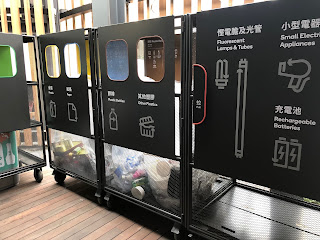
Inside are recycling bins for all kinds of waste
In some ways her comment is laughable -- isn't she doing this for the good of the environment and it will get hotter if she doesn't continue recycling. At the same time the government is not making it easier for people like Chau to recycle or be motivated to recycle.

Gael Cheng, 38, is an IT technician who lives in Tuen Mun. He has never been to any government recycling station because he has to take a train and walk 10 minutes to get there.

"I don't feel the government has ever encouraged us to recycle," he said. "Without the recycling bins, I wouldn't recycle at all. It is not compulsory anyway."

Why is the government making it so hard for people to recycle?

It's baffling what the government's strategy is when it comes to the environment. It's a joke that makes wannabe recyclers feel that their contribution is meaningless.


Wednesday, September 28, 2022

HK's Only Carton Recycler's Dead End

Yip says Mil Mill has been given a Dec 31 deadline to leave

The Hong Kong government has very little interest in protecting the environment. The latest news is a drinks carton recycler being kicked out of its space by Hong Kong Science and Technology Parks Corporation, a body set up by the government. 

The science park has given Mil Mill till the end of the year to operate and then it has to vacate the 20,000 sq ft plot in Yuen Long. In order to process everything and leave by December 31, Mil Mill's executive director Harold Yip Man-ki says they will have to stop taking in drink cartons in October.

He added the deadline is hardly enough time for the recycler to prepare for its departure.

The plant processes 3 tonnes of waste per day
Mil Mill is the only recycler in Hong Kong that can process drink cartons that are made with layers of polythene and aluminium for water resistance and durability. Recycling these cartons is considered to have lower profit margins compared to other recycling ventures because of the additional work needed to break down the coating.

In 2019, Mil Mill rented the current space in a three-year contract and then last year science park extended the least to the end of 2022.

It was in September that Mil Mill received an email from the landlord to vacate the premises without stating a reason why or any suggestions of renewing the lease.

The city's environmental department offered three alternative sites for Mil Mill: in Cheung Chau, Chai Wan and Stonecutters Island. But Yip rejected these offers, saying the locations were not suitable.

It is hard to understand why the science park is kicking the recycler out since its mandate is to support small and medium-sized enterprises. At the same time the government half-heartedly trying to solve the situation started by another government body. 

Seems strange and awkward.

Mil Mill takes in these drink cartons to recycle
This is happening at a time when Hongkongers feel even more passionate about saving the city's natural environment and are more environmentally conscious. 

If any thing the government should be leasing the land for the pulp mill since the current space is run by a government body. Mil Mill only recycles 3 tonnes of the 67 tonnes of waste produced in Hong Kong everyday. Hong Kong needs several of these recyclers to try to reduce as much garbage as possible.

It is imperative for the government to encourage more companies and individuals to recycle, if not set up its own enterprise to do so. But instead it shifts the responsibility on people who really care about the environment. They know they aren't going to make much money, but they feel strongly about landfills and excessive waste.

The current recycling bins in the city are a joke -- people haphazardly dump things into the wrong bins -- because the government has not educated them properly on how to separate their waste. 

As a result when they migrate abroad, Hongkongers have had complaints from neighbours about them having little understanding of how recycling works and what part we play in all of this. It is embarrassing that they know so little about it and why it's so important to participate and do it properly.

So this demonstrates how the government has given recycling such a low priority, not enforcing nor encouraging it.

Why does the government want its land to become a massive garbage dump? Very hard to understand its lack of interest in the environment and the three Rs: reduce, reuse and recycle.


Friday, July 22, 2022

Picture of the Day: Tennis Ball Furniture

Tennis ball furniture, anyone?

I don't know if these chairs are comfortable, but at least the material is being reused.

Sports for Hope Foundation has teamed up with Hong Kong designer and Goods of Desire owner Douglas Young to create furniture from used tennis balls that were collected at 16 private clubs and five Leisure and Cultural Services Department tennis courts across the city.

They are currently on display at Lee Theatre, across from Times Square shopping mall in Causeway Bay until the end of July.

It is estimated that over 2 million tennis balls are used each year in Hong Kong. That's a lot of tennis which is great, but then what does happen to these balls when they go soft and are unusable anymore?

Oldenburg made big versions of everyday objects
"I think most of us do not realise used tennis balls can cause such a huge environmental issue," said Young in a press release. 

"I am so grateful to be offered the opportunity to help. In making the world a better place, these amazing pieces of environmentally friendly artwork are born. The lesson I have learned is to never underestimate the creative potential of the most ordinary things we have around us."

That led me to think of artist Claes Oldenburg who died earlier this week at the age of 93. The Swedish-born American Pop artist took everyday objects and made them huge, placing them in outdoor landscapes. They made viewers look at ordinary things differently, with a dose of whimsy.

Tennis balls should definitely be reused some way -- and hopefully it's not just as art pieces, but in ways that can be useful to others.

VIFF -- Review: Our Mr. Matsura

Matsura (right) with a local in Okanogan County Frank (Sakae) Matsura, was the son of a Samurai in Hirado, Japan, but by the time he was gro...