Showing posts with label painting. Show all posts

Wednesday, September 23, 2026

Paris - Paying Homage to Monet in Giverny


The pond features a Japanese bridge, very photogenic


Visiting Claude Monet's home and garden in Giverny, France, is a magical experience. The massive garden is most impressive, filled with all kinds of flowers, from roses to irises, dahlias, tulips, sunflowers, wisteria and on and on... you can't help but be in awe of such a place. It's kind of an organised chaos.

Then the pond with the waterlilies, complete with the Japanese bridge helps you immediately see why Monet painted his famous waterlily paintings.

Monet's house is painted pink with green shutters
He lived at this house for 43 years, from 1883 until his death in 1926. 

I visited his home over 10 years ago and was so transfixed by the experience that I promised myself I had to come back if I had the chance.

So when I found out we were going to Paris, Giverny was definitely on the list.

The first time I went was part of a tour, and the tour bus took us directly there. So this time we were on our own and I did a bit of research, as Giverny is about a one hour away by train from Paris. There are a few blog posts explaining the process, which is pretty straight forward.

First check the train schedule, and we took the 10.12am train from Gare Saint Lazare to Giverny. 

I bought the tickets online, but it was quite a hassle to figure out how to scan the QR code for us to pass through the turnstile! Nevertheless, it was eventually sorted and we got on the train.

One of the rooms upstairs in the house
An hour later we got off the train found a mini electric open-air train in front of the station with a woman selling 10 euro return tickets per person to get us to Monet's home. It turns out her tour is 20 minutes, winding around some other landmarks, whereas a giant coach can take tourists to the house in half the time.

After we were dropped off at the parking lot, we still needed to walk another 15 minutes through the small village to the actual house. I bought timed tickets (12pm) ahead of time so we were able to go straight in (along with a lot of other people).

First up -- the house. There was a long line to get in, and it took a while for it to move because visitors were excited to take pictures of the first room, the gallery, which was filled floor to ceiling with paintings and photographs. 

The house, painted pink with a green trim, is large for 10 people, as Monet and his second wife Alice Hoschede-Monet had a total of eight children from previous marriages. While the gallery is quite large, as well as the bright sunny kitchen in yellow, the bedrooms are actually quite small.

A large stove with a beautiful tiled backsplash
Visitors can also see Monet's fascination for Orientalism, or things Japanese in particular, with Japanese prints in the kitchen -- including one of a women's bath house -- and others sprinkled around the home. There are also two ceramic sleeping Siamese cats.

However it's the garden that's much more interesting! The flowers are so photogenic, everywhere you look you can easily compose a nice photo. Some influencers are wearing dresses to take selfies.

The pond and waterlilies are in another area, which entails going through an underground passageway leading to a large pond surrounded by greenery, including large stalks of bamboo. Everyone flocks to the Japanese bridge, which is covered in green wisteria leaves; could you imagine when the wisteria flowers are in bloom? 

Off to the side of the house is where the gift shop is, and it does a brisk business selling all kinds of things Monet, from photography books to children's books about the artist, colouring books, scarves, T-shirts, and jewellery.

One can easily picture Monet painting this scene
We had to hurry through the gift shop because we had to catch the 1.40pm shuttle back to the village in order to get the 2.52pm train back to Paris. It's a pity there isn't another train after 3pm -- it doesn't come until around 5pm.

One tip we discovered is not to go on a Sunday -- almost all the restaurants in the area are closed! We managed to find one enterprising restaurant serving mostly pasta and pizza that was open. The pizzas we ordered were freshly made and delicious. 

Many other people who were at Monet's house the same time as us were catching the same train back. 

Nevertheless we arrived back in Paris around 4pm, invigorated and inspired by Monet's garden!

Claude Monet's home
84 rue Claude Monet
27620 Giverny

Saturday, May 2, 2026

Artist Emily Carr's Art in Nature


Only a few of Carr's paintings focus more on the sky than trees


Artist Emily Carr (1871-1945) lived an unconventional life, challenging norms and traditions at the time, and became an artist in her own right. She is best known for her paintings deep in the forest, trees in simplified shapes, but the brushstrokes have a lot of movement and energy.

The Vancouver Art Gallery is showing an extensive assemblage of her work in That Green Ideal: Emily Carr and the Ideal of Nature until November 8 this year.

Wood Interior, 1909
The exhibition shows over 100 works from sketches and charcoal drawings to numerous oil paintings focused on her love of nature and keen interest in Indigenous culture.

There is also a lot of background information about Carr's life. She was born in Victoria, British Columbia in 1871 into a privileged family. Carr was the second-youngest of nine children, her father intent on carrying on English traditions. 

It's surprising to see the exhibition reveal some personal details about Carr, such as when she was around 12 years old her father decided to talk to her about the birds and the bees that completely turned her off from sex... one wonders what he said to her which caused the conversation to have such a profound effect on her for the rest of her life.

Her childhood and life drastically changed when her mother died when Carr was 14 years old in 1886; she believes her father was heartbroken and died two years later. As a result Carr's oldest sister Edith was her guardian.

From a young age Carr showed artistic leanings and her father encouraged her to develop her talent. But it wasn't until two years later in 1890 that she studied art at the California School of Design in San Francisco for three years, then returned to Vancouver Island and then went to England to study painting; she also went to Paris later in her career.

Tree Trunk, 1931
Meeting Lawren Harris of the Group of Seven in 1930 made Carr feel like she was part of a community of painters who had similar philosophies, inspired by nature.

"Find the forms you desire to express your purpose," she wrote in her journal in June 1931. "When you have succeeded in getting them as near as you can to express your idea, never leave them but push further on and on strengthening and emphasising those forms to enclose that green idea or ideal."

Most of the paintings are vertical, showing the height of the trees she painted, admiring their trunks and leaves -- she used a lot of green paint! One painting called Wood Interior, 1909 shows trees at ground level, but with the morning light shining in between the tree trunks. 

Another called Tree Trunk, 1931, focuses on the simplified form of the tree trunk, which looks similar to a Georgia O'Keefe painting in its sensuous curves and earthy palette. 

Only a few works are horizontal, or only show sparse trees, or from a distance and instead focusing on the sky with clouds.

It's such an extensive exhibition, that it is quite an intense Carr retrospective! 

That Green Ideal: Emily Carr and the Ideal of Nature
On until November 8, 2026
Vancouver Art Gallery

Tuesday, March 25, 2025

Picasso's Tenuous Link with Asia


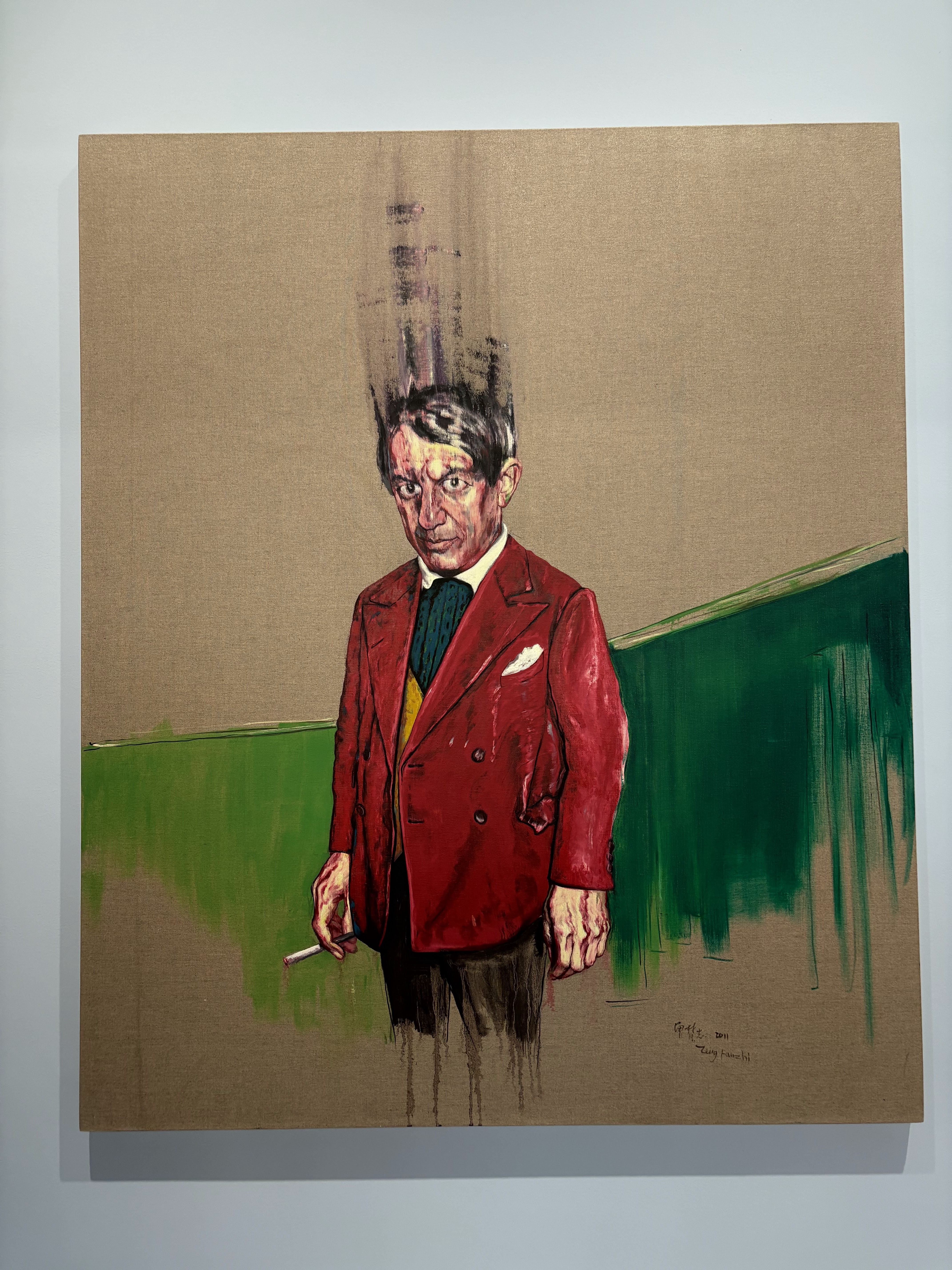
Zeng Fanzhi's portrait of Picasso


I managed to squeeze in some time this afternoon to go to M+ in West Kowloon to see the Picasso exhibit called "Picasso for Asia: A Conversation" that's on until mid-July.

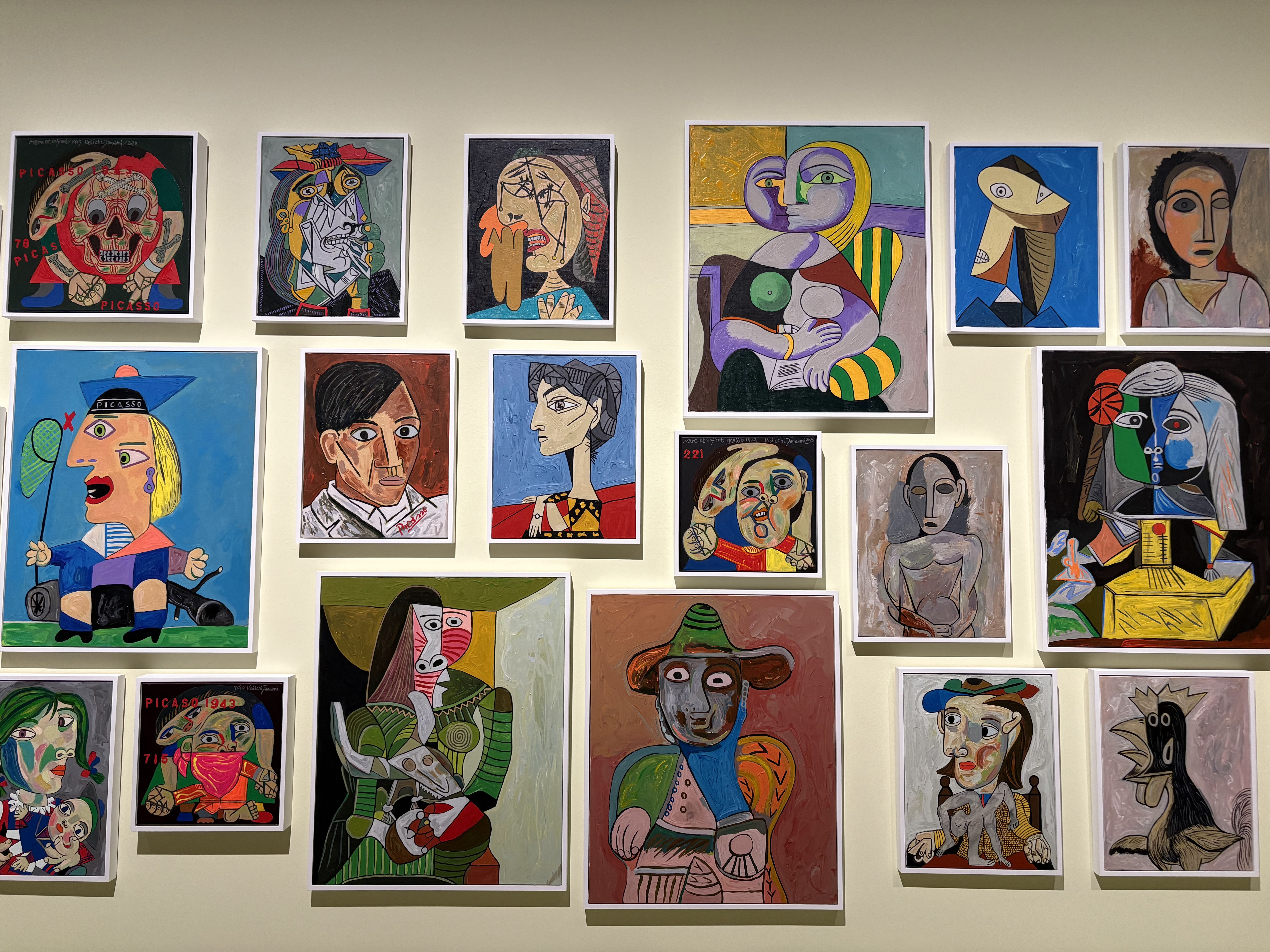
Tanaami Keiichi's interpretations of Picasso's art
The Spanish artist was a giant in the art world and has influenced so many following behind him, that this show not only showcases his work and how it evolved in his different periods, but also how other artists have been inspired by him.

More than 60 of Picasso's works were loaned from Musee national Picasso-Paris, which holds the largest and most significant collection of his art, and they are compared and contrasted with around 130 pieces of art by 30 Asian artists.

The opening painting is a portrait of Picasso by Chinese artist Zeng Fanzhi painted in 2011. It depicts Picasso as very intense with large eyes his hands muscular, and casually holding a cigarette in his right hand. 

Picasso's study of a horse for Guernica
The show is a good introduction to Picasso for those not familiar with his work. It first explains he learned to paint from his father, Jose Ruiz y Blasco, who was an art teacher and painter. Blasco quickly saw his son's artistic talent and helped him develop it.

In addition, the exhibition briefly addresses Picasso's detrimental relationships with women he considered his muses; he identified with the story of Pygmalion, a sculptor in Greek mythology who carved a statue of a woman so perfect that she came to life. He also identified with the Minotaur also in Greek mythology a character with a man's body and a bull's head, that was at times vulnerable or blind, or sexually charged and violent.

There are paintings that show his sketches for his masterpiece Guernica, and paintings of doves that soon became the global symbol of peace. The exhibition even points out that China used Picasso's paintings of doves on stamps and other propaganda.

The start of Picasso's Blue Period
Picasso's Blue Period from 1901 to 1904 is explained -- he was depressed following the suicide of his close friend, artist Carles Casagemas. Picasso expressed his sorry by painting him in Portrait of a Man. There are also works from Picasso's cubism period, how he began to see things in shapes that became more and more abstract.

One of the rooms invites visitors to sit down and watch videos of Picasso freely painting on glass, a vase of flowers, a bull, or a dove. At one point he stops and looks at the viewer before walking away. It's fun watching him painting quickly and easily, very sure of himself and carefree.

The show also demonstrates how Picasso was greatly influenced by masters before him, and shows his interpretations of paintings by other artists, like Francisco Goya and Edouard Manet. In that way the exhibition wants to show that Picasso wasn't just considered a master, but always an apprentice wanting to learn more from others.

Meanwhile Picasso's link with Asia is tenuous -- he made one painting that was related to the Korean War called Massacre in Korea, where one can easily see how he has made direct associations to Goya's work, The Third of May1808, and Manet's paintings depicting the execution of Emperor Maximilian.

Picasso painting a vase for the viewer
Nevertheless, while a few of the Asian artists' work are directly related to Picasso, others aren't so much, which makes the associations to him not quite credible...

The Hong Kong Jockey Club Series: Picasso for Asia -- A Conversation
Until July 13, 2025
M+


Monday, December 9, 2024

A Retrospective of Hockney's Whimsical Approach to Art


Hockney's interpretation of Yosemite


We paid a visit to the Palm Springs Art Museum again, after our first visit two years ago. This time the exhibition is on English artist David Hockney and it demonstrates a range of his work not only chronologically, but also in terms of the various mediums he uses.

A photo and painting of sunflowers
Entitled David Hockney: Perspective Should be Reversed: Prints from the Collections of Jordan D. Schnitzer and his Family Foundation, the show includes almost 200 of the artist's works in prints, collages, photographs and iPad drawings.

I don't know much about Hockney, save for his colourful, whimsical works, like his swimming pool paintings, and he designed a print for the 1972 Munich Olympic Games of a man diving into the water.

His curiosity in experimenting with new technology, in particular iPads is really interesting, as someone in his late 80s is open to trying new things and seeing if it works for him and his art. For example he did a sketch of Yosemite in his iPad and it could easily be a lithograph, with vibrant green trees in the foreground, and the mountain in the back. He uses various circles, dots, squiggles and scratches to create texture and depth. 

His collage portrait of his mother
Hockey also tries to make art fun and pokes fun at how people think it has to be high brow. In "Photography is Dead. Long Live Painting", he has a photo of a vase of sunflowers in an homage to van Gogh, but next to it is a painted version of the same flowers. 

There's also a portrait of his mother that he made by taking numerous pictures of her at one sitting and assembling the pictures together to create one image. The same goes for a massive collage of the Grand Canyon.

What I liked the most was a giant painting of two of him! Both sitting in chairs with their backs to the viewer, one smoking, the other not at a wall full of his paintings of flowers in vases on checkered tablecloths.

The museum got cheeky and replicated the painting with the same flower paintings framed on the wall, and the included two chairs similar to the ones in the painting complete with a side table and silk rose, and invited viewers to be in their own Hockney work. Quite amusing!

Two Hockneys looking at his flower paintings
David Hockney: Perspective Should be Reversed
Until March 31, 2025
Palm Springs Art Museum
101 Museum Drive
Palm Springs, CA 92262

Friday, December 6, 2024

Picture of the Day: Bob Ross Ornament

Bob Ross Christmas ornaments!

Yesterday I checked out a T.J. Maxx outlet and Christmas is in full swing in the discount department store in Palm Springs. There's an array of ugly Christmas sweaters (flamingos wearing sunglasses, the Grinch, and Scooby Doo), Christmas-themed pyjamas, gift tags, wrapping paper and even Christmas toys for dogs.

And then there are Christmas ornaments. 

One that caught my eye was a figurine in the likeness of Bob Ross!

I remember as a kid watching his TV shows where this hippy-looking guy with big hair would paint scenery from his imagination and they would always involve trees.

He was known for repeating the phrase, "let's adds some happy little trees" and using a thick brush would add dabs of wet oil paint on a relatively dark background and then bit by bit the blobs in different shades of green would become trees.

Watching his show was like witnessing magical paint suddenly become a painting. And it was his soothing voice that people today remember about him too. And that big round curly hair on his head.

While Ross has made a resurgence in popular culture thanks to him being spoofed in TV programs, films and even video games, it's was quite the surprise to see him as a Christmas ornament, holding a big brush in his right hand, and hugging three Christmas trees.

I wonder -- who has bought and put him on their Christmas tree?

Saturday, October 5, 2024

VIFF Review: John Singer Sargent: Fashion & Swagger


Sargent's portraits reveal character and fashion

Before watching the documentary John Singer Sargent: Fashion & Swagger, I didn't know much about him, except that he painted portraits of wealthy people, mostly women, with their luxurious dresses, the folds captured with brushstrokes that had energy and flair.

The film directed by David Bickerstaff is from Seventh Art Productions, which focuses on artists like Vincent Van Gogh, Frida Kahlo, and Edgar Degas to name a few. So you know this documentary will be one that fans of art and painting will appreciate. In this case there's the added dimension of fashion.

He went to Spain and was captivated by flamenco
Bickerstaff follows two exhibitions of Sargent's at the Tate in London and the Museum of Fine Arts Boston, and through several art experts as well as a fashion photographer, analyse the artist's work, give them context to explain how Sargent was one of the greatest artists of his time.

Sargent was born in Florence to American parents, his father an eye surgeon and his mother appreciated art and design. They quickly discovered their son had an artistic talent and encouraged him to study further in Munich, Florence and Paris. He was also fluent in several languages including French, English, and Italian. The family was relatively well-off after his mother inherited money from her family.

He followed artist Charles Auguste Emile Durand, known as Carolus-Duran; eventually the teacher saw his student surpassing him in his mastery, which in a way was his blessing that he could become a professional artist.

Portrait of Lady Sassoon
Carolus-Duran suggested Sargent study Velazquez and so he went to Spain and was captivated by flamenco dancing; he also did quick painting sketches of everyday life, which also enhanced his painting skills.

From there he began painting portraits of wealthy people, and the exhibition in Boston had Sargent's paintings next to the actual dresses his subjects wore to show the similarities and differences. The art experts pointed out how Sargent really paid attention to the fashion they were wearing and what image it portrayed, and at times took liberties with it. 

For example in his portrait of Lady Sassoon, she wore a black robe with a pink lining and if she wore it, one would not have been able to see the pink lining easily. But Sargent took liberties to make the pink lining show off, and create an S-shape from her shoulder down to her hip to make the eye travel down the painting. He was also doing black-on-black which can be difficult to pull off.

One of his famous paintings is called Madame X, who was actually Madame Pierre Gautreau. She was a young American socialite who married an older wealthy man in Paris. Sargent asked to paint her portrait and she wore a black dress with straps, not looking at the viewer.

Madame X
At first he painted one of the dress straps falling off and it caused such a stir that Gautreau and her mother begged Sargent to change it, but he refused. But in the end he changed it, but the scandal almost ended his painting career in Europe.

He later moved to England and then the United States, where he painted the portraits of nouveau riche.

One of the art experts in the documentary suggests that Sargent was gay, that he painted his male subjects with a slightly feminine air by the way their hands were posed and what they wore. Perhaps, as he never married...

Nevertheless, he inspired fashion photographer Tim Walker to create portraits in the style of Sargent, evoking a kind of fantasy with billowing fabric that he admitted were made of sheets of plastic. His portraits of Tilda Swinton are almost ethereal and hint sophistication.

Sargent was extremely passionate about creating art and he did it very well. Learned so much from this documentary!

John Singer Sargent: Fashion & Swagger

Directed by David Bickerstaff

93 minutes

2024


Friday, August 9, 2024

Picture of the Day: Star Wars Typewriter


An Olivetti typewriter with Star Wars on it!

This morning we took an early morning flight from YVR, Vancouver International Airport, and near our gate I spied some art work in the form of Olivetti typewriters!

The attention to detail is impressive
One in particular caught my eye -- a typewriter painted with Star Wars scenes on it! On the front was the Emperor, and on the top yoda on the left, Darth Vader on the right, and on the sides a frozen Han Solo, a stormtrooper, C-3P0, and Luke Skywalker.

It turns out the typewriter was painted by Vancouver artist Dave Benning. He works with Brendan Raftery who restores old typewriters so they are actually usable again, while Benning paints them with custom designs. 

Star Wars is near and dear to his heart, explaining he first watched the film when he was eight years old and left a very strong impression on him so many decades later. He says the typewriter is a tribute to the movies, the screenwriters and Lucas' vision.

Benning painted key scenes in Star Wars movies
Nice to see the typewriter displayed at the airport for all fans to see!


Friday, December 1, 2023

Palm Springs: La Qinta Art Saturday

Strolling down the main street to check out the art fair

On Saturday we visited La Qinta, a city in Palm Springs, in between Indian Wells and Indio.

It was originally an agricultural town in the late 19th century, and is home to some 40,000 residents. It is best known for its golf course, La Qinta Resort and Club which dates back to 1926, and was where director Frank Capra wrote the screenplay for Lost Horizon.

Colourful glass sculptures for sale
As it was the weekend, it just so happened there was an outdoor art fair there so we parked the car and took a stroll along Main Street that was closed off for pedestrians.

Many people brought their dogs on leashes as they walked from stall to stall. Vendors were selling jewellery, ceramics, glass pieces, and large canvas paintings. We snagged a beautiful silver chain bracelet that would have cost more in a jewellery store.

The atmosphere was very laid-back and there was a musician busking and selling his CDs too. One stall sold miniatures of well-known landmarks like the giant pink elephant sign "Rancho Super Car Wash", and "Bombay Drive-In" complete with retro-looking cars.

Meanwhile many of the colourful paintings were inspired by the mountains and the dessert landscapes. One would need a very large wall to hang them on!

Iron bark eucalyptus with inlaid turqoise, malachite
One of the most beautiful things we saw was wood carved into large bowls and polished. Picking them up they are not heavy, and make for a stunning highlight piece on a coffee table or dining table. They only start at US$300...!


Tuesday, October 17, 2023

Picture of the Day: Vancouver Painted


The Park Theatre on Cambie Street

On the weekend I visited a neighbourhood art gallery exhibiting the paintings of Vancouver artist David Wilson. The show is called "The Ground Beneath My Feet" and features street scenes around the city.

One looks down on the downtown core, views looking up to the Burrard Street Bridge at sunset, or the intersection of downtown streets in the early morning.

Dunbar Theatre in my neighbourhood
However, Wilson's best paintings are the ones of rainy night street scenes. These ones each have an old school theatre in them -- Stanley, Park and Dunbar. They are all scenes shot in the rain, with the colours of the lights reflected in the wet slick roads.

The images are so evocative, inspiring a feeling of nostalgia, and Wilson's work is a cross between Edward Hopper and Jackson Pollack in acrylic. 

So nice to know there is an artist here who loves to paint Vancouver.

David Wilson
Until October 28
Visual Space Gallery
3352 Dunbar Street, Vancouver
604 559 0576

Monday, June 20, 2022

Building van Gogh Brick by Brick

Van Gogh's The Starry Night in Lego form by Truman Cheng


One of the latest products to come from Lego is a reproduction of Vincent van Gogh's The Starry Night -- in the colourful bricks.

The swirl of the clouds in blues, grey and yellow is cleverly recreated using straight, thin bricks, but perhaps what's so fascinating about it is that the piece is its three-dimensional look.

Even better? It was designed by a Hongkonger.

Cheng likes van Gogh's paintings
Twenty-six-year-old Truman Cheng is a PhD student studying medical robotics and magnetic controlled surgical endoscopes.

During his free time however, he loves playing with Lego, something he's done since he was a child.

"To me, Lego is more than 'toys', it's something similar to painting," he said in an interview with Lego. "I can express myself, create characters and sculptures from my imagination. It's a very relaxing experience where I can forget about the petty troubles in daily lives, and get lost in my own imagination."

He later explained that he's always loved van Gogh's work and that The Starry Night is such a well known piece. 

"I had wanted to make a Lego creation based on the artwork for a long time but never thought of a good execution-style for it.

"One day I was just playing with Lego parts, and I realised stacking Lego plates together in random intervals look a lot like van Gogh's iconic brush strokes!

A figurine of the artist himself
"I couldn't help but wonder what the full painting would look like with this build style. I kept building and modifying, and eventually created the model you see in the project."

There are over 1,500 pieces for this particular Lego set and the company teamed up with the Museum of Modern Art -- which houses the original art work -- to produce the set, which retails for US$159.99.

One wonders what royalties Cheng will get!

But in the meantime it just shows how playing can get those creative juices going!

Saturday, May 14, 2022

A Visit to Getty Center


The Getty Center has a maze garden down below

This morning we visited the Getty Center, which houses a large collection of art, from the Middle Ages to the Impressionists and contemporary photography that are constantly rotated on show.

It's free admission as long as you register online, and if you are vaccinated then you don't need to wear masks in the museum, but a must on the tram that takes visitors on a short ride up to the museum made up of a few buildings.

The museum celebrates its 25th anniversary
Each has different themed works, from paintings and sculptures, to photography and furniture. While the exterior of the buildings is very contemporary, inside the rooms match the different themes and all are furnished with beautiful wood floors. 

Early on I stepped too close to a painting and a security guard came over to quietly whisper in my ear to stand a bit further away next time. The staff also seem to be quite knowledgeable of the collections too, not just on directions to get from one place to another.

Some of the highlights we saw:

We were lucky to catch a small show on the Impressionists, and there were famous paintings by Claude Monet, including The Portal of Rouen Cathedral in Morning Light. In the description, the cathedral was less important as a religious symbol than as a richly textured surface on which light could play with colourful variation. 

Another was Wheatstacks, Snow Effect, Morning, where he painted wheatstacks near his garden at Giverny during different times of day and seasons in the year. He captured light on the wheatstacks using different colours.

Thrilled to be able to see this painting in person
One painting I hadn't seen before was Paul Cezanne's Young Italian Woman at the Table. A young peasant woman in plain clothes looks reflective as she rests her elbow and arm on a richly colourful and textured piece of fabric. It's an interesting contrast between her and the fabric.

The absolute highlight is Vincent Van Gogh's Irises. A few years ago I traveled to Saint-Remy, where we saw the sanitarium where he stayed for several months. I also saw the stunning film Loving Vincent, which is completely animated in the style of his paintings. It was gobsmacking amazing to watch and the storyline interesting too.

Then last year my good friend treated me to tickets to a one-man play called Vincent, based on the letters between the artist and his brother Theo, that reveal some interesting personal information about Van Gogh that I didn't know before. He had studied to become a priest and at one point was in love with his cousin but her family did not approve.

Cunningham famous for calla lilies
The Irises painting is colourful and textured; the leaves are undulating, while there are various shades of blue and purple contrasting with green, yellow and orange.

In another building we saw a retrospective on photographer Imogen Cunningham, quite the trailblazer from 1913 till her death in 1976. She photographed almost all her images in black and white, focusing on contrast and composition. 

She is best known for her calla lily pictures, as well as magnolias, focusing on the flowers in her garden in the mid to late 1920s. Cunningham also extended to shapes of the naked body, as well as portraits of people for her commercial work. 

One picture is of her father at the age of 90 posing with his cane next to a pile of wood he had just chopped. He had a large mane of silver white hair neatly combed and he seems bemused that his daughter would want to take a picture of him.

J Paul Getty collected a lot of French Roccoco furniture, and one of the first items he bought was the portrait of King Louis XIV. Some of the furniture included a very elaborate looking desk and writing stand.

Innovative uses of Chinese bowls!
Another called Lidded Bowl, where two Chinese bowls from Kangxi's reign are placed with one inverted over the other to form a lid. Then the two bowls are decorated with gilt bronze mounts to create a very expensive potpourri vessel, where flower petals and spices were placed in there to create a pleasing scene in the room as people during the 18th century didn't bathe much...

The Getty Center is also a nice place to just sit around outside and have coffee, lunch or snacks. We had a substantial lunch of sandwiches, a large garden salad filled with greens, fennel, tomatoes, pistachios, and farrow. 

The museum even offers umbrellas for people to use to shade themselves from the direct sun when moving from one building to the other and leave the umbrella outside before going into the next building.

We didn't make it down to the maze garden with the hot temperatures near 30 degrees, but it's a wonderful place to wander around, see some fantastic works of art and enjoy the scenery at the same time.

1200 Getty Center Drive
Los Angeles, CA 90049


VIFF -- Review: Our Mr. Matsura

Matsura (right) with a local in Okanogan County Frank (Sakae) Matsura, was the son of a Samurai in Hirado, Japan, but by the time he was gro...