Showing posts with label museum. Show all posts

Tuesday, October 6, 2026

Paris - Artistic Impressions at Musee d'Orsay


Sculptures displayed at Musee d'Orsay

The Louvre is an intimidating place to visit as it's so large and filled with masterpieces that it's an overwhelming experience.

A more approachable art museum that focuses more on the Impressionists is Musee d'Orsay, in a former train station still retains its original ceiling mouldings, but also a contemporary look.

Monet's Poppies or The Promenade
We got timed tickets the night before and thankfully we did because the next morning when we arrived at 9.30am when it opened, there was a massive queue for those who didn't have tickets or timed tickets.

When I showed them our tickets, we were ushered into another entrance where we went through security and then were in.

The museum has expanded its gallery space to the fifth floor, the top floor where its Impressionist collection is. There's also a balcony area where we could go outside and across the Seine see the Louvre and the giant balloon (minus the fiery cauldron) parked in the Tuileries Gardens.

It's interesting to see the museum's collection of Impressionist works arranged by collectors who bequeathed their paintings to the French state.

The Starry Night by Van Gogh
There is a short introduction of the collector, how they got to know the artists and following their deaths, how their collections were donated to either the state or Musees Nationaux.

It's not often that we know about the collectors, and how they supported artists financially, and these short biographies give visitors a chance to get to know them, and appreciate the role they had in artists' careers.

We saw numerous works by Claude Monet, like Poppies, also known as The Promenade, with a woman and child walking through a field of red poppies, or Vincent Van Gogh's Portrait of the Artist, the Dutchman painting himself in a light blue suit with a wavy background, and his Bedroom in Arles.

But there were other paintings that caught my eye, like Van Gogh's The Starry Night -- not the one in the Museum of Modern Art in New York, but the precursor to it that he painted in 1888. A few months later, he was committed to a psychiatric hospital, and that's where he painted the work we all know.

Caillebotte's The Floor Scrapers
There's also an artist by the name of Gustave Caillebotte, who had a knack for painting scenes of blue-collar workers, like The Floor Scrapers in 1875.

Three bare-chested men are on their knees on the floor of a Paris apartment where the are stripping away the wood on the floor. Some critics at the time felt the work was vulgar and how it focused on the working class.

However, that's what makes the painting so interesting for us today, seeing the work they did was back-breaking and very physical, working hard for the benefit of the rich.

Caillebotte has another interesting perspective of being in a rowboat sitting in front of a man in a top hat who has the oars. The angle is one we'd probably take today with our phone cameras, but at the time was considered "audacious immersive framing" according to the caption.

Polar Bear by Pompon
The ground floor of Musee d'Orsay is well known for its display of sculptures, and there was one of a polar bear by Francois Pompon from 1923 to 1933. Pompon worked with Rodin, but focused more on animals. His Polar Bear is so contemporary looking, it's surprising that it was made a century ago.

A pair of sculptures caught our eye -- Chinese Man and Chinese Woman by Charles Cordier in 1853, the busts of two real people, Chung Atai and his second wife, Yung Achoi. Perhaps the spelling should be Ah-tai and Ah-choi?

In any event, according to the caption, the couple were originally from Canton (now Guangzhou) and traveled to London for the 1851 Universal Exhibition before touring Europe.

The Chinese Man, Chung Atai
The busts are made of bronze and have a lot of detail, like Atai's long braid, the embroidery on his chest, and he holds an opium pipe, whereas Achoi has butterfly and floral hairpins in her hair, the intricate designs on her silk robes, and her long fingernails.


Tuesday, September 15, 2026

Paris - Cloud of Mist the Bourse de Commerce


A large cloud forms out of water mist in the rotunda


For our first day in Paris started with blue skies and temperatures in the low 20s. We made our way to the Palais Royal, and from there walked to the Bourse de Commerce (Commodities Exchange), which holds the Pinault Collection.

We were lucky to catch the tail end of the Fujiko Nakaya show -- the only thing going on at the Bourse de Commerce.

Visitors being enveloped in the cloud
The 93-year-old Japanese artist is best know for her fog sculptures. They aren't sculptures per se, but art installations, where water droplets are spewed into the air and create cloud-like formations. In this case it is called "Cloud #07156."

Visitors had to wait in line before being allowed to enter the circular space designed by Tadao Ando. On the floor are rows of grates on the floor in the middle shaped like a square, and they are timed to shoot out the water droplets that move from one side of the room to the other, enveloping people in the mist as they sit.

After a few of these sprayings, which is exactly the same as water mists sprayed on vegetables in the supermarket, visitors are invited to stand up and take pictures, but not to stand too close to the grates.

Ando's design contrasts the building 
The whole thing lasted about 15 minutes. It was quite the experience to be enveloped in this way, and it reminded me of when I saw the Ryuchi Sakamoto exhibition in Tokyo, where the courtyard was filled with mist!

Interestingly, the fog sculpture don't seem to affect the paintings above it. They are four paintings by four different artists, depicting the trade France had with different countries and continents, like Asia, North America, Russia and the Mediterranean.

None of the artists had been to all these places, so they were stereotypical depictions of the people represented. The paintings were all painted on canvas before they were glued onto the circular wall.

The Bourse de Commerce has an interesting history in itself all the way to today.

Built in 1763-1767, the circular building was originally used to house grain, and later became a marketplace for residents to buy and sell food stuffs. It was an open air interior courtyard that was later enclosed with a wooden dome, one of the largest of its kind in Europe.

But in 1802 a fire destroyed the dome and it was later replaced with a copper frame with glass.

The paintings above depict trade with continents
In 1854 the Bourse de Commerce became a commodities exchange, buying and selling items like wheat, rye, oats, flour, sugar, oil, and alcohol. But then in 1998 with the ushering in of the age of the internet, market activity ended in the building, and was left abandoned.

In 2016, the then Mayor of Paris, Anne Hildago, offered Francois Pinault, one of the richest men in France, a 50-year lease of the Bourse de Commerce for his art collection for 15 million euros and yearly fees, to fund the renovation of the building, which was finally opened in 2021.

Pinault chose Japanese architect Tadao Ando to design a massive concrete cylinder inside the building at the cost of US$170 million. It was quite controversial because why did concrete cost that much and what would happen to the integrity of the building?

The double spiral staircase
But it turns out it's quite interesting, smooth concrete that has holes in it to display works of art, and down below in the basement level is a small auditorium where visitors can watch videos or presentations.

2 rue de Viarmes
75001 Paris


Sunday, May 31, 2026

A Visit to the Royal Ontario Museum

The ROM has a crystal-like structure jutting out of it

The Royal Ontario Museum has something for everyone: there are informative exhibitions that invite visitors to touch and smell items, and staff on hand to give more interesting facts and answer questions, and a large room for children to freely play and do activities without disturbing others.

Currently the museum has an exhibition called Bees: A Story of Survival. It informs people about the plight of bees, how they form from egg to insect, and how crucial they are to human survival through their act of pollination.

There were so many interesting facts about bees sprinkled throughout the show:

A most intricate porcelain vase
Bees have been around for over 120 million years

More than 75 percent of the world's food crops depend on pollinators like bees

One hectare of a well-managed meadow can contain about 7.5 million flowers, enough to support over 200,000 bees.

Bees have 170 smell receptors, as scent is essential for bees to survive, reproduce, communicate, find food sources, and keep their nests safe.

Bees produce a resin-like material called propolis, which has anti-microbial properties that we use in medicine, including cough syrups and cosmetics.

There are more than 300 native bee species living in and around Toronto

Most bees are wild and don't live in hives. Other kinds of bees include: 
Mason bees that live in existing south-facing holes, like trees to window frames; 
Leafcutter bees that cut discs in leaves and glue them together with leaf pulp to build cells; 
Mining bees make nests in the ground and dig vertical tunnels into the the soil;
Indian stingless bees create nests in tree trunks, logs and wall cavities.

There were also some interesting exhibits where visitors touch the screen to illuminate some facts, a room where points of light represented a bee and showed what a swarm looked like, mostly to protect their queen. 

Most fascinating was a video from a bee's point of view of what the outside world looked to them, how they are near-sighted so they depend on the bright colours of flowers to guide them to find pollen.

Another interesting fact is that a wild honey bee queen can lay 1,500 to 2,000 eggs each day, and produces a scent called pheromone that encourages the colony to work together.

Over 100 birds in movement
The exhibition was created by the National Museums Liverpool together with artist and sculptor Wolfgang Buttress, making it an inviting, artistic, multi-sensory experience for visitors with interesting facts about bees that are not lecturing, but informative, and encourages people to appreciate these insects. 

We also wandered around other parts of the museum, looking at the rooms showcasing China and Korea, metal armour dating back to the Norman conquest of England in 1066, many dinosaur bones, and a replica of a Ming dynasty tomb with a tomb guard.

Another room showed Japanese textiles and the most intricate porcelain vase we'd ever seen. Up close there were tens of thousands of tiny delicate swirls that looked like flower petals. It's called Cocoon by contemporary artist Makkiko Hattori, and is actually part of the collection at the Gardiner Museum across the street from the ROM!

Kids are sure to have a fun time at the ROM with interactive exhibits, and several volunteers and staff explaining things and answering questions. After looking at the bee display, we went to see the live bees the museum keeps and a woman was there to show us the queen bee (marked with a blue dot), and that there was a drone bee in the hive too. The bees can go in and out of the hive through a plastic pipe that leads to the outside of the museum.

We also enjoyed the section on birds, where over 100 avian species are on display, mostly in flight, so visitors can see how they move and in particular, flying above people as they walk through the exhibit. 

There was also a room full of precious stones, many of which we did not know there were so many names for! Lots of giant sparkling rocks that were made over 4.5 billion years ago.

Mind boggling!

Royal Ontario Museum
100 Queen's Park
Toronto


Monday, May 25, 2026

Shoes Reveal the Human Condition


Colourful pairs of car-themed shoes in the museum


Who knew people would be so fascinated by shoes? Sonja Bata did. She married into the Bata shoe family business that has been around for 131 years. Her husband, Thomas J Bata was sent to Toronto after World War II to expand the company in Canada, and wherever they travelled, Sonja would collect shoes.

By the late 1970s she had collected over 1,500 pairs of shoes by the late 1970s, and a friend and anthropologist suggested she house them in a museum.

Silk shoes for Chinese women with bound feet
The Bata family set up the Bata Shoe Foundation in 1979, and then in 1995 opened the Bata Shoe Museum on Bloor Street West, near the Royal Ontario Museum in Toronto. Today the collection has over 15,000 pairs of shoes!

I had visited over two decades ago and so it was fun to go check it out again. And here's a pro tip: if you have a Toronto Public Library card, you can visit the Bata Shoe Museum free by registering online!

After we went in, we were advised to start from the bottom and work our way up the building. In the basement is the permanent exhibition, showing an array of very old shoes, from depictions of sandals on Egyptian mummy cases, to tiny silk embroidered slippers worn by Chinese women with bound feet, to a French chestnut crushing clog with craggy spikes, and Nike sneakers designed by Pharrell Williams.

Perugia's patented shankless shoe
The next floor up had an exhibition about the Italian-French shoemaker Andre Perugia (1897-1977). He was the son and grandson of shoemakers, and Perugia went on to innovate when it came to fashion-forward designs that showed off women's feet in creative ways.

He made shoes that had a basket-like weave, or detailed button closures with a scalloped edge, and designed mules that had no heel so it looked like the woman was on tip toe.

Another intriguing design is a shankless shoe, where the middle part of the shoe that connects the sole and heel is missing. Perugia's design was first mentioned in 1934 and he patented it in 1940. One wonders if it is even comfortable to wear, but reports of the time claimed it was... if so, why aren't there more shankless shoes?

Perugia worked with fashion houses like Dior and Schiaparelli, and his place in fashion was immortalised in a painting that featured such giants as Christian Dior, Hermes, and Guerlain. 

Cactus-themed boots by Charlie Dunn
Another fun exhibition is called Rough & Ready: A History of the Cowboy Boot. It takes visitors on the history of the cowboy boot since the late 19th century to the present. Some are purely for practical use, others are decorative, like boots decorated with cactus plants complete with flowers designed by Charlie Dunn, who has been called the Michelangelo of cowboy boots, and there's also a beautiful pair featuring turquoise peacocks by Rocketbuster Boots.

And yes, there's even a pair of boots featuring Woody from the Toy Story animated franchise. 

The final exhibition room is about Vindolanda, a Roman auxiliary fort and settlement just south of Hadrian's Wall in Northumberland, England. The excavation site there has unearthed many pairs of Roman footwear.

Originally it was believed these military sites only housed men, but there were also women and children there, and they have also found socks, bowls, and cups. They have also unearthed messages like, "Please send me socks and underwear" to the price of beer, to "I'm getting kicked out of the social club house", which gives archeologists an even better picture of the lives of the people in Vindolanda. 

French boots worn to crush chestnuts
Really interesting, and as I said before, who isn't interested in footwear? It's a fantastic way to understand how people lived thousands of years ago.

For that we have Sonja Bata to thank!

Bata Shoe Museum
327 Bloor Street West
Toronto, ON
416 979 7799


Wednesday, January 28, 2026

Celebrating Failure as a Sign of Progress


There's a new exhibition -- in a Vancouver shopping mall -- that most people can probably relate to.

Called The Museum of Personal Failure, it's a collection of artefacts from the public, from a dead plant to a wedding dress and a spilled can of paint with anecdotes to explain why they were not successful.

It's the brainchild of Burnaby resident Eyvan Collins, who started it when a relationship of his fizzled out.

"I felt like a failure. It was a heartbreak," Collins told the CBC. "I just needed to do something with it -- and this is what I did."

He made posters saying, "Failures Wanted" and plastered them around Metro Vancouver. People responded with offers of all kinds of items signifying their failures.

Collins says failure is an essential part of life. 

"It's part of making an attempt. Sometimes it goes the way you want it to, sometimes it doesn't," he said.

There's also a "Wall of Reject", featuring firing notices and rejection letters.

I'm sure many people would have some of these lying in the back of their desk drawers.

His mother, Jennifer Campbell donated her wedding dress for display.

"I wanted to sort of tell a story about a failing that occurred in my marriage, and how we were able to move on," she said.

"I've called it Threads of Innocence, because it's about the innocence of false fairy tales or things that you think are going to happen when you're young... and it doesn't happen."

The dress is even shown in a cardboard moving box to signify her being able to move on from it. 

Meanwhile, bladesmith Casey Vilensky submitted a knife he can't be sharpen because he made mistakes while making it.

"Failure is a step forward. You don't go forward until you fail. You have to be able to look back at your failures, figure out why they failed and change the process and move on. I don't harp on them... I put them in the bucket," he said.

If I were to submit something to the Museum of Failure, I'd probably donate my empty sketchbooks.

I keep meaning to get back into drawing, but have left them blank, too terrified to make a mistake. A fear of failure.

But it's totally unfounded!

Or probably some jewellery from failed relationships... 

What would you donate to the Museum of Failure?

The exhibition is on until February 3 at Kingsgate Mall.

Sunday, March 30, 2025

Tokyo: Snoopy Museum


A family-friendly, fun place to visit

A friend and I have a mutual love of Snoopy. Mine goes back to when I was a child, reading the Peanuts comic strips and watching A Charlie Brown Christmas. The comics and characters reflected how kids felt at the time -- and they still hold up today! Snoopy projected our fantasies, from being able to dance to being the World War I Flying Ace shooting down the Red Baron. Oh and observations about cats and dogs were so true.

So when my friend told me about the Snoopy Museum in Tokyo I had to go visit. It is the only satellite museum affiliated with the Charles M Schultz Museum and Research Center in Santa Rosa, California.

One of the first Snoopy comic strips by Schultz
The Snoopy Museum Tokyo opened in 2016 and was located in Roppongi, but closed two years later and re-opened in the outskirts of Tokyo in Minami-machida Grandberry Park, a kind of outlet store outdoor shopping area in 2019. Just last February it finished renovations.

It takes about an hour to get to Grandberry Park, southwest of Tokyo, but once you get there you can see how appealing it is for families, with lots of outlet shops -- tax free for tourists -- and activities for children to do, as well as the Snoopy Museum.

There are Snoopy statues along the way to point you in the right direction, but soon you will come across a giant Snoopy with his mouth open, indicating the entrance to the museum. We got tickets online in advance, and in exchange we received paper tickets that were each Peanuts comic strips and two stickers too.

From there we were invited to go up to the third floor and work our way down. There are some rooms where we couldn't take pictures, as they were photographs of Charles Schultz as a child or family pictures, but other than that lots of large-scale comic strips that were reproduced.

Snoopy trying to hit a golf ball with an audience
There were also sections dedicated to each character, and themes like homework, the school bus, and baseball, introducing these from an American perspective. There was also a room with a massive sleeping Snoopy, and up on the rooftop garden lots of Snoopys watching one trying to hit a golf ball. 

Some of the comic strips were animated which was fun, like Charlie Brown watching TV, and Snoopy trying to get his attention and sleeping on top of his head; Charlie Brown gets annoyed and walks to the door, outside and flings Snoopy onto his red dog house to sleep.

Interestingly not much about A Charlie Brown Christmas, though a lot of jazz was played in the museum which made it relaxing to be in there.

And of course the other best part of the museum was the gift shop! All kinds of merchandise were available, but strangely no children's T-shirts, but lots of stuffed Snoopys, plastic folders, stickers, cookies, notebooks, key rings and so on.

Giant sleeping Snoopy... you can't touch though
If that wasn't enough, just outside the museum was the Snoopy Cafe where we had cups of latte in ceramic cups on plates that could be purchased in the cafe. The most popular item seemed to be the Charlie Brown milkshake, with a chocolate wave around the inside of the tall glass.

It was a fun trip down memory lane, but also impressive to see how Schultz's comics still stand the test of time!

Snoopy Museum Tokyo

Tsuruma 3-1-4, Machida-shi

Tokyo


Wednesday, January 17, 2024

Snow Day in Vancouver


Trees covered in snow made for a beautiful sight today


We were warned ahead of time there would be a big snowstorm starting at midnight on Wednesday and the weather forecast was correct. Late in the evening Vancouver started to get a dusting of snow that continued for hours and hours... 

This morning we woke up to the white stuff -- a lot of it. 

Vancouver got a record 28cm today
Schools, including post-secondary ones closed for the day, much to the thrill of students. Today was the start of Dine Out Vancouver, where restaurants offer set meals at discounted prices. But the terrible road conditions caused some restaurants to close for the day, while some shops and museums closed early.

Around 9am I went out to start shovelling the snow off the sidewalks around our house and there was over 20cm accumulated already. It was tough going because the snow was already so thick and still coming down fast. 

Today we got a total of 28cm, a record for January 17, smashing the 1962 record of 13.5cm!

After I managed to clear both sidewalks and walkways to our home, I was dismayed to find there was already a light layer of snow covering the area I had just shovelled earlier.

So about an hour later I went out again, and after lunch, and one more time in the late afternoon with the shovel. By that time it was much easier to clear the walkways, but it had to be done to prevent it from accumulating too much.

By late afternoon the snow stopped falling for a bit and I tried to go out for a walk. Some neighbours did shovel the snow, doing an even better job than me, while others completely neglected this chore and it was difficult to walk at times. 

A smiling Henry Moore-like snow sculpture
Nearby is a park and it was nice to see young children having fun tobogganing down the slope, or making snowmen. One of them looked like a Henry Moore statue. It was quite a sight to see snow on the tree branches creating a beautiful scene.

The park is next to a main road and it was mostly cleared of snow, though the dirt from the cars had already turned the snow on the street into an ugly brown slush.

And tomorrow's weather will not be pretty -- tonight the temperature drops below zero, causing everything to freeze into ice, and then in the early evening on Thursday there will be freezing rain at 1 degree Celsius.

Already some post-secondary schools have cancelled classes again tomorrow. Better safe than sorry.


Thursday, December 7, 2023

Palm Springs: Agua Caliente Cultural Museum

Entrance to the Agua Caliente Cultural Museum

Palm Springs has casinos in three locations called Agua Caliente, run by the indigenous people known as the Agua Caliente Band of Cahuilla Indians.  

Next door to the one in Palm Springs is the recently opened Agua Caliente Cultural Museum, giving visitors more insight in to this Indian band and how this land in Palm Springs is so important to them.

They occupied the land in the valley because there was a large lake there called Lake Cahuilla and they flourished there. But an earthquake caused this body of water to disappear.

Impressive 3-D video of the history of the area
Around the time of the gold rush in the late 1840s was when the Cahuilla Indians first encountered white people, who pushed the indigenous people into smaller and smaller tracts of land as the area became developed. 

Fast forward to today, the Agua Caliente band not only has casinos, but also hotels, land, businesses and banks.

A video of the faces of today show the Cahuilla have intermarried with non-Cahuilla, and they are all proud of their identity, wearing traditional garb and practicing their traditions.

In one of the earlier sections of the museum, an excavation of the land the museum sits on revealed numerous objects, some of which are on display, from shells to tools, and there are beautifully woven baskets too.

Another exhibition space showed the work of indigenous photographer Horace Poolaw (1906-1984), who was one of the first American-Indians to visually document his community in Oklahoma in black and white photographs.

Poolaw's portrait of his brother and buffalo head
"I do not want to be remembered for my pictures, but through my pictures I want my people to remember themselves," he once said.

Some feature his children in western or Indian clothing, others cultural events or striking contrasts -- one shows Horace's brother wearing his feather headdress and in front of him the head of a buffalo that he had killed. Another shows an American TV host posing with an Indian in full traditional garb.

Most impressive was a video projection of the history of the Indian band on a relief map that created animation, lots of information and clips that made the story much more rich and interesting as it moved over the three-dimensional map of the valley. Telling stories using the latest technology is impressive and memorable.

Agua Caliente Cultural Museum

140 North Indian Canyon Drive

Palm Springs

760 778 1079


Friday, March 31, 2023

Chinese Art Collector Shot Dead

Guy and Myriam Ullens at the opening of UCCA in 2007

The art world is in shock following the death of Myriam Ullens, who was allegedly shot fatally by her step-son, Nicolas Ullens. Myriam Ullens was the wife of Guy Ullens, and the couple were well known for their massive collection of contemporary Chinese art. Myriam was 70.

The couple were in their car outside their home in the village of Ohain, south of Brussels when her step-son allegedly fired at her and she died at the scene; Guy Ullens survived the shooting. 

Nicolas and Myriam were apparently in a protracted dispute regarding the issue of inheritance.

Xu Bing's A Book from the Sky at UCCA
The Ullens' made a huge splash in the art scene in Beijing when they opened the Ullens Centre for Contemporary Art in 2007, and I attended the opening with colleagues when I worked at China Daily. 

We interviewed the couple and took in the extensive collection of art shown all over a renovated factory space in the 798 Art District.

Most memorable was Xu Bing's A Book from the Sky, featuring long scrolls suspended in the air, and numerous "ancient" books opened up to reveal a made up of 4,000 invented characters. They cannot be decoded, which raises fundamental questions about the Chinese identity and its relationship to the written word. 

The exhibition was fantastical with paintings, sculptures, installations, videos. One involved visitors going on a slide and seeing psychedelic colours along the way.

It was all quite a surprise to see this Belgian couple just open a museum in China, and not surprisingly it went through a lot of financial problems. Ten years later they sold the museum to a group of investors. They could have just sold the artwork at auction, but perhaps felt it best to keep the museum going if possible.

The museum is in a former Beijing factory space
Philip Tinari, the UCCA director released a statement on Thursday:

"The vision and passion of Myriam Ullens -- her love for art, belief in cultural exchange and commitment to helping others -- are at the core of UCCA's history and values. We are shocked and saddened by her death, and will remember her strength, style, creativity and generosity as we carry forward the work of the institution that she and Guy so generously founded and nurtured through its first decade."

She was born in Cologne, Germany, and worked in the food industry before marrying Guy in 1999, a Belgian businessman and baron. She had a fashion brand and had philanthropic interests.

Nicolas Ullens was apparently a former Belgian state security agent and is one of Guy Ullens' four children.

Monday, May 16, 2022

A Visit to Getty Villa


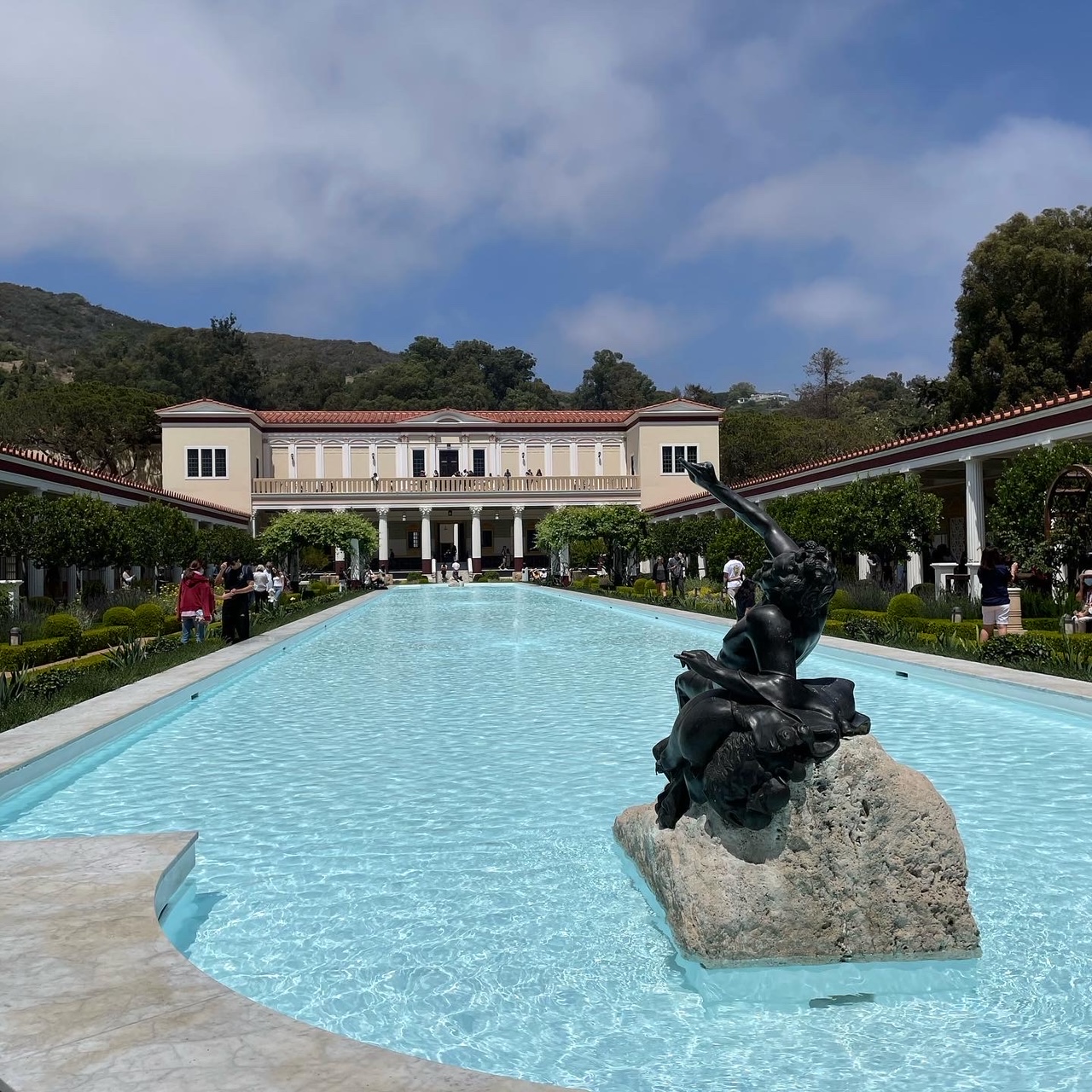
Looking at Getty Villa from far end of the Outdoor Peristyle

This morning we headed to Getty Villa, a place we visited almost 10 years ago. The museum is designed like a Roman villa, inspired by a sculpture J Paul Getty acquired in 1951. It's the Landsdowne Hercules, who holds a club in his left hand and a lion skin in the other.

The Landsdowne Hercules
The statue is housed in its own special room with a stunning mosaic floor of concentric circles made up of triangles.

Getty Villa has an extensive collection of Greek and Roman items, from statues and carvings to jewellery, vessels and coins. There are tour guides on hand to give groups or individual visitors an insider's look inside the museum and they are quite knowledgable.

We bumped into one who explained extensively how there are portraits on wood that have survived thousands of years in Egypt because it was very hot and dry, and also they were preserved together with mummies!

The portraits were of the dead people who were mummified: the expert explained typically their organs were removed and then dried out before being covered in oils and then resin, wrapped in linen, covered in another layer of resin and then another layer of linen before the wooden portrait was placed on top of the head.

How's that for detail!

An exhibition that is going on now is Persepolis: The Palace Experience. It is about the time of ancient Iran (550BC-AD650) and centres around the rein of King Xerces (pronounced sir-seas). We watched an immersive almost 360-degree five-minute film that showed through computer animation what the palace must have looked like when King Xerces built it (and was completed by his son decades later) in Persepolis, the ceremonial capital of the Achaemenid Empire (550-330BC).

Persian winged lion at Persepolis
However it was razed to the ground by Alexander the Great in around 330BC.

The show featured different Iranian artefacts from coins and jewellery to glazed bricks, reliefs, and statues. They were very elaborate, some in gold and silver, the carvings very intricate and the reliefs have a lot of expression, particularly of animals attacking each other, or men hunting for animals.

It then dawned on me -- why throughout history has civilisation only celebrated violence, victory against enemies, power over others? It's a very masculine, or a projection of what men should do to others. Why not put a greater value on peace? Happiness? Progress?

Guess not... but since that's all we have perhaps that's what we should appreciate, but also try to change the narrative of history?

In any event, what is wonderful about Getty Villa is that you can alternatively enjoy the museum pieces as well as the outdoor gardens, of which there are a few on the property. The most stunning is the Outdoor Peristyle, where Greek replica sculptures are nestled in bushes and flowers along a very long and narrow pool with fountains at both ends.

Royal Lion Hunt from Assyria
There's also the Inner Peristyle that also has lots of colourful flowers and shrubs, while the East Garden has a replica of a fountain found in Pompeii. There's also a herb garden next to the Outer Peristyle, and a small garden in the atrium area. Lots of young people were trying to do their perfect Instagram pose... better to just enjoy the gardens that have been carefully tended to by thoughtful (and artistic) gardeners.

I couldn't stop taking pictures of the beautiful roses in bloom, and the irises too that were very large and so interesting to look at up close. There is also a small lily pond near the back where the cafe is.

Today being a Monday it was nice that there weren't too many people visiting the museum. It too is concerned about Covid-19 and has warned visitors to keep masks on if not vaccinated, while those who have been jabbed have the option of masks off. Some staff didn't wear them, others did. There was a brief security check at the door and lots of hand sanitiser stations nearby.

So glad Getty built the museum for people like to us to enjoy for free! We had a fun leisurely time here.

Relief of a lion and bull in combat at Persepolis
Getty Villa
17985 Pacific Coast Highway
Pacific Palisades, CA
90272
310 440 7300


VIFF -- Review: Our Mr. Matsura

Matsura (right) with a local in Okanogan County Frank (Sakae) Matsura, was the son of a Samurai in Hirado, Japan, but by the time he was gro...